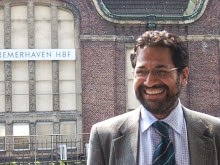
‘Trip to Washington did happen, but it was private visit, not junket' ...
31 December 2010
The Hindu
Singed by WikiLeaks, Indian official says U.S. cable a lie
Siddharth Varadarajan
New Delhi: A former Indian official criticised for making unauthorised contact with the United States embassy and angling for a junket in order to “feed” American views on Iran into the Indian system, has accused a senior American diplomat of fabricating the contents of the confidential cable — published by WikiLeaks earlier this month — which “outed” him.
“I cannot answer for what [the former U.S. Charge d'Affaires Geoffrey] Pyatt might or might not have reported and if he did send such a cable, why he should have done so,” K.V. Rajan, a former secretary in the Ministry of External Affairs and a former member of the Prime Minister's National Security Advisory Board (NSAB) told The Hindu.
In the cable titled ‘Iran manipulating Indian elite opinion makers' of May 4, 2007, Mr. Pyatt — who is now the Principal Deputy Assistant Secretary for South Asia at the U.S. State Department — said Mr. Rajan sought an urgent meeting to discuss a Tehran-sponsored visit to Iran by Indian opinion-makers. According to the cable, Mr. Rajan said he had turned down the invitation but gave a list of the other invitees to the U.S. Embassy.
“To counter this new and worrying effort to reach out to Indian opinion makers, Mr. Rajan proposed a visit to the U.S., starting May 14, in his NSAB capacity, for five to seven days, to talk to officials, think tanks, and the intelligence community to discuss ways to understand better the U.S. assessments of Iran. He would expect this to feed into NSAB discussion of Iran policy options,” the embassy cable said. “To counter this insidious new Iranian effort, we recommend Rajan receive meetings, if possible, with xxx,” the cable concluded.
WikiLeaks redacted the names of the senior U.S. officials Mr. Pyatt wanted Mr. Rajan to meet. But The Hindu has been able to establish that the U.S. embassy sought meetings with four senior intelligence officials: Deputy National Security Adviser Elliott Abrams, National Intelligence Council (NIC) Vice-Chair David Gordon, NIC Deputy South Asia Officer John Dister and CIA Director of Intelligence John Kringen.
Mr. Rajan, who coincidentally travelled to Washington D.C. shortly after the cable was sent, denies meeting these or other officials during that trip.
The Hindu published details of the Rajan cable on December 18. Mr. Rajan, who was travelling at the time and could not be reached for comment, said upon his return: “It is true that an invitation was addressed to me by the Iranian government in my capacity as member, National Security Advisory Board.' After checking with the Ministry of External Affairs, I declined as it would have been inappropriate to have accepted such an invitation. I have no idea about what happened subsequently and certainly have no recollection about discussing the matter with any foreign diplomat, apart from conveying my apologies to the Iranians. I can emphatically confirm that I have never discussed the Iran non-visit with U.S. officials.”
Asked why Mr. Pyatt would fabricate a conversation which never took place in a confidential cable that was not meant to be read by anyone outside the U.S. system, Mr. Rajan said he could not answer for what the U.S. diplomat might or might not have reported.
He admitted travelling to the U.S. in May-June 2007, but denied that visit was arranged by the U.S. government. “I visited the U.S. and some European countries during that period in connection with seminars and conferences. The U.S. government/Embassy were in no way involved,” he said.
The U.S. trip “was for a conference and celebration of the silver jubilee of Washington Times,” Mr. Rajan said, when asked for details of the visit. “I did not meet a single one of the persons you have mentioned. Indeed, I can confirm that I did not meet any other official of the U.S. government either, before during or after the visit to discuss any other subject pertaining to foreign policy,” he added.
Describing himself as “not a particular favourite of the U.S. embassy,” he said: “My only guess as to the sudden affection they developed later is a gross misunderstanding of the reasons for my declining the Iran invite.”
With the State Department advising its missions and posts abroad not to engage with any questions stemming from the leaked cables, attempts to clarify matters with the U.S. embassy drew a blank.
Speaking on background, however, MEA officials said it was unlikely the U.S. embassy would invent a conversation or meeting which never took place. Indeed, South Block has been struck by how accurately the leaked cables have captured the contents of sometimes complicated meetings between senior American and Indian officials on a whole range of topics. “I think I'm going to go with Mr. Pyatt on this one,” a senior official said. “Look at the people Mr. Pyatt wanted Mr. Rajan to meet. Even if the meetings never worked out, a career diplomat would be mad to get State to pitch for top guys at the NIC and CIA on the basis of some made up story.”
Showing posts with label Iran. Show all posts
Showing posts with label Iran. Show all posts
31 December 2010


18 December 2010
Carrying anti-Iran tales, top official angled for U.S. junket
 Ratting out on his pals for an imaginary offence, he pushed for a trip to the United States ...
 18 December 2010
The Hindu
Carrying anti-Iran tales, top official angled for U.S. junket
Siddharth Varadarajan
Sandeep Dikshit
New Delhi: India's first major embarrassment from the Wikileaks closet came tumbling out on Friday with the revelation that a top official had initiated unauthorised contact with the United States embassy to complain about Iran and pitch for a U.S. visit, where he could receive inputs that would then “feed the [Indian] discussion of Iran policy options”.
On May 4, 2007, K.V. Rajan — described in a confidential cable by U.S. Charge d'affaires Geoffrey Pyatt as “Former Secretary of the Ministry of External Affairs and then Chairman of the Prime Minister's National Security Advisory Board (NSAB)” — sought an urgent meeting with the U.S. embassy to inform it that he and a number of other Indian “politicians, scholars and commentators” had been invited by Iran on an “all-expenses-paid trip” to visit nuclear installations there and meet officials.
“Rajan told the Charge [Pyatt] that this trip was part of an effort of the Iranian government to encourage anti-American, pro-Muslim scholars and think-tanks in India to influence Prime Minister [Manmohan] Singh's supporters to take a more pro-Iranian, anti-U.S. view, and that his presence on the delegation would have handed Iran a Public Relations coup. In light of his suspicions, Rajan cancelled at the last minute, citing a sudden family emergency.” The cable then notes that Mr. Rajan provided the embassy a list of invitees.
“To counter this new and worrying effort to reach out to Indian opinion-makers”, the U.S. Charge d'Affaires wrote, “Rajan proposed a visit to the United States starting May 14 in his NSAB [chaiman] capacity for five-seven days to talk to officials, think tanks, and the intelligence community to discuss ways to better understand U.S. assessments of Iran.” Mr. Rajan “would expect this to feed the NSAB discussion of Iran policy options”, the confidential cable titled ‘New Iranian Mischief' added.
After hearing him out and noting reports of a visit to Iran's heavy water reactor at Arak that had appeared in The Hindu and The Asian Age, the cable records Mr. Pyatt's recommendation: “To counter this insidious new Iranian effort, we recommend that Rajan receive meetings, if possible, with [xxx]”. The names of his recommended interlocutors are blanked out.
Mr. Rajan was unavailable for comment and it is not known if the proposed trip materialised. But Indian government officials speaking to The Hindu on background said it was most inappropriate for an NSAB member to have approached the U.S. embassy in this way.
M.K. Rasgotra, the actual chairman of the NSAB at the time — Mr. Rajan having been a mere member of the board, it is not known why Mr. Pyatt described him as its head — reacted angrily to the revelation that a board member had approached the U.S. embassy to provide information and propose a trip for himself. “Firstly, I was chairman and there was never any mention of this bloody nonsense. I never sought to go out on any one's account nor did any member approach me to discuss this. He was clearly acting on his own. I am really surprised.”
Mr. Rasgotra, a former foreign secretary, said that all NSAB members take an oath of secrecy. Speaking on background, a former official of the National Security Council Secretariat said NSAB members are meant to provide reports only to the Government of India. “They are not meant to approach foreign embassies/governments. It is not their job to be doing diplomacy.”
The names of the respected Indian commentators who visited Iran in April 2007 are blacked out in the cable but their identities are no secret: Vikram Sood, former head of Research and Analysis Wing, India's external intelligence agency; A. Gopalakrishnan, former head of the Atomic Energy Regulatory Board; Anuradha and Kamal Chenoy from Jawaharlal Nehru University; Bharat Karnad from the Centre for Policy Research; and Amit Baruah, the then Diplomatic Correspondent of The Hindu.
Correspondents from this newspaper and other publications routinely visit foreign countries on official invitations. Asked for his reaction to Mr. Rajan's apprehensions about the Iran trip, Mr. Sood said he was amused at his presumption that seasoned commentators and ex-officials would be unable to form their own opinions on places they visited.
11 April 2010
Iran sanctions push casts shadow on Manmohan-Obama meet
Washington has been trying to garner international support for tightening screws on Tehran...
11 April 2010
The Hindu
Iran sanctions push casts shadow on Manmohan-Obama meet
Siddharth Varadarajan
New Delhi: Apart from lingering concerns over aspects of the U.S. administration's AfPak policy, it is the latest American sanctions drive against Iran that most immediately concerns Prime Minister Manmohan Singh's advisers as he goes into a bilateral meeting with President Barack Obama here on Monday afternoon.
Asked about the agenda of the meeting — which is being held on the eve of the Nuclear Security Summit — a senior Indian official said the two leaders would cover the full range of bilateral, regional and international issues.
Apart from discussions on how to move the bilateral relationship forward in the run-up to the Foreign Minister-level strategic dialogue set for June, Afghanistan and Iran are the issues expected to dominate. “It is obvious the U.S. will raise what bothers them most, which is Iran,” said the official. For the past few weeks, Washington has been trying to garner international support for tightening economic sanctions on Tehran over the nuclear issue, a move that key countries like China and Brazil are resisting.
Though India is not a member of the United Nations Security Council, the U.S. is keen to enlist its support. But New Delhi is not convinced. “We don't think sanctions are needed or that they will solve the problem,” said the official, speaking on background. “We have complied with whatever sanctions the UN imposed but only as part of a broader process of engagement with Iran.” The Iranians, he said, had repeatedly told India that they do not want nuclear weapons.
“Unfortunately others don't believe that. So the only way to resolve this is through the [work of the] International Atomic Energy Agency” rather than through coercive means.
Red rag to Washington
The official also confirmed that India, like China, had accepted Iran's invitation to participate in an international conference in Tehran on April 17-18 on the theme of ‘Nuclear Energy for All, Nuclear Weapons for None.' That conference, scheduled right after the Nuclear Security Summit to which the Islamic Republic has not been invited, is another red rag to Washington, which has quietly been discouraging other countries from attending.
The senior official said the Prime Minister would also discuss the AfPak issue with Mr. Obama. Asked about recent reports suggesting the Pentagon favoured a smaller Indian footprint in Afghanistan, the official said “our role [there] is not a function of India-U.S. relations. We just happen to have the same goals. But we will play our role with or without the U.S. because we have core interests in our periphery which we will protect. The issue really is about coordination.”
No change in role
Since the Manmohan-Obama meeting of November 2009, the situation in the region had evolved. “There are two things here – first, the increasing predominance of the Army and second, legal statutes are being modified to transfer power back to the prime minister.” The official said the U.S. couldn't be blamed for trying to use the Pakistani military as part of its strategy of pacifying Afghanistan.
But in India's assessment, Pakistan's role in Afghanistan had not really changed and was unlikely to in the future.
India shared the same goal as the U.S., the official said – the establishment of a peaceful, neutral Afghanistan free from foreign interference. “Last year, there was talk of giving regional powers a greater role. But not much has happened, perhaps because of the Iran-U.S. tension, and now the situation in Kyrgyzstan and Central Asia. There are so many moving parts in this equation it needs reviewing constantly.”
11 April 2010
The Hindu
Iran sanctions push casts shadow on Manmohan-Obama meet
Siddharth Varadarajan
New Delhi: Apart from lingering concerns over aspects of the U.S. administration's AfPak policy, it is the latest American sanctions drive against Iran that most immediately concerns Prime Minister Manmohan Singh's advisers as he goes into a bilateral meeting with President Barack Obama here on Monday afternoon.
Asked about the agenda of the meeting — which is being held on the eve of the Nuclear Security Summit — a senior Indian official said the two leaders would cover the full range of bilateral, regional and international issues.
Apart from discussions on how to move the bilateral relationship forward in the run-up to the Foreign Minister-level strategic dialogue set for June, Afghanistan and Iran are the issues expected to dominate. “It is obvious the U.S. will raise what bothers them most, which is Iran,” said the official. For the past few weeks, Washington has been trying to garner international support for tightening economic sanctions on Tehran over the nuclear issue, a move that key countries like China and Brazil are resisting.
Though India is not a member of the United Nations Security Council, the U.S. is keen to enlist its support. But New Delhi is not convinced. “We don't think sanctions are needed or that they will solve the problem,” said the official, speaking on background. “We have complied with whatever sanctions the UN imposed but only as part of a broader process of engagement with Iran.” The Iranians, he said, had repeatedly told India that they do not want nuclear weapons.
“Unfortunately others don't believe that. So the only way to resolve this is through the [work of the] International Atomic Energy Agency” rather than through coercive means.
Red rag to Washington
The official also confirmed that India, like China, had accepted Iran's invitation to participate in an international conference in Tehran on April 17-18 on the theme of ‘Nuclear Energy for All, Nuclear Weapons for None.' That conference, scheduled right after the Nuclear Security Summit to which the Islamic Republic has not been invited, is another red rag to Washington, which has quietly been discouraging other countries from attending.
The senior official said the Prime Minister would also discuss the AfPak issue with Mr. Obama. Asked about recent reports suggesting the Pentagon favoured a smaller Indian footprint in Afghanistan, the official said “our role [there] is not a function of India-U.S. relations. We just happen to have the same goals. But we will play our role with or without the U.S. because we have core interests in our periphery which we will protect. The issue really is about coordination.”
No change in role
Since the Manmohan-Obama meeting of November 2009, the situation in the region had evolved. “There are two things here – first, the increasing predominance of the Army and second, legal statutes are being modified to transfer power back to the prime minister.” The official said the U.S. couldn't be blamed for trying to use the Pakistani military as part of its strategy of pacifying Afghanistan.
But in India's assessment, Pakistan's role in Afghanistan had not really changed and was unlikely to in the future.
India shared the same goal as the U.S., the official said – the establishment of a peaceful, neutral Afghanistan free from foreign interference. “Last year, there was talk of giving regional powers a greater role. But not much has happened, perhaps because of the Iran-U.S. tension, and now the situation in Kyrgyzstan and Central Asia. There are so many moving parts in this equation it needs reviewing constantly.”
30 November 2009
Barack Obama’s myopic Iran policy
 By giving Israel veto rights and threatening more sanctions, the U.S. is squandering the best chance we have for a negotiated solution to the Iranian nuclear issue...
30 November 2009
The Hindu
Barack Obama’s myopic Iran policy
Siddharth Varadarajan
Ordinarily, it would have been easy to dismiss the latest resolution of the International Atomic Energy Agency [PDF] censuring Iran as a text, drafted by idiots, full of sound and fury, signifying nothing.
But context is everything. Whether by design or default, the unhelpful resolution comes at a time when the Iranians are still in the process of working out the terms of a landmark agreement on a nuclear fuel swap. If implemented, this would represent the first genuine breakthrough in the nuclear arena since the present standoff between Iran and the West began in 2005. Under the terms of the original proposal made last month by the five permanent members of the U.N. Security Council and Germany (known collectively as the P5+1), Iran is to send to Russia most of its stocks of 3.5 per cent low enriched uranium (LEU) produced under safeguards at Natanz. There, the LEU would be enriched to 20 per cent and sent on to France for fabrication into fuel rods for eventual use at the Tehran Research Reactor (TRR).
The TRR was set up in 1967 with U.S. support and is used by the Iranians for the production of medical isotopes for cancer diagnostics. With the TRR’s fuel set to run out next year, Iran had asked the IAEA for help in procuring new supplies, failing which it would be obliged to up the level of its own enrichment activities so as to fuel the TRR domestically. The IAEA, in consultation with the United States, came up with the 3.5-for-20 per cent fuel swap idea. The proposal was, and remains, win-win as far as the U.S. and Iran are concerned. Washington, which worries about the possibility of Iran using its LEU stocks to bust out of the Nuclear Non-Proliferation Treaty, buys time. And the Iranians, who do not as yet have any domestic use for their LEU stocks, get fuel for the TRR and also reassure the international community about the peaceful nature of their nuclear programme. Most importantly, the TRR fuel deal represents a political victory for Iran because it shows the U.S. and its allies are willing to engage in dialogue and deal-making despite Tehran not suspending enrichment — something Washington has been insisting on since 2005.
Despite these benefits, the proposal ran into trouble in Tehran for two reasons. First, ever since the controversial re-election of Mahmoud Ahmadinejad earlier this year, the Islamic Republic has been buffeted by deep political schisms that have reduced the president’s room for manoeuvre internationally and also, perhaps, his appetite for compromise. Second, Iran’s establishment is distrustful of France and, to a lesser extent, Russia, and fears the deal may not be honoured once its LEU is exported. The fact that IAEA director general Mohammed ElBaradei, who has generally played straight with Iran, retires December 1 is a further source of unease in Tehran. His successor, Yukio Amano, is an unknown quantity. Would he, for example, insist on upholding the Western side of the bargain if France declares, sometime next year, that it will not supply fuel for the TRR after all? No gambling man would be willing to wager a large sum on Mr. Amano defying the West.
In order to cover for all contingencies, Iran modified the original proposal. In an interview to The Hindu earlier this month, Foreign Minister Manochechr Mottaki said the swap should take place on Iranian territory. This condition would not alter the essential structure of the deal. At a certain date, when French fabrication of the TRR fuel starts, the IAEA could take into its custody an equivalent amount of Iranian LEU and hold it, in escrow, inside Iran. When the TRR fuel is ready, the Iranian LEU can be loaded onto a plane, which would take off once the French fuel lands inside Iran. At the end of the day, the outcome for the U.S. from a simultaneous swap would be the same as from a sequential swap: Iranian LEU stocks would have been depleted.
For reasons best known to itself, however, Washington declared the original proposal could not be modified. Rather than using Mr. Mottaki’s comments on a swap inside Iranian territory as a means of swiftly closing the TRR deal, President Barack Obama expressed disappointment in Iran’s response and said the Security Council would soon have to consider fresh sanctions. It is in this context that last week’s IAEA resolution must be seen. According to the Washington Post, the U.S. won Chinese backing for it by sending Dennis Ross, arguably the most pro-Israeli official in the White House, to Beijing with the message that the Zionist state was likely to attack Iran if the IAEA and UNSC did not act against Tehran.
President Obama’s refusal to find creative ways of reaching a settlement is of a piece with the approach of his predecessor. In early 2005, the Bush administration leaned on the European troika of Britain, France and Germany to ensure the package they proposed to Iran included the insulting condition that Tehran should abandon enrichment altogether. And now, once again, by turning the P5+1 into a U1+5 — a body driven by U.S. interests and considerations — Washington is sabotaging the prospects of a diplomatic solution.
The proximate trigger for the latest IAEA resolution is Iran’s recent disclosure that it is constructing a second enrichment facility. This facility, at Fordo near Qom, is fortified and designed to withstand the kind of military attack that Washington and Tel Aviv have been threatening. Legally, Iran insists it was obliged to inform the IAEA about Fordo only six months prior to the introduction of nuclear material. It says it started construction in late 2007, after it had declared it would no longer abide by new rules of early disclosure it had provisionally accepted. The U.S. initially claimed the work on Fordo began in 2002 or 2003, but satellite imagery from late 2006 shows no construction work there. As Gareth Porter has argued, the Iranian timeline is consistent with the findings of the U.S. National Intelligence Estimate of 2007, which said “covert” enrichment work had probably ended in 2003, and with the U.S. military build-up which took place around Iran two years back.
Last month, I asked Dr. ElBaradei if he thought it reasonable for Tehran to be secretive given the threats Israel and the U.S. have made of a military attack on their nuclear facilities. He avoided a direct answer but said: “That’s why I say using the language of force is not helpful. It leads to confrontation, to the other country taking counteraction. It is better to forget the language of coercion and focus on trying to engage in dialogue”.
Sadly, the U.S. has now further undermined the prospects for dialogue. Iran has responded to the latest IAEA vote by threatening to further downgrade the level of its cooperation with the Agency. It knows the purpose behind the IAEA vote is to prepare the ground for more sanctions. Russia and China went along because they have a veto in the UNSC and were willing to kick the can down. India, which voted against Iran, naively stated that the latest resolution “cannot be the basis of a renewed punitive approach or new sanctions”. But Brazil, which abstained, demonstrated a clearer understanding of international politics. “The resolution clear the way for sanctions... and sanctions don’t lead to anything,” its ambassador to the IAEA said.
Ever since Iran was referred to the UNSC, Tehran has withdrawn its voluntary adherence to the Additional Protocol and to the modified Subsidiary Arrangements to its Safeguards Agreement requiring early disclosure of nuclear-related construction. Despite losing these windows of access, the IAEA has managed to close the file on all the outstanding issues which led the Board of Governors to find Iran in violation of its safeguards obligations in September 2005. The only issue which remains pertains to alleged studies Iran is supposed to have conducted on nuclear weaponisation. But although Western intelligence agencies have shared some documents pertaining to these alleged studies with the IAEA, they have not allowed these to be shown to the Iranians. Iran cites this refusal as proof that the documents are forgeries and says that the purpose of sanctions is to ensure it abandons its enrichment programme.
Since existing sanctions — and the impending threat of more punitive measures — have had little impact on Iran, the U1+5 need to seriously rethink their approach. One way out of the current impasse is for the UNSC to suspend sanctions for a finite period, to begin with, during which time the Iranians once again voluntarily abide by the AP and step up cooperation with the IAEA over the alleged weaponisation studies. This mechanism would allow the agency to conclude that there are no undeclared nuclear activities in Iran, following which U.N. sanctions could be lifted. While the world would welcome such an outcome, Israel wouldn’t, since it is not prepared to accept a safeguarded Iranian enrichment programme under any circumstances. Mr. Obama’s inability to press ahead with his campaign promise of engaging Iran is of a piece with his failure to play the honest broker on the Israel-Palestine issue and can only lead to confrontation and conflict. Sooner rather than later, the world, and America, will come to regret this abject failure of leadership.
17 November 2009
Iran wants nuclear fuel swap to take place on its own soil
 In the first official confirmation that Iran is leaning towards accepting some version of the US-backed proposal for a nuclear fuel swap, Foreign Minister Manouchehr Mottaki told The Hindu the proposed exchange of low enriched uranium would have to take place inside Iran, meaning the Islamic Republic will make no prior shipment of 3.5 per cent LEU to Russia before some part of the 20 per cent LEU needed for the Tehran Research Reactor lands on its own territory...
17 November 2009
The Hindu
Iran wants nuclear fuel swap to take place on its own soil
Siddharth Varadarajan
New Delhi: In the clearest statement to date of Tehran’s attitude to the U.S.-backed proposal for a nuclear fuel swap as a step towards building trust with Washington, Iranian Foreign Minister Manouchehr Mottaki has said his government takes a positive view of the plan provided the exchange of enriched uranium takes place inside Iran.
Mr. Mottaki told The Hindu in an exclusive interview on Monday that Iran is not keen to send its own nuclear fuel out of the country before the fuel it is to receive for the Tehran Research Reactor (TRR) arrives on its territory.
Under the original proposal made last month by the U.S. and its partners, Iran is supposed to ship 1200 kg of 3.5 per cent low enriched uranium (LEU) to Russia, where it would be further enriched to 20 per cent. The 20 per cent LEU would then be sent to France for fabrication into fuel rods. Eventually, the rods would be shipped to Iran for use in the TRR, which produces medical isotopes.
Mr. Mottaki said Iran and was in the process of sending and receiving suggestions to the other side. With a positive view regarding the essence and nature of the proposal, we are reviewing the possibility of exchanging this fuel inside Iran.
Asked whether the insistence on exchange inside Iran meant the TRR fuel must come first, Mr. Mottaki replied: Well, if there is going to be any exchange of fuel inside Iran, this must mean one side of the fuel exists in Iran and the other side should come, the 20 per cent.
The U.S. says its main interest in the original proposal of Iran shipping out virtually its entire stockpile of LEU is to buy time, since the fuel would no longer be available for weaponisation should Tehran choose to break out of the NPT.
Interview: ‘Iran hopes President Obama can deliver on his promises’
If diplomacy continues, it is possible to reach an agreement on the U.S.-led proposal for the exchange of nuclear fuel, says Iran’s Foreign Minister...
17 November 2009
The Hindu
‘Iran hopes President Obama can deliver on his promises’
Siddharth Varadarajan
In an exclusive interview to The Hindu during a two-day visit to Delhi, Iranian Foreign Minister Manouchehr Mottaki talks about the latest western proposal on the nuclear issue, the reasons behind the recent disclosure of a new enrichment facility at Fardoo and the current state of Indo-Iranian relations. Excerpts.
Iran has yet to respond to the proposal of the five permanent members of the UN Security Council and Germany (the P5+1) for fuelling the Tehran Research Reactor (TRR). The proposal, which involves Iran shipping out some of its low-enriched uranium (LEU) in return for 20 per cent enriched uranium, seems good for both sides. It shows the P5+1 is dropping its insistence on Iran suspending all enrichment, and also allows Tehran to build confidence with the U.S. and its allies. What will Iran’s stand be?
In order to provide fuel for the TRR, there are three options in front of us. The first is producing the fuel ourselves, i.e. enriching LEU up to 20 per cent; second, purchasing the fuel from other countries as in the past; or third, considering the proposal which has been made by the other side. And we have taken this proposal into consideration and provided an initial response - that we are ready to discuss that option. We have some technical and economical observations here but in principle, this option could be taken into consideration and put on the agenda. We believe that with the continuation of the diplomacy going on now, it is possible to reach an agreement and compromise. Complementary suggestions and proposals are being sent and received by both sides, and by [International Atomic Energy Agency head Mohammed] ElBaradei.
One of the proposals is to involve Turkey as a staging post for the swap, or for Iran to buy half its requirement for the TRR and export only half of its own LEU. Are these some of the ideas being actively considered by your government?
One part of the discussion is the exchange of Iran’s 3.5 per cent LEU with 20 per cent enriched uranium of the other side. There’s some talk regarding the exchange of these two fuels inside Iran. With a positive view regarding the essence and nature of the proposal, we are reviewing the possibility of exchanging this fuel inside Iran. We have studied this proposal in order to open a new door for the other side. And the truth of the matter is their interaction could somehow build confidence among the Iranians.
When you say “exchange inside Iran”, are you saying the 20 per cent enriched fuel for the TRR must come first?
Well, if there is going to be any exchange of fuel inside Iran, this must mean one side of the fuel exists in Iran and the other side should come, the 20 per cent.
Is it that Iran doesn’t trust some of the countries involved? Are you afraid, for example, that the French may cheat you?
That is not what we are saying. We need fuel for the TRR. May be in exchange for one portion of this fuel, we hand over some of our fuel. Therefore, it is quite natural to see this happen inside Iran.
From what I gather, you are looking to modify the basic P5+1 proposal but U.S. Secretary of State Hillary Clinton has said this is a ‘take it or leave it’ offer.
In diplomacy, we do not have zero or hundred. Therefore, flexibility is considered the essence of diplomacy. I believe this, and I guess the American side will understand this point as well…. Earlier, when they wanted to talk to us, they put some preconditions [like suspension of enrichment].But today they are talking and participating in talks without any preconditions.
The IAEA has now visited the proposed nuclear facility you recently declared at Fardoo near Qom. What is the purpose of the facility and why did Iran inform the agency about it only recently?
The reason for nuclear activity in Iran is producing fuel for generating power. The Fardoo facility is a site designed to take into account the use of new and updated centrifuges and the [need for] security. According to the laws we have ratified in Iran, we had to inform the IAEA only18 months before injecting fuel into the centrifuges. But we have done so before that time.
The U.S. claims Iran told the IAEA about Fardoo because it realised the CIA knew about the site and was likely to go public. Is this true?
Whenever they have any information, they highlight it ten times more for the benefit of the world’s public. So how come the CIA was so humble that it did not announce this site to the public! No matter when we announced it, they were going to say something else.
Do you feel President Obama is sincere when he says he wants to build new relations with Iran? Do you feel he represents a change from George W. Bush?
We consider the new administration different from the earlier one, which was a total warmonger administration that sullied the reputation of the U.S. The failure of the Bush policies has been confirmed by the American people, who showed this with their votes in the presidential election. Today, everyone around the world knows Obama is a chance for the U.S. And the experts there should not allow this opportunity to lead to failure. We want to believe what President Obama is saying. We hope he can operationalise what he says. To the extent to which President Obama is serious in his approach, Iran is ready to help.
There is a feeling in the aftermath of your recent presidential election that divisions within the Iranian establishment might make it hard for Tehran to take advantage of the opportunities for dialogue presented by Mr. Obama and the latest P5+1 proposal.
The incidents after the elections ended a long time ago. It was a miscalculation by those who lost. I think the presidential election strengthened the capability of Iran. It was unique in our history that the difference between the president and his nearest rival was 11 million votes. Therefore, the decision-makers of the Islamic Republic of Iran are moving forward with more energy and power. We have received the messages of President Obama and are studying those messages. When we assess that the administration’s actions and deeds go along with one another, certainly they are going to have our help.
Indian officials say they are keen to expand relations with Iran. What are the specific areas of cooperation you discussed with External Affairs Minister S.M. Krishna?
In my meetings with Prime Minister Manmohan Singh and Mr. Krishna, we reviewed all dimensions of our relations. I agree they are interested and keen on developing and enhancing relations with Iran. We found our Indian friends serious and believe a new chapter has been opened for cooperation.
But the Iran-Pakistan-India gas pipeline remains dead?
We voiced our full readiness that after finalisation of the issue by the Indian side we can add India to the project. Both the EAM and PM reiterated and raised this issue.
Among well-wishers of Iran in India, there is concern about the recent secret trial of the Iranian scholar, Kian Tajbakhsh, for his alleged involvement in the post-election protests. Now he has been sentenced to 12-15 years. We hope his case can be reviewed because he is a scholar and not someone involved in subversion.
All judicial verdicts can be reviewed and the opportunity of appeal is there for him. I am not aware of the details of his case. But our great effort is to see that those entering court can use all their rights, including appeal or using the capacity and potentiality of pardon.
17 November 2009
The Hindu
‘Iran hopes President Obama can deliver on his promises’
Siddharth Varadarajan
In an exclusive interview to The Hindu during a two-day visit to Delhi, Iranian Foreign Minister Manouchehr Mottaki talks about the latest western proposal on the nuclear issue, the reasons behind the recent disclosure of a new enrichment facility at Fardoo and the current state of Indo-Iranian relations. Excerpts.
Iran has yet to respond to the proposal of the five permanent members of the UN Security Council and Germany (the P5+1) for fuelling the Tehran Research Reactor (TRR). The proposal, which involves Iran shipping out some of its low-enriched uranium (LEU) in return for 20 per cent enriched uranium, seems good for both sides. It shows the P5+1 is dropping its insistence on Iran suspending all enrichment, and also allows Tehran to build confidence with the U.S. and its allies. What will Iran’s stand be?
In order to provide fuel for the TRR, there are three options in front of us. The first is producing the fuel ourselves, i.e. enriching LEU up to 20 per cent; second, purchasing the fuel from other countries as in the past; or third, considering the proposal which has been made by the other side. And we have taken this proposal into consideration and provided an initial response - that we are ready to discuss that option. We have some technical and economical observations here but in principle, this option could be taken into consideration and put on the agenda. We believe that with the continuation of the diplomacy going on now, it is possible to reach an agreement and compromise. Complementary suggestions and proposals are being sent and received by both sides, and by [International Atomic Energy Agency head Mohammed] ElBaradei.
One of the proposals is to involve Turkey as a staging post for the swap, or for Iran to buy half its requirement for the TRR and export only half of its own LEU. Are these some of the ideas being actively considered by your government?
One part of the discussion is the exchange of Iran’s 3.5 per cent LEU with 20 per cent enriched uranium of the other side. There’s some talk regarding the exchange of these two fuels inside Iran. With a positive view regarding the essence and nature of the proposal, we are reviewing the possibility of exchanging this fuel inside Iran. We have studied this proposal in order to open a new door for the other side. And the truth of the matter is their interaction could somehow build confidence among the Iranians.
When you say “exchange inside Iran”, are you saying the 20 per cent enriched fuel for the TRR must come first?
Well, if there is going to be any exchange of fuel inside Iran, this must mean one side of the fuel exists in Iran and the other side should come, the 20 per cent.
Is it that Iran doesn’t trust some of the countries involved? Are you afraid, for example, that the French may cheat you?
That is not what we are saying. We need fuel for the TRR. May be in exchange for one portion of this fuel, we hand over some of our fuel. Therefore, it is quite natural to see this happen inside Iran.
From what I gather, you are looking to modify the basic P5+1 proposal but U.S. Secretary of State Hillary Clinton has said this is a ‘take it or leave it’ offer.
In diplomacy, we do not have zero or hundred. Therefore, flexibility is considered the essence of diplomacy. I believe this, and I guess the American side will understand this point as well…. Earlier, when they wanted to talk to us, they put some preconditions [like suspension of enrichment].But today they are talking and participating in talks without any preconditions.
The IAEA has now visited the proposed nuclear facility you recently declared at Fardoo near Qom. What is the purpose of the facility and why did Iran inform the agency about it only recently?
The reason for nuclear activity in Iran is producing fuel for generating power. The Fardoo facility is a site designed to take into account the use of new and updated centrifuges and the [need for] security. According to the laws we have ratified in Iran, we had to inform the IAEA only18 months before injecting fuel into the centrifuges. But we have done so before that time.
The U.S. claims Iran told the IAEA about Fardoo because it realised the CIA knew about the site and was likely to go public. Is this true?
Whenever they have any information, they highlight it ten times more for the benefit of the world’s public. So how come the CIA was so humble that it did not announce this site to the public! No matter when we announced it, they were going to say something else.
Do you feel President Obama is sincere when he says he wants to build new relations with Iran? Do you feel he represents a change from George W. Bush?
We consider the new administration different from the earlier one, which was a total warmonger administration that sullied the reputation of the U.S. The failure of the Bush policies has been confirmed by the American people, who showed this with their votes in the presidential election. Today, everyone around the world knows Obama is a chance for the U.S. And the experts there should not allow this opportunity to lead to failure. We want to believe what President Obama is saying. We hope he can operationalise what he says. To the extent to which President Obama is serious in his approach, Iran is ready to help.
There is a feeling in the aftermath of your recent presidential election that divisions within the Iranian establishment might make it hard for Tehran to take advantage of the opportunities for dialogue presented by Mr. Obama and the latest P5+1 proposal.
The incidents after the elections ended a long time ago. It was a miscalculation by those who lost. I think the presidential election strengthened the capability of Iran. It was unique in our history that the difference between the president and his nearest rival was 11 million votes. Therefore, the decision-makers of the Islamic Republic of Iran are moving forward with more energy and power. We have received the messages of President Obama and are studying those messages. When we assess that the administration’s actions and deeds go along with one another, certainly they are going to have our help.
Indian officials say they are keen to expand relations with Iran. What are the specific areas of cooperation you discussed with External Affairs Minister S.M. Krishna?
In my meetings with Prime Minister Manmohan Singh and Mr. Krishna, we reviewed all dimensions of our relations. I agree they are interested and keen on developing and enhancing relations with Iran. We found our Indian friends serious and believe a new chapter has been opened for cooperation.
But the Iran-Pakistan-India gas pipeline remains dead?
We voiced our full readiness that after finalisation of the issue by the Indian side we can add India to the project. Both the EAM and PM reiterated and raised this issue.
Among well-wishers of Iran in India, there is concern about the recent secret trial of the Iranian scholar, Kian Tajbakhsh, for his alleged involvement in the post-election protests. Now he has been sentenced to 12-15 years. We hope his case can be reviewed because he is a scholar and not someone involved in subversion.
All judicial verdicts can be reviewed and the opportunity of appeal is there for him. I am not aware of the details of his case. But our great effort is to see that those entering court can use all their rights, including appeal or using the capacity and potentiality of pardon.
03 October 2009
The ElBaradei interview: ‘Language of force is not helpful on Iran issue’
 Tehran should be more transparent but its nuclear programme does not pose a threat that is imminent, says IAEA chief Mohamed ElBaradei....
3 October 2009
The Hindu
‘Language of force is not helpful on Iran issue’
Siddharth Varadarajan
As Director-General of the International Atomic Energy Agency, Mohamed ElBaradei is the world’s top nuclear policeman as well as its most valuable diplomatic asset in the struggle for disarmament and nonproliferation. A voice of sanity in a field otherwise dominated by irrational and sometimes violent rhetoric, Dr. ElBaradei strongly backed the lifting of nuclear sanctions on India and has helped prevent the escalation of the Iran nuclear crisis. In an interview with The Hindu during a visit to New Delhi this week, he spoke at length about the Iranian issue.Excerpts:
What do you think prompted the Iranian authorities to make the declaration on September 21 about a new enrichment facility?
I don’t know. We are yet to go and inspect and verify that new facility. The western countries say this was meant to be a secret facility, that it was declared by Tehran because it was compromised and the Iranians knew they would be discovered. The Iranians insist this is not the case, that they had to delay informing the agency because they wanted to build the facility underground to protect their technology in case of an attack on their nuclear facility. And they have been hearing about the threat of attacks over the past four or five years. Nonetheless, Iran, of course, has not complied with the requirement of the IAEA that they should have told us once they decided to construct the facility. I understand they have been working on it for a number of years.
How many years? What has the U.S. told the IAEA about it?
I think they said the work has been on since about 2005 and we have to go to Iran and verify but Iran should have informed us. This is clearly a setback because we have been trying to get Iran to be more transparent and cooperate more with the IAEA to clarify the issues that are still remaining for us to be able to verify the peaceful nature of the programme. But I also call on those who continue to say that we should use force, to attack Iran — that this is absolutely counterproductive. We need to create a different environment based not on confrontation but cooperation. For the first time, there is hope this could happen with Barack Obama talking about engaging Iran without preconditions, unlike the previous administration. Even after discovery of the [new] facility, he repeated that they are willing to engage Iran and I hope Iran will respond to that offer and I am not sure that offer is going to last forever. They better make use of that offer. It is only through engagement that we can verify the past and present Iranian nuclear activities. In the past, there were some claims that had done some military studies…
In fact, I want to come specifically to that. Your report as DG, on the basis of which the IAEA Board voted in September 2005 to find Iran in non-compliance, listed a set of outstanding issues. All of those issues have since been clarified. In some sense, isn’t that proof of considerable progress?
There is no question we have made considerable progress. At the time Iran was referred to the Security Council, the major concern was about the nature of its enrichment programme and that has been clarified. That is a major achievement. People seem to forget we have through systematic inspection made a considerable advance in understanding the nature of the Iranian programme. Then came these alleged studies.
Now, the first time the U.S. spoke of these alleged military studies was in the summer of 2005, when they briefed the IAEA and some countries about the contents of a laptop computer. Yet, this issue never figured in your September 2005 report.
Information about the alleged studies came over time to the agency. Iran says this information is fake. U.S. intelligence says Iran had weaponisation studies that stopped in 2003, other [Western agencies] claim Iran continued after that. Obviously, this is not very helpful — all agencies should get their act together and come to one conclusion. The IAEA is not making any judgment at all whether Iran even had weaponisation studies before because there is a major question of authenticity of the documents.
But clearly there were enough doubts in 2005 that you did not mention it then.
If I recall, the issue had not yet materialised in 2005.
No sir, the U.S. had done a briefing in the summer of 2005 with the so-called laptop. Your reports begin to flag alleged studies only in 2006. But not in 2005 when Iran was found in non-compliance.
Probably because in 2005, we did not go through the vetting process. We receive information all the time. It is not automatically referred to in our reports. Information continued to come to us. As I have said, if this information is correct, there is a strong likelihood that Iran has engaged in weaponisation studies. But if authentic. And I underlined if three times! That’s why I continue to urge Iran, they are the ones who continue to say it is fake….
But how does Iran prove a negative? This is like the run up to Iraq war, when Baghdad was asked to prove it did not have WMD. Iran says the documents are fake, they have no markings, no seals. The U.S. says they are genuine but the supposed originals are not being given, which you said should be.
Sure.
So how does one square the circle? It seems impossible to resolve.
Well, there is a lot of information in these documents that Iran said is authentic, but in different contexts, done for non-nuclear activities, while some of it is fake. What we want is for Iran to engage in substantive discussions with us, tell us what is authentic, what is not. We need to talk to some of the scientists involved. But I agree with you – this is one of the most difficult questions to deal with. We are very good when we are dealing with nuclear material, we can take measurements and do environmental sampling. When we work with papers, it very difficult because it is one’s word against the other. That is why I continue to call on those who supplied us the information to give us the originals, some copies, to be able to move the discussion with Iran. And I call on Iran to help us clarify the wheat from the chaff. And that’s not happening. And that is why we have this issue still hanging.
But your reports say there has been no use of nuclear material connected with these studies.
That’s right.
Surely this reduces the gravity of the issue. Clearly Iran has not diverted nuclear material for prohibited purposes.
The only time we found Iran in breach of its obligations not to use undeclared nuclear material was when they had experimented in 2003 and 2004 at Kalaye. Those were experiments. And I have been making it very clear that with regard to these alleged studies, we have not seen any use of nuclear material, we have not received any information that Iran has manufactured any part of a nuclear weapon or component. That’s why I say, to present the Iran threat as imminent is hype.
In a sense, this one outstanding issue is far less serious than the issues which prompted Iran’s referral to the Security Council!
It is a serious concern but I am not going to panic, to say it is an imminent threat that we are going to wake up and see Iran with nuclear weapons. Our job is to make sure we do not overstate or understate a case. There are enough people around to use or abuse what we say. The judgment call is very difficult, but based on what we have seen so far — we are concerned, we need to clarify this issue, we need to build confidence in the peaceful nature of Iran’s programme, we need Iran to adhere to the Additional Protocol because that will help me build confidence. But I am not going to sound an alarm and say that Iran is on the verge of developing nuclear weapons.
You are right that the Security Council referral was based on issues that have since been settled. So if Iran were to continue to cooperate with us, help us to clarify these alleged studies and also if the suppliers [of the documents] should help in that process, we would move quite forward.
Has the world benefited from the Iran file being referred to the Security Council? Or have the costs outweighed the benefits? We’ve lost Iran’s adherence to the Additional Protocol, to the latest Subsidiary Arrangements, it hasn’t stopped enrichment.
The IAEA remains seized of the matter but the Security Council referral was to get Iran to suspend enrichment and apply sanctions. I leave it to those who decided to refer them to make that judgment. I always believe the more we use carrots rather than sticks in such complex situations, the better is the prospect of finding a solution. As you can see now, after three or four years of referral, the focus is not on the Security Council but on engaging Iran! So the focus right now is on dialogue, engagement, incentives and not on the stick. The stick is always there, you can always use it. But first exhaust every possibility of trying to understand where the other party is coming from.
Coming back to Iran’s latest disclosure, the IAEA legal adviser has acknowledged there is a grey area in the implementation of the Subsidiary Arrangements.
Subsidiary Arrangements are a technical requirement but the more important issue is transparency and confidence and Iran lost on confidence with this action, no matter what they said about the need to protect their technology, human resources, passive security. I don’t look only at the legal issue but the political implication.
Even if Tehran failed to report to you on time, don’t you think it was reasonable for them to be secretive given the open threats Israel and the U.S. have made of a military attack on their nuclear facilities?
That’s why I said using the language of force is not helpful. It leads to confrontation, to the other country taking counteraction. It is better to forget the language of coercion and focus on trying to engage in dialogue.
25 September 2009
U.S. overshadows G-20 summit with Iran nuclear hype
Iran disclosed the existence of the new enrichment plant to the IAEA on September 21 but that hasn't stopped the Western media from speaking of the "discovery" of the plant by U.S. intelligence agencies. The plant, incidentally, is not a violation of the Iranian safeguards agreement with the IAEA...
25 September 2
The Hindu
U.S. overshadows G-20 summit with Iran nuclear hype
Siddharth Varadarajan
Pittsburgh: Iran’s decision to inform the International Atomic Energy Agency about a new pilot fuel enrichment plant it is building has been seized upon by the United States, and its allies as proof of the danger posed to the world by the Iranian nuclear programme.
Appearing before reporters an hour before the first plenary session of the G-20 group of leading world economies was set to begin here, U.S. President Barack Obama, French President Nicolas Sarkozy and British Prime Minister accused Tehran of defying the U.N. Security Council and directly challenging the international non-proliferation regime. They called upon Iran to provide the IAEA immediate access to the facility or face new international sanctions.
According to an IAEA spokesperson, Iran informed the agency about the facility on September 21.
Although U.S. officials say Iran had been forced to admit the existence of the new plant because it feared imminent exposure by Western intelligence agencies -- an unverifiable claim that has, nevertheless, been dutifully echoed by the American media – Tehran’s safeguards agreement with the IAEA only obliges it to provide design information not later than 180 days before the introduction of nuclear material into a new facility.
The facility is said to be in the preliminary stage of development, with the introduction of uranium still several months away. Any international inspection of the facility could only come after that point, not before. That is why the IAEA never considered the Natanz facility whose existence was only revealed in 2002 a violation of Iran’s safeguards agreement.
In 2003, Iran agreed to a modified subsidiary arrangement requiring it to inform the IAEA as soon as a decision to construct a new facility was taken. But Tehran withdrew its adherence to the arrangement four years later, in retaliation against UN sanctions.
In March 2009, the IAEA’s Legal Adviser was asked by some member governments to qualify in legal terms Iran’s non-implementation of the new disclosure rules. His reply made it clear that there was considerable ambiguity and the matter was not as clear-cut as the U.S. and its allies claimed it to be. While Iran could not unilaterally withdraw its adherence to the new arrangement, the Legal Adviser said its actions should be seen in proper context. Elaborating, he said that since the old rules had been considered consistent with a country’s safeguards obligations for 22 years, it is difficult to conclude that providing information in accordance with the earlier formulation in itself constitutes non-compliance with, or breach of, the Safeguards Agreement as such.
Though Iran may be on reasonably firm legal ground, the politics of its latest disclosure could swing either ways. Tehran will begin formal talks with the five permanent members of the Security Council and Germany on October 1. It is possible that it may use the new facility as a bargaining chip to resist the demand for an end to its enrichment programme. On the other hand, the new facility clearly gives the U.S. an excuse to harden its own stance in the run up to those talks.
25 September 2
The Hindu
U.S. overshadows G-20 summit with Iran nuclear hype
Siddharth Varadarajan
Pittsburgh: Iran’s decision to inform the International Atomic Energy Agency about a new pilot fuel enrichment plant it is building has been seized upon by the United States, and its allies as proof of the danger posed to the world by the Iranian nuclear programme.
Appearing before reporters an hour before the first plenary session of the G-20 group of leading world economies was set to begin here, U.S. President Barack Obama, French President Nicolas Sarkozy and British Prime Minister accused Tehran of defying the U.N. Security Council and directly challenging the international non-proliferation regime. They called upon Iran to provide the IAEA immediate access to the facility or face new international sanctions.
According to an IAEA spokesperson, Iran informed the agency about the facility on September 21.
Although U.S. officials say Iran had been forced to admit the existence of the new plant because it feared imminent exposure by Western intelligence agencies -- an unverifiable claim that has, nevertheless, been dutifully echoed by the American media – Tehran’s safeguards agreement with the IAEA only obliges it to provide design information not later than 180 days before the introduction of nuclear material into a new facility.
The facility is said to be in the preliminary stage of development, with the introduction of uranium still several months away. Any international inspection of the facility could only come after that point, not before. That is why the IAEA never considered the Natanz facility whose existence was only revealed in 2002 a violation of Iran’s safeguards agreement.
In 2003, Iran agreed to a modified subsidiary arrangement requiring it to inform the IAEA as soon as a decision to construct a new facility was taken. But Tehran withdrew its adherence to the arrangement four years later, in retaliation against UN sanctions.
In March 2009, the IAEA’s Legal Adviser was asked by some member governments to qualify in legal terms Iran’s non-implementation of the new disclosure rules. His reply made it clear that there was considerable ambiguity and the matter was not as clear-cut as the U.S. and its allies claimed it to be. While Iran could not unilaterally withdraw its adherence to the new arrangement, the Legal Adviser said its actions should be seen in proper context. Elaborating, he said that since the old rules had been considered consistent with a country’s safeguards obligations for 22 years, it is difficult to conclude that providing information in accordance with the earlier formulation in itself constitutes non-compliance with, or breach of, the Safeguards Agreement as such.
Though Iran may be on reasonably firm legal ground, the politics of its latest disclosure could swing either ways. Tehran will begin formal talks with the five permanent members of the Security Council and Germany on October 1. It is possible that it may use the new facility as a bargaining chip to resist the demand for an end to its enrichment programme. On the other hand, the new facility clearly gives the U.S. an excuse to harden its own stance in the run up to those talks.
31 October 2008
India to make fresh proposals on Iran pipeline
Pranab leaves for Tehran today for joint commission meet and though concerns remain over the cost, project structure and security of the gas pipeline, Indian officials say India intends seriously to pursue the project...
31 October 2008
The Hindu
India to make fresh proposals on Iran pipeline
Siddharth Varadarajan
New Delhi: Falling oil prices and the successful conclusion of the Indo-U.S. nuclear agreement have come together to produce a renewed Indian interest in the $7.4 billion natural gas pipeline from Iran.
According to senior officials, External Affairs Minister Pranab Mukherjee, who departs for Tehran on Friday for the 15th meeting of the India-Iran Joint Commission, will carry with him a new set of proposals aimed at addressing the few outstanding concerns still remaining over the cost, project structure and security of the Iran-Pakistan-India pipeline.
The discussion India and Iran will have on the pipeline will build on the issues touched upon by both sides in their exchange of ‘non-papers’ earlier this year. During the visit to Delhi of Iranian President Mahmoud Ahmadinejad on April 29, India has drawn Tehran’s attention to a number of its concerns. The Iranian side replied to these concerns in July but matters did not progress any further as the Manmohan Singh government was wary of provoking the Bush administration at a time when Washington’s help was needed in the Nuclear Suppliers Group.
In its non-paper, Iran identified, for the first time, phases 19, 20 and 21 of the South Pars offshore gas field as the source for the gas to be fed into the IPI pipeline. Iran also said it was willing to examine a trilateral arrangement for the delivery of gas to India on the Pakistan-India border, as the Indian note had suggested.
In the absence of active Indian interest in the project, Pakistan has been suggesting running the pipeline northwards into China. But the Iranians are keen to reach agreement with India.
Among the specific ideas India intends to discuss with Iran on November 1 and 2 are the role that cross-investments in both upstream and downstream projects in all three countries could play in fostering co-dependency and confidence in the project. In addition, India would like to explore the possibility of Iran undertaking to provide alternative fuel to IPI gas-fed downstream projects in India in the event of supply disruption for any reason.
“The project is viable and good but the hype about a ‘peace pipeline’ has meant that we haven’t really been hard-nosed about the commercial details,” a senior Indian official told The Hindu. But given the country’s growing energy needs, India intends seriously to pursue the project, the official said.
If the passage of the NSG exemption and the 123 Agreement has eased some of the diplomatic pressure the Manmohan Singh government was feeling, the recent fall in oil prices is seen as strengthening the country’s negotiating hand on the prickly question of gas tariffs. With oil prices set to rise eventually as the world slowly pulls out of recession, India has a limited window to take advantage of.
31 October 2008
The Hindu
India to make fresh proposals on Iran pipeline
Siddharth Varadarajan
New Delhi: Falling oil prices and the successful conclusion of the Indo-U.S. nuclear agreement have come together to produce a renewed Indian interest in the $7.4 billion natural gas pipeline from Iran.
According to senior officials, External Affairs Minister Pranab Mukherjee, who departs for Tehran on Friday for the 15th meeting of the India-Iran Joint Commission, will carry with him a new set of proposals aimed at addressing the few outstanding concerns still remaining over the cost, project structure and security of the Iran-Pakistan-India pipeline.
The discussion India and Iran will have on the pipeline will build on the issues touched upon by both sides in their exchange of ‘non-papers’ earlier this year. During the visit to Delhi of Iranian President Mahmoud Ahmadinejad on April 29, India has drawn Tehran’s attention to a number of its concerns. The Iranian side replied to these concerns in July but matters did not progress any further as the Manmohan Singh government was wary of provoking the Bush administration at a time when Washington’s help was needed in the Nuclear Suppliers Group.
In its non-paper, Iran identified, for the first time, phases 19, 20 and 21 of the South Pars offshore gas field as the source for the gas to be fed into the IPI pipeline. Iran also said it was willing to examine a trilateral arrangement for the delivery of gas to India on the Pakistan-India border, as the Indian note had suggested.
In the absence of active Indian interest in the project, Pakistan has been suggesting running the pipeline northwards into China. But the Iranians are keen to reach agreement with India.
Among the specific ideas India intends to discuss with Iran on November 1 and 2 are the role that cross-investments in both upstream and downstream projects in all three countries could play in fostering co-dependency and confidence in the project. In addition, India would like to explore the possibility of Iran undertaking to provide alternative fuel to IPI gas-fed downstream projects in India in the event of supply disruption for any reason.
“The project is viable and good but the hype about a ‘peace pipeline’ has meant that we haven’t really been hard-nosed about the commercial details,” a senior Indian official told The Hindu. But given the country’s growing energy needs, India intends seriously to pursue the project, the official said.
If the passage of the NSG exemption and the 123 Agreement has eased some of the diplomatic pressure the Manmohan Singh government was feeling, the recent fall in oil prices is seen as strengthening the country’s negotiating hand on the prickly question of gas tariffs. With oil prices set to rise eventually as the world slowly pulls out of recession, India has a limited window to take advantage of.
15 September 2008
Bush report says India complying with Hyde Act on Iran
As part of the 123 approval process, the Bush administration forwarded a set of documents to Congress last Friday, including a report pursuant to Section 104(c) of the Hyde Act. The report's portion on Iran is likely to reignite the controversy over the Hyde Act being used by the U.S. to condition and influence Indian foreign policy because of the way it is formulated. India's votes at the IAEA against Iran are described as steps New Delhi has taken to support U.S. efforts, rather than as decisions India took based on its own assessment as the Manmohan Singh government has always maintained.
Of course each government caters to different constituencies and will, therefore, put things differently. But there is a history to the controversy over this issue.
15 September 2008
The Hindu
Bush report says India complying with Hyde Act on Iran
Agrees that Indian ‘Additional Protocol’ will not be same as for non-nuclear weapon states
Siddharth Varadarajan
New Delhi: In a report to Congress that forms part of the ‘123 Agreement package’, the Bush administration has cited India’s votes against Iran at the International Atomic Energy Agency as part of “several steps” New Delhi has taken “to support the U.S.” in its efforts to “dissuade, isolate, and, if necessary, sanction and contain Iran.”
The report also gives more information about the steps India has taken to fulfil the commitments made to the United States in July 2005 than the United Progressive Alliance government has provided so far.
It reveals, for example, that India has formally committed its adherence to the guidelines of the Nuclear Suppliers Group (NSG) and Missile Technology Control Regime (MTCR) in separate letters dated September 8 and September 9, 2008, an announcement the Ministry of External Affairs has yet to make. The report also cites, as evidence of the steps India has taken to prevent the spread of enrichment and reprocessing technology, a letter sent to the International Atomic Energy Agency by Atomic Energy Commission Chairman Anil Kakodkar on August 18, 2008 in which he indicates India’s interest in participating as a supplier nation in the IAEA’s efforts to establish an international fuel bank. None of this is controversial, though the government’s failure to make this information public is likely to provide ammunition to the Opposition.
Submitted pursuant to Section 104(c) of the Hyde Act, the report is meant to detail the basis for President Bush’s determinations that India has fulfilled its “non-proliferation commitments” to the U.S. and is thus eligible for a waiver from America’s domestic restrictions on nuclear exports to the country.
Section 104(c)(2) outlines 10 subjects where the administration is required to provide Congress with the fullest possible information. Part (G) asks for a description and assessment of the specific measures “India has taken to fully and actively participate in” U.S. and international efforts against Iran “for its efforts to acquire weapons of mass destruction (sic) ... and the means to deliver WMD.”
The report submitted to Congress on Friday says the “Government of India has taken several steps to support the U.S. in this regard and to bring Iran back into compliance with its international obligations, particularly those pertaining to its nuclear weapons programme (sic).” Apart from the IAEA votes, it cites India’s compliance with U.N. Security Council resolutions and its “strong public line of support for P5+1 and U.S. diplomatic efforts to resolve international concerns with Iran’s nuclear program.”
In its summary of the 123 Agreement, the report repeats President Bush’s September 10 formulation that the fuel supply assurances contained within are not legally binding.
In a separate Nuclear Proliferation Assessment (NPA) statement submitted to Congress last Friday, as part of the Hyde Act’s requirements, the Bush administration for the first time acknowledges that the Additional Protocol India will negotiate and sign with the IAEA will be different from what non-nuclear weapon states sign. “Because India will obviously have undeclared activities that are outside the scope of the safeguards agreement, the primary function of its Additional Protocol will not in general be the same as that of the Model Additional Protocol (that of detecting undeclared nuclear activities).” The assessment concludes that India’s AP “will probably provide some additional information or access to the facilities declared as civil, enhancing somewhat the effectiveness of the safeguards” there.
Seeking to allay fears about nuclear cooperation with the safeguarded Indian nuclear sector somehow giving a boost to its weapons programme, the NPA also notes that since “India’s non-civil facilities already include every capability likely to exist among the facilities declared as civil ... India thus would have no apparent incentive to divert material, equipment, or technology from its declared civil sector to military uses.” It adds that India’s non-civil sector already possesses the necessary capabilities “and a diversion would risk a strong reaction from the U.S. and other nuclear cooperation partners.”
On the safeguards agreement, the NPA asserts that although the text “includes preambular language noting India’s ability to take ‘corrective measures’ to ensure uninterrupted operation of India’s reactors, both the U.S. and the IAEA have concluded that the preambular language establishes the historical context of the agreement and does not affect the obligations [on termination of safeguards] which are contained in the agreement’s operational provisions.”
The NPA disputes claims by some critics of the nuclear deal that it would free up India’s own uranium for weapons use. The amount of fissile material available for potential weapons use is a function of not just the amount of natural uranium available, but also of factors such as overall fuel cycle capabilities such as the production of plutonium in reactors and reprocessing, it notes. “In this regard, [under the agreement], several indigenous Indian reactors which in theory have been available to support military programs, will be placed under safeguards and no longer be available for this purpose,” it says.
Finally, the NPA also acknowledges the ongoing dispute between India and the U.S. over the American claim to having certain “vested rights” over the Tarapur reactors despite the expiration of the 1963 bilateral agreement.
Of course each government caters to different constituencies and will, therefore, put things differently. But there is a history to the controversy over this issue.
[Flashback: See 'So now we know for sure' on my reporting of a senior U.S. official's admission that India's votes were "coerced"; See also my interview two years ago to Abbas Edalat of the Campaign against Sanctions and Military Intervention against Iran on Rademaker's statement]At the same time, there is something positive in the latest Bush report too: an acknowledgment for the first time that India's Additional Protocol will necessarily have to differ from the kind of AP that non-nuclear weapon states sign since the entire deal is predicated on India having a set of non-safeguarded, strategic facilities in the first place ...
15 September 2008
The Hindu
Bush report says India complying with Hyde Act on Iran
Agrees that Indian ‘Additional Protocol’ will not be same as for non-nuclear weapon states
Siddharth Varadarajan
New Delhi: In a report to Congress that forms part of the ‘123 Agreement package’, the Bush administration has cited India’s votes against Iran at the International Atomic Energy Agency as part of “several steps” New Delhi has taken “to support the U.S.” in its efforts to “dissuade, isolate, and, if necessary, sanction and contain Iran.”
The report also gives more information about the steps India has taken to fulfil the commitments made to the United States in July 2005 than the United Progressive Alliance government has provided so far.
It reveals, for example, that India has formally committed its adherence to the guidelines of the Nuclear Suppliers Group (NSG) and Missile Technology Control Regime (MTCR) in separate letters dated September 8 and September 9, 2008, an announcement the Ministry of External Affairs has yet to make. The report also cites, as evidence of the steps India has taken to prevent the spread of enrichment and reprocessing technology, a letter sent to the International Atomic Energy Agency by Atomic Energy Commission Chairman Anil Kakodkar on August 18, 2008 in which he indicates India’s interest in participating as a supplier nation in the IAEA’s efforts to establish an international fuel bank. None of this is controversial, though the government’s failure to make this information public is likely to provide ammunition to the Opposition.
Submitted pursuant to Section 104(c) of the Hyde Act, the report is meant to detail the basis for President Bush’s determinations that India has fulfilled its “non-proliferation commitments” to the U.S. and is thus eligible for a waiver from America’s domestic restrictions on nuclear exports to the country.
Section 104(c)(2) outlines 10 subjects where the administration is required to provide Congress with the fullest possible information. Part (G) asks for a description and assessment of the specific measures “India has taken to fully and actively participate in” U.S. and international efforts against Iran “for its efforts to acquire weapons of mass destruction (sic) ... and the means to deliver WMD.”
The report submitted to Congress on Friday says the “Government of India has taken several steps to support the U.S. in this regard and to bring Iran back into compliance with its international obligations, particularly those pertaining to its nuclear weapons programme (sic).” Apart from the IAEA votes, it cites India’s compliance with U.N. Security Council resolutions and its “strong public line of support for P5+1 and U.S. diplomatic efforts to resolve international concerns with Iran’s nuclear program.”
In its summary of the 123 Agreement, the report repeats President Bush’s September 10 formulation that the fuel supply assurances contained within are not legally binding.
In a separate Nuclear Proliferation Assessment (NPA) statement submitted to Congress last Friday, as part of the Hyde Act’s requirements, the Bush administration for the first time acknowledges that the Additional Protocol India will negotiate and sign with the IAEA will be different from what non-nuclear weapon states sign. “Because India will obviously have undeclared activities that are outside the scope of the safeguards agreement, the primary function of its Additional Protocol will not in general be the same as that of the Model Additional Protocol (that of detecting undeclared nuclear activities).” The assessment concludes that India’s AP “will probably provide some additional information or access to the facilities declared as civil, enhancing somewhat the effectiveness of the safeguards” there.
Seeking to allay fears about nuclear cooperation with the safeguarded Indian nuclear sector somehow giving a boost to its weapons programme, the NPA also notes that since “India’s non-civil facilities already include every capability likely to exist among the facilities declared as civil ... India thus would have no apparent incentive to divert material, equipment, or technology from its declared civil sector to military uses.” It adds that India’s non-civil sector already possesses the necessary capabilities “and a diversion would risk a strong reaction from the U.S. and other nuclear cooperation partners.”
On the safeguards agreement, the NPA asserts that although the text “includes preambular language noting India’s ability to take ‘corrective measures’ to ensure uninterrupted operation of India’s reactors, both the U.S. and the IAEA have concluded that the preambular language establishes the historical context of the agreement and does not affect the obligations [on termination of safeguards] which are contained in the agreement’s operational provisions.”
The NPA disputes claims by some critics of the nuclear deal that it would free up India’s own uranium for weapons use. The amount of fissile material available for potential weapons use is a function of not just the amount of natural uranium available, but also of factors such as overall fuel cycle capabilities such as the production of plutonium in reactors and reprocessing, it notes. “In this regard, [under the agreement], several indigenous Indian reactors which in theory have been available to support military programs, will be placed under safeguards and no longer be available for this purpose,” it says.
Finally, the NPA also acknowledges the ongoing dispute between India and the U.S. over the American claim to having certain “vested rights” over the Tarapur reactors despite the expiration of the 1963 bilateral agreement.
29 July 2008
Iran replies to Indian 'non-paper' on gas pipeline
 Given the lack of urgency New Delhi is displaying in finalising the Iran-Pakistan-India gas pipeline project, Tehran has sent across a note with new proposals aimed at addressing lingering Indian concerns...
29 July 2008
The Hindu
Iranian government replies to Indian ‘non-paper’ on gas pipeline
Siddharth Varadarajan
New Delhi: In an attempt to address the pointed concerns India raised about the proposed Iran-Pakistan-India pipeline during the visit here of President Mahmoud Ahmadinejad last April, the Iranian government has handed over some fresh proposals and called for talks to quickly finalise the deal.
The Iranian proposals are contained in a ‘non-paper’ that was delivered to the Indian embassy in Tehran last week, The Hindu has learned. Drafted as a response to the ‘non-paper’ handed over by the Prime Minister’s Office to Mr. Ahmadinejad’s delegation at the end of his five-hour visit to Delhi on April 29, the Iranian note identified for the first time the specific offshore fields which will be used to feed the $7.4 billion pipeline with natural gas for Pakistan and India.
Time-frame
During the visit, the Iranian President had proposed an accelerated time-frame of 45 days for resolving the outstanding issues but no technical level meeting of the two sides has taken place since then. The Iranian non-paper is Tehran’s way of reinvigorating the process, since New Delhi does not appear to be in a hurry to schedule a meeting or resolve its concerns through technical or political negotiations.
In its non-paper, the PMO had raised a number of issues. Among these were the question of security of transit through Pakistan and India’s desire to take delivery of its share of the gas not on the Iran-Pakistan border as has been envisaged till now but at the Pakistan-India border. India also expressed concern about Iran’s failure to nominate the gas fields concerned for the pipeline. Finally, the Indian side sought an Iranian response to the possibility of the three partner countries taking commercial stakes in downstream projects in each other’s territories as a means of providing an additional layer of protection against wilful disruption of gas supply.
Trilateral arrangement
The Iranian note identifies phases 19, 20 and 21 of the massive South Pars offshore gas field as the source of feedstock for the pipeline and says other phases can also be deployed to maintain adequate pressure at all times.
It also says that Tehran is prepared to look at a “trilateral arrangement” for the delivery of gas at the Pakistan-India border. On the question of cross-investments too, the Iranian non-paper says suitable arrangements can be examined.
While Indian officials feel Iran is “not serious” about the pipeline and is only looking to score propaganda points over the U.S. by demonstrating it is not isolated, the Iranian side harbours doubts about India’s sincerity, given Washington’s hostility to the gas deal.
15 July 2008
Bolton has a way with words

"Tehran's efforts to intimidate the United States and Israel from using military force against its nuclear program..." is the astonishing way in which John R. Bolton, the former American ambassador to the United Nations and neocon extremist non-pareil, describes the gathering war clouds in the Middle East in an op-ed in today's Wall Street Journal.
So when the U.S. and Israel threaten force against Iran, that's not intimidation but Iran's effort to prepare for that use of force is! Nice.
05 March 2008
The U.N. is escalating the Iran nuclear crisis
 If the Security Council were truly concerned about Iran’s nuclear programme, it would have lifted sanctions in the light of the IAEA’s latest report and thereby secured Iranian adherence to the Additional Protocol.
5 March 2008
The Hindu
The U.N. is escalating the Iran nuclear crisis
Siddharth Varadarajan
On Monday evening, the United Nations Security Council voted 14-0 with one abstention to impose a fresh set of sanctions against Iran for failing to suspend its civilian nuclear fuel cycle programme. The resolution had the backing of not just the United States, Britain and France but also Russia and China. The latter two, who have made much of their official commitment to a diplomatic solution to the Iranian issue, justified their support for the latest resolution by adver tising the absence of any reference to the “use of force” in its language. But this reading of the text is wilfully naïve: Resolution 1803 authorises the U.S. military to inspect all air and sea cargo into and out of Iran on board Iranian vessels if “there are reasonable grounds to believe that the aircraft or vessel is transporting goods prohibited under this resolution.” It doesn’t require much imagination to see how this enabling provision can serve as the trigger for a showdown between the U.S. — with its overwhelming naval presence around the Persian Gulf — and Iran.
Leaving aside the possibility of military confrontation, Resolution 1803 is a dishonest and provocative document that undermines not just the credibility of the Security Council but also the International Atomic Energy Agency. Just how irrelevant the IAEA and its work have been rendered is proved by the fact that the resolution’s text was prepared before the IAEA’s latest report on Iran, a point mentioned by the South African ambassador to the U.N., who made it clear his government was deeply unhappy with the draft despite agreeing to go along with it in the interest of “consensus.”
Astonishingly, the UNSC resolution takes virtually no notice of the fact that all outstanding issues which led to the Iran file being sent to New York in the first place have now been resolved. The demand, first made in 2006, that Iran suspend enrichment and reprocessing activity, was a derivative demand aimed at instilling confidence pending resolution of those outstanding issues. Now that those original issues have been resolved — and this is what the IAEA has pointed out in its last two reports — there is no basis for the suspension demand to be pressed, let alone made the basis for fresh sanctions.
When Iran was censured by the IAEA Board of Governors in September 2005 and January 2006 and declared in breach of its safeguards obligations, it was for failing to declare in a timely and complete manner a number of nuclear-related activities and procurements. Even though the IAEA has certified that no nuclear material inside Iran has been diverted for prohibited purposes, it said it was unable to certify the absence of “undeclared nuclear activities” pending investigation into those Iranian failures. Over the past six months, however, each and every one of those documented failures has been exhaustively probed. These include questions over the extent of Iranian research into the P-1 and P-2 centrifuge designs, the purpose of its experiments with Polonium-210, the source of uranium contamination at a number of research sites, the possession of a document on the casting of uranium into hemispherical shapes provided unsolicited by the A.Q. Khan network in 1987, and the reasons behind its attempt to procure certain equipment with nuclear applications. Under each of these heads, the IAEA now says the explanations Iran provided are either “consistent with” or “not inconsistent with” information the Agency has. “Therefore, the Agency considers those questions no longer outstanding at this stage,” IAEA DG Mohammed el-Baradei’s February 22, 2008 report categorically states.
As far as the uranium metal document is concerned — at one point the Bush administration regarded this as the smoking gun of an alleged Iranian nuclear weapons programme — the IAEA says any further assessment of its significance must await “a response from Pakistan on the circumstances of the delivery of this document.” Thus, the only peg the U.S. and its allies now have to hang their charge of Iranian non-compliance on is the alleged research Tehran is said to have conducted on a nuclear warhead. And thereby hangs a tale.
It was in 2004 that U.S. officials first began speaking of this issue based on information they said they had obtained from an Iranian laptop. This laptop was provided to the U.S. by the German intelligence agency, BND. On November 22, 2004, the Wall Street Journal ran a story quoting a senior German diplomat by name as acknowledging that the source of the computer was “an Iranian dissident group.” Gareth Porter of Inter-Press Service reconfirmed this information in a report last week, quoting a German diplomatic source as identifying the group as the National Council of Resistance of Iran (NCRI). The NCRI is the political wing of the Mojaheddin-e-Khalq, a group designated as terrorist by the U.S. State Department. On the basis of the NCRI and MeK’s links with Tel Aviv, Porter speculates that the “incriminating” laptop might well have Israeli fingerprints.
Indeed, so sceptical were both the U.S. and the IAEA of its authenticity that this so-called “laptop of death” never formed the primary, secondary or even tertiary focus of concern about Iran’s nuclear programme. The U.S. briefed the IAEA about its contents in the summer of 2005 and news reports at the time spoke of the agency’s experts being sceptical. This scepticism was official. The crucial September 2, 2005 report by Dr el-Baradei — which was to form the basis later that month for the IAEA Board declaring Iran in non-compliance with its obligations — makes no mention of the alleged studies contained in the shady laptop though its contents had been shared with Agency experts a few months earlier. Even now, the IAEA’s latest report refers to the documents as “alleged studies,” notes it has seen no evidence of the use of nuclear material in connection with the “alleged studies” and that it does not have “credible information” in this regard.
Despite this, we are now supposed to believe that these “alleged studies” — about which there is no “credible information” tying them to the use of nuclear material — is the proverbial smoking gun!
In a sense, this dishonest spin was inevitable. For as the U.S. found the IAEA knocking off the other (equally irrelevant but slightly more credible) “outstanding issues” one by one, it was forced to wheel out the laptop’s contents once again, but this time as Exhibit No. 1. Even now, the Agency’s experts are divided. Dr. el-Baradei’s report treats the laptop’s contents with justified circumspection. However, his deputy, Olli Heinonen, briefed IAEA Board members about its contents, buttressing them with more information provided by unnamed intelligence agencies. In his telling, the same documents which looked suspect two years ago now seem to paint an alarming picture. His briefing took place in Vienna on February 25, three days after the official IAEA report was released.
One week later, unnamed diplomats helpfully provided the notes they took at that briefing so that virtually identical stories on Iran’s “nuclear warhead” appeared in the Washington Post, New York Times and Reuters on the eve of the crucial March 3 Security Council vote. Conveniently, dubious information that America (or perhaps the MeK or Israel) first put out thus found its way into the American press as an “IAEA briefing.” After Iraq, the American press has forgotten nothing and learned nothing. And neither, it seems, has the international community, with the honourable exception of Jakarta.
An opportunity lost
The irony is that in upping the ante, the Security Council has allowed a golden opportunity slip out of its hands. What the IAEA needs more than anything else is for Iran to resume its adherence to the Additional Protocol. If there is an iota of truth in the “alleged studies” — which Iran says are based on fabricated documents — the best way for the IAEA to find out is by invoking the wider powers to inspect unlisted sites that the AP confers. Iran had declared that if the UNSC lifts its sanctions now that all concrete outstanding issues have been resolved, it is willing once again to adhere to the AP. As for the enrichment issue, the Iranian offer of running its national facilities as a multinational venture (with multinational oversight) very much remains on the table. These two elements would go a long way towards assuring the international community that Iran’s nuclear programme was entirely peaceful. But it seems there are more powerful interests at work, with aims that go well beyond what is stated.
Later this week, India, which blindly voted against Iran at the IAEA Board in 2005, will get another chance to redeem its place as a responsible member of the international community. Britain is likely to introduce a resolution echoing Monday’s UNSC resolution and ignoring the progress Iran and the IAEA have made in resolving all outstanding issues. With their permanent seats and vetoes on the Security Council — and their delusions about “not allowing the use of force” — Russia and China can afford the luxury of censuring Iran once again. And other non-aligned countries like South Africa may well lack the political and economic heft to resist the kind of pressure that will no doubt be brought to bear. But India is a different story. It is big. It is powerful. And unlike Russia and China, geography has placed us in the same region as Iran. Under no circumstances should India allow itself to once again become party to the irrational and disastrous confrontation that Washington is foisting on our neighbourhood.
17 November 2007
On Iran, no news is good news for U.S.
The IAEA’s latest report on the Iranian civilian nuclear programme will take the wind out of the sails of the war party in Washington. It suggests Tehran might be telling the truth about not having worked as extensively on its centrifuge designs as the Anglo-American bloc alleges it has.
17 November 2006
The Hindu
On Iran, no news is good news for U.S.
The IAEA’s latest report on the Iranian civilian nuclear programme will take the wind out of the sails of the war party in Washington. It suggests Tehran might be telling the truth about not having worked as extensively on its centrifuge designs as the Anglo-American bloc alleges it has.
Siddharth Varadarajan
Somewhere along the line, between the blur of sanctions and the threat of war, the world has forgotten what the Iranian nuclear crisis is really all about.
The ‘crisis’ does not revolve around Iranian defiance of the United Nations Security Council’s demand that all uranium enrichment, reprocessing, and heavy water-related activities be suspended immediately. Rather, it is about the underlying question that led to the Iranian file being sent to the UNSC in the first place. And that question is the following: Does Iran have any undeclared nuclear facilities which the world and the International Atomic Energy Agency do not know about and where, presumably, work is being carried out on a secret weapons programme?
Any non-nuclear weapon state that is party to the Non-Proliferation Treaty (NPT) is required to adhere to one principal obligation — to not develop or manufacture nuclear weapons. In order to implement this obligation, all nuclear facilities in that country have to be safeguarded by the International Atomic Energy Agency (IAEA), which ensures the country is not diverting nuclear material for any prohibited purpose. The import of nuclear material is supposed to be reported to the agency in a timely manner, as are any experiments or research projects involving the use of source or fissionable material.
The Additional Protocol, which embodies obligations not included in the standard IAEA safeguards agreement, further requires that there be no undeclared nuclear activities in the country. Iraq, prior to the first Gulf war, had a fully safeguarded nuclear programme, but it also developed unknown to the IAEA facilities where weapons research was being conducted. The Additional Protocol emerged in response to the challenge posed by Iraq’s clandestine weapons programme. It was believed that granting the IAEA enhanced access to physical locations and documentation could help establish the absence of undeclared nuclear activity and material in a country.
Iran, like many NPT signatories, has not yet ratified the Additional Protocol but undertook, in 2003, voluntarily to adhere to its provisions. Iran withdrew its voluntary adherence in February 2006, following the decision of the IAEA Board of Governors to refer its file to the U.N. Security Council. During the intervening period, however, it provided information to the Agency that helped the latter discover a number of instances going back to the 1980s of Iranian failure to declare or provide information about certain nuclear imports and experiments.
These failures were serious but not consequential and by 2005 the IAEA said it was able to close the file on most of them. None of these failures suggested the existence of a hidden nuclear weapons programme. Moreover, the one issue which American officials and propagandists most often speak about — the construction of a hidden enrichment facility at Natanz — was not a violation of Iran’s safeguards agreement. Indeed, at no point has the IAEA characterised the facility as such.
Once Iran announced its adherence to the Additional Protocol, the IAEA was mandated not only to certify that no safeguarded material in Iran was being used for military purposes but also that there were no undeclared nuclear facilities anywhere in the country. At the best of times, implementing the second mandate is time consuming and complicated. One of the questions the IAEA sought an answer for during its work to establish a complete history of the Iranian nuclear programme was when precisely did fabrication work seriously begin on the P-1 and P-2 centrifuge designs. The P-2 drawings were acquired by Iran in 1996 but Tehran insisted it never began work on the P-2 until 2002. The discrepancy was important only to the extent to which one might assume Iran used the six years to master the P-2 manufacturing process and set up a hidden enrichment facility somewhere. No one — not even the U.S. or Britain with sophisticated intelligence gathering capabilities at their disposal — has said such a facility actually exists but prudence suggested the IAEA do what it could to verify the truth of Tehran’s claims.
Major obstacle
It is important to remember that in September 2005 — when the IAEA Board of Governors first declared Tehran in breach of its safeguard obligations — and then again in February 2006, when it sent the file to the U.N., the only major outstanding obstacle in the way of the Agency certifying the absence of undeclared nuclear activities in Iran was this ambiguity about the extent of prior work on the P-2 centrifuge. Two other minor issues got added along the way. The first was Iran’s disclosure to the IAEA after September 2005 that it had received an unsolicited document from the A.Q. Khan network in 1987 about the casting of uranium in hemispherical shapes. The Americans immediately claimed this was the smoking gun which proved Iran had a weapons programme. The second was the claim by the U.S. of information suggesting the Iranian military was conducting research on a nuclear-capable missile as well as on uranium conversion. Tehran protested its innocence on both counts.
Once the IAEA revealed it had been shown the uranium document by the Iranians (rather than being ‘discovered’), the U.S. changed tack and demanded that Tehran hand over the drawings and plans. For more than a year, Iran refused to do this out of fear that the document would be used by the U.S. for propaganda purposes as ‘proof’ that Tehran was secretly working on a bomb. But then last week, in a change of tactic, the Iranians relented and handed over a copy of the document.
In line with the ‘work plan’ developed between Iran and the IAEA in August, the Iranians also appear finally to be making a serious effort to answer the outstanding question about the P-2. Indeed, IAEA director general Mohammed el-Baradei’s latest report on Iran dated November 15, 2007 acknowledges the progress being made and notes in several places that the additional information Iran had provided to back up its claims on the P-2 was “consistent” with the information gleaned by the IAEA from its investigation of the supplier end of the Khan network. “Based on visits made by Agency inspectors to the P-2 workshop in 2004, examination of the company owner’s contract [handed over on November 5, 2007], progress reports and logbooks, and information available on procurement enquiries,” Mr. el-Baradei’s report states, “the Agency has concluded that Iran’s statements on the content of the declared P-2 R&D activities are consistent with the Agency’s findings. Environmental samples taken at declared R&D locations and from equipment did not indicate that nuclear material was used in these experiments.”
The language is cautious but the import is clear: there is every likelihood that Iran is telling the truth about not having worked on the P-2 till 2002. If this conclusion is eventually upheld, perhaps by the time the IAEA’s next report on Iran is issued in March 2008, the Agency ought to have no major problem certifying the absence of undeclared nuclear facilities inside the country. In turn, that would render the UNSC’s demand for the suspension of enrichment activity infructuous and irrelevant.
Given the concern President George W. Bush and his colleagues have shown at the prospect of Iran developing nuclear weapons, one might imagine the IAEA’s latest report would be seen as good news in Washington. In reality, the war party sees the report as a threat to its plans to up the ante against Iran. The Bush administration has already unveiled tougher unilateral sanctions and the U.S. Congress has pushed a new law, the Iran Counterproliferation Act, which aims to target countries such as Russia for cooperating with Tehran in the nuclear field. Behind closed doors, military planners are also developing scenarios for aggression.
Though the administration is divided on the use of force, both the hawks and ‘doves’ within the system see the IAEA’s pro-activeness as an irritant. That is why the official spin from Washington, London, and Paris will be to downplay Iranian cooperation on the P-2 and uranium casting document issues and emphasise Tehran’s non-compliance with the UNSC demand that enrichment activities be suspended. Dr. el-Baradei’s report notes that close to 3,000 centrifuges are up and running, though not at optimum capacity. But it also stresses that the uranium being enriched is only up to 4 per cent — hardly the stuff bombs are made of — and is fully accounted for within the safeguards system.
No immediate or remote threat is posed by this enrichment. The international community would be foolish to destabilise the work the IAEA and Iran are doing to resolve the “core issue” of the P-2 because of a derivative issue like non-compliance with the suspension fatwa. Indeed, to the extent to which it is in everyone’s interest that Iran resume its voluntary adherence to the Additional Protocol, the UNSC should suspend its sanctions and return the Iranian file to the IAEA in exchange for that adherence.
17 November 2006
The Hindu
On Iran, no news is good news for U.S.
The IAEA’s latest report on the Iranian civilian nuclear programme will take the wind out of the sails of the war party in Washington. It suggests Tehran might be telling the truth about not having worked as extensively on its centrifuge designs as the Anglo-American bloc alleges it has.
Siddharth Varadarajan
Somewhere along the line, between the blur of sanctions and the threat of war, the world has forgotten what the Iranian nuclear crisis is really all about.
The ‘crisis’ does not revolve around Iranian defiance of the United Nations Security Council’s demand that all uranium enrichment, reprocessing, and heavy water-related activities be suspended immediately. Rather, it is about the underlying question that led to the Iranian file being sent to the UNSC in the first place. And that question is the following: Does Iran have any undeclared nuclear facilities which the world and the International Atomic Energy Agency do not know about and where, presumably, work is being carried out on a secret weapons programme?
Any non-nuclear weapon state that is party to the Non-Proliferation Treaty (NPT) is required to adhere to one principal obligation — to not develop or manufacture nuclear weapons. In order to implement this obligation, all nuclear facilities in that country have to be safeguarded by the International Atomic Energy Agency (IAEA), which ensures the country is not diverting nuclear material for any prohibited purpose. The import of nuclear material is supposed to be reported to the agency in a timely manner, as are any experiments or research projects involving the use of source or fissionable material.
The Additional Protocol, which embodies obligations not included in the standard IAEA safeguards agreement, further requires that there be no undeclared nuclear activities in the country. Iraq, prior to the first Gulf war, had a fully safeguarded nuclear programme, but it also developed unknown to the IAEA facilities where weapons research was being conducted. The Additional Protocol emerged in response to the challenge posed by Iraq’s clandestine weapons programme. It was believed that granting the IAEA enhanced access to physical locations and documentation could help establish the absence of undeclared nuclear activity and material in a country.
Iran, like many NPT signatories, has not yet ratified the Additional Protocol but undertook, in 2003, voluntarily to adhere to its provisions. Iran withdrew its voluntary adherence in February 2006, following the decision of the IAEA Board of Governors to refer its file to the U.N. Security Council. During the intervening period, however, it provided information to the Agency that helped the latter discover a number of instances going back to the 1980s of Iranian failure to declare or provide information about certain nuclear imports and experiments.
These failures were serious but not consequential and by 2005 the IAEA said it was able to close the file on most of them. None of these failures suggested the existence of a hidden nuclear weapons programme. Moreover, the one issue which American officials and propagandists most often speak about — the construction of a hidden enrichment facility at Natanz — was not a violation of Iran’s safeguards agreement. Indeed, at no point has the IAEA characterised the facility as such.
Once Iran announced its adherence to the Additional Protocol, the IAEA was mandated not only to certify that no safeguarded material in Iran was being used for military purposes but also that there were no undeclared nuclear facilities anywhere in the country. At the best of times, implementing the second mandate is time consuming and complicated. One of the questions the IAEA sought an answer for during its work to establish a complete history of the Iranian nuclear programme was when precisely did fabrication work seriously begin on the P-1 and P-2 centrifuge designs. The P-2 drawings were acquired by Iran in 1996 but Tehran insisted it never began work on the P-2 until 2002. The discrepancy was important only to the extent to which one might assume Iran used the six years to master the P-2 manufacturing process and set up a hidden enrichment facility somewhere. No one — not even the U.S. or Britain with sophisticated intelligence gathering capabilities at their disposal — has said such a facility actually exists but prudence suggested the IAEA do what it could to verify the truth of Tehran’s claims.
Major obstacle
It is important to remember that in September 2005 — when the IAEA Board of Governors first declared Tehran in breach of its safeguard obligations — and then again in February 2006, when it sent the file to the U.N., the only major outstanding obstacle in the way of the Agency certifying the absence of undeclared nuclear activities in Iran was this ambiguity about the extent of prior work on the P-2 centrifuge. Two other minor issues got added along the way. The first was Iran’s disclosure to the IAEA after September 2005 that it had received an unsolicited document from the A.Q. Khan network in 1987 about the casting of uranium in hemispherical shapes. The Americans immediately claimed this was the smoking gun which proved Iran had a weapons programme. The second was the claim by the U.S. of information suggesting the Iranian military was conducting research on a nuclear-capable missile as well as on uranium conversion. Tehran protested its innocence on both counts.
Once the IAEA revealed it had been shown the uranium document by the Iranians (rather than being ‘discovered’), the U.S. changed tack and demanded that Tehran hand over the drawings and plans. For more than a year, Iran refused to do this out of fear that the document would be used by the U.S. for propaganda purposes as ‘proof’ that Tehran was secretly working on a bomb. But then last week, in a change of tactic, the Iranians relented and handed over a copy of the document.
In line with the ‘work plan’ developed between Iran and the IAEA in August, the Iranians also appear finally to be making a serious effort to answer the outstanding question about the P-2. Indeed, IAEA director general Mohammed el-Baradei’s latest report on Iran dated November 15, 2007 acknowledges the progress being made and notes in several places that the additional information Iran had provided to back up its claims on the P-2 was “consistent” with the information gleaned by the IAEA from its investigation of the supplier end of the Khan network. “Based on visits made by Agency inspectors to the P-2 workshop in 2004, examination of the company owner’s contract [handed over on November 5, 2007], progress reports and logbooks, and information available on procurement enquiries,” Mr. el-Baradei’s report states, “the Agency has concluded that Iran’s statements on the content of the declared P-2 R&D activities are consistent with the Agency’s findings. Environmental samples taken at declared R&D locations and from equipment did not indicate that nuclear material was used in these experiments.”
The language is cautious but the import is clear: there is every likelihood that Iran is telling the truth about not having worked on the P-2 till 2002. If this conclusion is eventually upheld, perhaps by the time the IAEA’s next report on Iran is issued in March 2008, the Agency ought to have no major problem certifying the absence of undeclared nuclear facilities inside the country. In turn, that would render the UNSC’s demand for the suspension of enrichment activity infructuous and irrelevant.
Given the concern President George W. Bush and his colleagues have shown at the prospect of Iran developing nuclear weapons, one might imagine the IAEA’s latest report would be seen as good news in Washington. In reality, the war party sees the report as a threat to its plans to up the ante against Iran. The Bush administration has already unveiled tougher unilateral sanctions and the U.S. Congress has pushed a new law, the Iran Counterproliferation Act, which aims to target countries such as Russia for cooperating with Tehran in the nuclear field. Behind closed doors, military planners are also developing scenarios for aggression.
Though the administration is divided on the use of force, both the hawks and ‘doves’ within the system see the IAEA’s pro-activeness as an irritant. That is why the official spin from Washington, London, and Paris will be to downplay Iranian cooperation on the P-2 and uranium casting document issues and emphasise Tehran’s non-compliance with the UNSC demand that enrichment activities be suspended. Dr. el-Baradei’s report notes that close to 3,000 centrifuges are up and running, though not at optimum capacity. But it also stresses that the uranium being enriched is only up to 4 per cent — hardly the stuff bombs are made of — and is fully accounted for within the safeguards system.
No immediate or remote threat is posed by this enrichment. The international community would be foolish to destabilise the work the IAEA and Iran are doing to resolve the “core issue” of the P-2 because of a derivative issue like non-compliance with the suspension fatwa. Indeed, to the extent to which it is in everyone’s interest that Iran resume its voluntary adherence to the Additional Protocol, the UNSC should suspend its sanctions and return the Iranian file to the IAEA in exchange for that adherence.
31 July 2007
Why Iran matters to U.S.
 Two new books chronicle the ‘crude’ reality of U.S. policies towards oil-rich regions in the world
 31 July 2007
The Hindu
Why Iran matters to U.S.
Siddharth Varadarajan
IRAN OIL: The New Middle East Challenge to AmericaThe nuclear issue has so come to dominate contemporary analysis about the hostile relationship between the United States and Iran that one tends to forget the role that oil is also playing in the slow but seemingly inevitable slide towards confrontation and conflict between the two countries.
By Roger Howard
2007. I.B. Tauris, 6, Salem Road, W2 4BU, London.
CRUDE INTERVENTIONS: The United States,
Oil and the New World (Dis)order
By Garry Leech
2006. Zed Books,
London, Books for Change, 139, Richmond Road, Bangalore-560025. Rs. 475.
To a certain extent, the absence of oil from the equation is understandable. The United States has not had direct access to Iranian crude for nearly two decades now, though American subsidiaries were free to buy and even import oil from Iran until the Clinton administration imposed a blanket ban on trade with Iran in 1995 as well as any oil development deals of the kind the erstwhile government of Hashemi Rafsanjani had offered the Dutch subsidiary of Conoco earlier that year. In response to complaints from American companies that international rivals would step in to fill the void, the U.S. Congress passed the Iran-Libya Sanctions Act (ILSA) of 1996 threatening sanctions on foreign companies that crossed the $40 million trigger for investment in Iran’s hydrocarbon sector. To date, however, the ILSA penalties have not been invoked against foreign investor.
Contradictions
But if the U.S. has been able to live with this self-imposed boycott of Iranian oil all these years and not bothered to use the financial tools it has at its disposal, what explains the sudden sharpening of contradictions? Perhaps concerns about terrorism or nuclear weapons are really what is driving the Bush administration’s current policy towards Iran after all. Not so, argues Roger Howard, in this timely and well-argued book on the challenge posed by Iranian oil to the hegemonic interests of the U.S.
The starting point of Howard’s analysis is precisely the unintended dialectic that ILSA produced. When the U.S. sought to impose extra-territorial sanctions on third country (non-U.S.) companies investing in the Iranian energy industry, it had assumed its threat would have a deterrent effect. While smaller players were indeed deterred, ILSA also created opportunities for companies from France, Russia, Japan, India, Malaysia, China and elsewhere. By playing the interests of these countries against the U.S., Iran has been able to undermine American power.
Challenges
Howard argues that the convergence between Iran’s oil resources and the political conditions created by the U.S. boycott of Iran are undermining American power in three distinct ways. First, it is putting increasing strain on Washington’s relations with its allies like the European Union, Japan and even Pakistan, all of whom would like to pursue a closer energy relationship with Tehran. Second, Iran is building stronger political and economic links with Russia and China and even India, which further reduces America’s room for manoeuvre. Third, Iranian oil undermines U.S. power directly by serving as a source of revenue for the Islamic regime in Tehran.
The book’s core chapters take the reader through each of these three ways in which Iranian oil challenges U.S. interests. Howard has assembled considerable information on the manner in which the need for energy and the shortsightedness of American policy have helped fracture alliances built by the U.S over half a century. Though the author has underestimated somewhat the American capacity to browbeat its allies — the Japanese company, INPEX, did finally abandon its plans to invest $2 billion in the lucrative Azadegan oil field — his general point about the Iranian ability to use their energy resources to create political space for themselves is well taken. It is precisely for this reason that the Bush administration is finding it difficult to get the U.N. Security Council to impose truly crippling sanctions on Iran despite the hysteria it has managed to generate over Tehran’s civil nuclear programme.
In policy terms, Howard argues that Washington’s long-term goal of bringing about a change in official Iranian attitudes towards America would perhaps be better served by ending the energy embargo. If the U.S. were to drop its hostility towards the Iran-Pakistan-India pipeline project, for example, and the pipeline were to be built, Iran would acquire a stake in regional stability. Howard says that this, in turn, “could arguably help to moderate the ‘aggressive’ and ’reckless’ foreign policy that its enemies in Washington say it has…” An end to the U.S. embargo would also, by creating more economic opportunities with Iran, increase the standard of living there and perhaps moderate the country’s politics. The problem, however, is the extent to which Iran has been demonised in the U.S.
Oil interests
If Howard’s book deals exclusively with Iran, Garry Leech provides a very lucid overview of American oil interests in regions as diverse as Iraq, Central Asia and West Africa.
In all oil-rich regions of the world, the thrust of Washington’s policies has been the desire to impose neo-liberal reforms in order to open up the energy sector to foreign investment and reverse the effect of the oil nationalisation wave of the 1970s when multinational oil majors were squeezed out of upstream activities. Where this has not been possible through political diktat, Leech argues that the U.S. has not hesitated to use military force (as in the case of Iraq), or corruption (as in the case of Africa). Venezuela under Hugo Chavez is one of the few major oil producers that has not only refused to succumb to this pressure but has actually taken measures to further limit the role of foreign oil companies. The author predicts that other energy-rich countries and regions will eventually be forced to confront the erosion of sovereignty that Washington is seeking.
15 June 2007
An Indian campaign for an Iranian scholar
 The Iranian scholar, Dr. Kian Tajbakhsh, who studied with me at Columbia University in New York in the 1990s, was arrested by the authorities last month in Tehran. Kian and I had stayed in touch over the years and I spent a pleasant evening with him in Tehran this February discussing everything under the sun but especially his ongoing work on urban local government in Iran and the danger posed to Iran and the Middle East by the Bush administration's policies and actions.
Though his one-time affiliation with the Soros Foundation is likely being held against him, I can state with complete confidence that Dr. Tajbakhsh is an Iranian patriot and is as opposed to the U.S. policy of "regime change" as any self-respecting Iranian. Most of all, I find it impossible to believe he could be involved in any attempt to subvert the Islamic Republic of Iran.
A number of us in India who know him well had written to the Iranian ambassador in Delhi last month urging his release. Now that he has been in jail for over a month, we decided to hand over a letter with the signature of over 150 prominent Indian artists, writers, Shia clreics and public figures -- all friends and well-wishers of Iran -- calling for Dr. Tajbakhsh's release on humanitarian grounds.
15 June 2007
The Hindu
Prominent artists, intellectuals, public figures urge release of Iranian scholar
Special Correspondent
NEW DELHI: More than 150 prominent Indian artists, intellectuals and public figures have written to the Iranian authorities seeking immediate release of jailed scholar Kian Tajbakhsh.
Arrested on May 11, Dr. Tajbakhsh is one of the four Iranians with dual American nationality who have been charged with working to undermine the government of the Islamic Republic of Iran.
He lived in India in the 1990s and is well known in academic and cultural circles here.
In the letter, which was handed over to Iranian Charge d'Affaires Reza Alaei on Thursday, the signatories expressed deep concern at the incarceration of Dr. Tajbakhsh. While recognising Iran's "sovereign right to secure itself against any perceived threat to its welfare and safety," they described the imprisoned scholar as a "man of integrity and an Iranian patriot incapable of indulging in `espionage' against his country."
India a friend
India, the letter notes, is a friend of the Islamic Republic of Iran. "Those of us from India — academics, artists, intellectuals, journalists, professionals and the most respected Shia leaders — calling upon your Government to release Dr. Tajbakhsh are all friends of Iran and of the Iranian people. Many of us have taken public stand against the American-led `global war on terror' and against its hegemonic agenda of `regime change' in Iran or elsewhere," it says.
The signatories include Shia cleric Maulana Kalbe Sadiq; writers Khushwant Singh, Arundhati Roy, Dilip Chitre and Gulzar; journalists Saeed Naqvi, Tarun Tejpal, Farah Naqvi, Siddharth Varadarajan and Praful Bidwai; artists Tyeb Mehta and Jehangir Sabavala; filmmakers Saeed Mirza and Govind Nihalani and academics Achin Vanaik, Nivedita Menon and Anuradha Chenoy.
Personal plea
"Whatever be the nature of the questioning that Dr. Tajbakhsh must undergo, surely it can happen outside the prison walls," the letter states.
"We take this occasion to make a personal plea to your Government on humanitarian grounds. Dr. Tajbakhsh and his wife are expecting their first child a few months from now. The stress and strain of his imprisonment can only harm the health of both mother and child," it adds.
List of Signatories
1. Maulana Kalbe Sadiq, Lucknow
2. Khushwant Singh, Eminent Writer, Delhi
3. Saeed Naqvi, Senior Journalist, Delhi
4. Tarun J. Tejpal, Editor-in-chief, Tehelka, Delhi
5. Arundhati Roy, Eminent Writer, Delhi
6. Gulzar, writer, poet, filmmaker, Mumbai
7. Tyeb Mehta, eminent artist, Mumbai
8. Sakina Mehta, Mumbai
9. Jehangir Sabavala, eminent artist, Mumbai
10. Saeed Mirza, filmmaker, Mumbai
11. Siddharth Varadarajan, Associate Editor, The Hindu, New Delhi
12. Govind Nihalani, filmmaker, Mumbai
13. Jennifer Mirza, film producer, Mumbai
14. Dr. Achin Vanaik, Professor, International Relations & Global Politics, Delhi University
15. Dr. Aditya Nigam, Centre for the Study of Developing Societies, Delhi
16. Dr. Anuradha Chenoy, Professor, School of International Studies, JNU, Delhi
17. Bina Sarkar Ellias, Editor, Gallerie Publishers, Mumbai
18. Dr. Deepak Mehta, Dept of Sociology, Delhi University
19. Farah Naqvi, Independent Writer, Delhi
20. Dr. Farida Khan, Professor, Jamia Milia Islamia University, Delhi
21. Harsh Sethi, Consulting Editor, Seminar, Delhi
22. Jamal Kidwai, Director, Aman Trust, Delhi
23. Kai Friese, Editor, Outlook Traveler Magazine, Delhi
24. Dr. Kamal Chenoy, Professor, School of International Studies, JNU, Delhi
25. Dr. Madhulika Banerjee, Dept of Political Science, Delhi University
26. Nandini Mehta, Features Editor, Outlook Magazine, Delhi
27. Dr. Nivedita Menon, Dept of Political Science, Delhi University
28. Praful Bidwai, Columnist, Frontline, Delhi
29. Dr. Radhika Chopra, Dept of Sociology, Delhi University
30. Rajan Prasad, Sahmat, Delhi
31. Yogendra Yadav, Professor, Centre for the Study of Developing Societies, Delhi
32. Satyajit Mayor, Professor, National Centre for Biological Sciences, Bangalore
33. Dr. Nandini Sundar, Professor of Sociology, Delhi University
34. Narendra Kumar, Publisher and Educationist, Delhi
35. Mollica Dastidar, Independent Academic, Delhi
36. S.P Srivastava, former Indian Revenue Service Officer, Delhi
37. Shabnam Hashmi, Anhad, Delhi
38. Uma Chakravarti, Historian, Delhi University
39. Gautam Vohra, DRAG, Delhi
40. Dr. K.S Subramanian, IPS (retd), Delhi
41. K.B. Dayani, CEO Industrial Management Academy, Delhi
42. Girijesh Pant, Professor, JNU, Delhi
43. Jawed Naqvi, Columnist, Delhi
44. Rafeeq Ellias, Photographer/filmmaker, Mumbai
45. Shirin Sabavala, Mumbai
46. George Jose, consultant, Asia Society Centre in India, Mumbai
47. Madhushree Dutta, Executive Director, Majlis, Centre for Rights Discourse & Multicultural Art Initiatives, Mumbai
48. Prabodh Parekh, Director, Katha Centre for Film Studies, Mumbai
49. Sabrina Buckwalter, Correspondent, Times of India newspaper, Mumbai
50. Mona Seervai, Principal, Bombay International School, Mumbai
51. Ritu Menon, Publisher, Women Unlimited, New Delhi
52. Shobha Vishwanath, Publisher, Karadi, Chennai
53. Padmini Mirchandani, Publishing Director, India Book House, Mumbai
54. Mohammed Khan, Chairman, Bates Enterprise, Mumbai
55. Tom Alter, actor and writer, Mumbai
56. Kalpana Sharma, ex-bureau chief and writer, The Hindu, Mumbai
57. Arvind Krishnaswamy, Chief Executive, Bharat Petroleum, Mumbai
58. R. Sriram, co-founder of Crossword Books, Mumbai
59. K. Anita, co-founder of Crossword Books, Mumbai
60. Kalpana Shah, Director, Tao Art Gallery, Mumbai
61. Atul Dodiya, artist, Mumbai
62. Indira Chandrashekhar, Publisher, Tulika Publishers, New Delhi
63. Anju Dodiya, artist, Mumbai
64. Sudeep Sen, poet, New Delhi
65. Rekha Rodwittiya, artist, Baroda
66. Surendran Nair, artist, Baroda
67. Manisha Gera Baswani, artist, New Delhi
68. Sarnath Bannerji, graphic novelist and artist, New Delhi
69. Bani Abidi, artist, New Delhi
70. Manisha Parekh, artist, New Delhi
71. Anand Patwardhan, filmmaker, Mumbai
72. Rahul Baswani, YPO, New Delhi
73. Kahini Arte, painter, Mumbai
74. Visha Sushde Mehta, Producer, Music Productions, Mumbai
75. Richard Waswo, photographer & writer, Udaipur
76. Sharmishtha Ray, artist and writer, Mumbai
77. Sampurna Chatterji, poet, Mumbai
78. Manjari Chaturvedi, Kathak danceuse, New Delhi
79. Amit Mehra, photographer, New Delhi
80. Priya Sarukkai Chhabria, poet and writer, Pune
81. Nandini Bhaskaran Jal, writer, Mumbai
82. Brinda Chudassama, artist, Mumbai
83. Dilip Chitre, writer and poet, Pune
84. Ranjit Hoskote, writer and poet, Mumbai
85. Nancy Adajania, writer, Mumbai
86. Christopher Samuel, Managing Director, Madison Pr
87. Pranab K. Das, architect, Mumbai
88. Sen Kapadia, architect, Mumbai
89. Vaishaili Bannerji, CEO, Platinum, Mumbai
90. Sudhir Patwardhan, artist, Mumbai
91. Gieve Patel, artist, writer, poet, Mumbai
92. Mehlli Gobhai, artist, Mumbai
93. Meera Devidayal, artist, Mumbai
94. Mortimer Chatterji, gallerist and writer, Mumbai
95. , anthropologist, Mumbai
96. Dolly Thakore, theatre person, Mumbai
97. Tushar Joag, artist, Mumbai
98. Bhagwat Devidayal, Proprietory Business, Mumbai
99. Vinod Shetty, lawyer, Mumbai
100. Mahendra Sinh, photographer, Mumbai
101. Jeroo Mulla, head of department, Sophia Polytechnic College, Mumbai
102. Pallu Newatia, Icecube Film Productions, Mumbai
103. Kekoo Gandhi, gallerist, Mumbai
104. Khorshed Gandhi, gallerist, Mumbai
105. Puja Kshatriya, artist, Mumbai
106. Shireen Gandhi, gallerist, Mumbai
107. Jitish Kalat, artist, Mumbai
108. Reena Kalat, artist, Mumbai
109. Yuki Ellias, theatre actor, Mumbai
110. Shilpa Gupta, artist, Mumbai
111. Anu Tandon, theatreperson, Mumbai
112. Khushboo Mody, designer, Mumbai
113. James Fereira, designer, Mumbai
114. Anuradha Dev Benegal, architect, Mumbai
115. Dev Benegal, filmmaker, Mumbai
116. Khushro Patel, Proprietor, Jak Printers, Mumbai
117. Debjani Chatterji, teacher, Mumbai
118. Chiru Mazumdar, artist, Mumbai
119. Shivmeet Deol, student, Mumbai
120. Manisha Bhattacharya, studio potter, New Delhi
121. Baruna Bhattacharya, art writer, Kolkata
122. Leena Kejriwal, photographer, Kolkata
123. Pradip Raman, lawyer, Mumbai
124. Dr. Anuradha Krishnamurthy, Pathologist, Mumbai
125. Celine D’Cruz, Representative, Slum Development International, Mumbai
126. Namita Devidayal, Correspondent, Times of India
127. Meher Rafat, member of NGO, Cleanair, Mumbai
128. Sanjay Divecha, musician, Mumbai
129. Nishit Mehta, musician, Mumbai
130. Mohana Dutt, retd school teacher, Mumbai
131. Shanta Gokhale, writer, Mumbai
132. Neel Chatterji, film curator/writer Osian-Fest, New Delhi
133. Firdausi Jussawala, marketing & sales director, retd, Air India, Mumbai
134. Darryl D’Monte, environmentalist, Mumbai
and many others
Text of Letter
Mr. Reza Alaei
Charge d’Affaires
Embassy of the Islamic Republic of Iran
New Delhi
Date: June 14th, 2007
Ref: Continued Incarceration of Iranian scholar Dr. Kian Tajbakhsh
Dear Mr. Alaei:
This follows our earlier letter dated May 29, 2007, handed over to Mr. Saeid Asadi, Second Secretary (Press & Public Relations), expressing our deep concern at the incarceration of our friend and colleague Dr. Kian Tajbakhsh in Tehran and urging your government to release him. (A copy of that letter is attached)
Despite an assurance of communication given to us by Mr. Asadi, there has been no news or response from your Embassy regarding Dr. Tajbakhsh’s wellbeing or release.
We recognize that it is your Government’s sovereign right to secure itself against any perceived threat to its welfare and safety. We also respect the pressures under which the Islamic Republic of Iran is operating, for these are difficult times not only for your country but indeed, for all peace loving citizens of the world. And when global battle-lines are drawn in this manner, suspicion rather than trust becomes the prevailing norm. However, even in these difficult times we urge your Government to recognize the difference between friend and foe.
India is a friend of the Islamic Republic of Iran. Those of us from India - academics, artists, intellectuals, journalists, professionals and the most respected Shia leaders - calling upon your Government to release Dr. Tajbakhsh are all friends of Iran and of the Iranian people. Many of us have taken public stands against the American led ‘global war on terror’ and against its hegemonic agenda of ‘regime change’ in Iran or elsewhere.
When voices like ours throw themselves behind a campaign to release Dr. Tajbakhsh from an unjust incarceration, we do expect a favorable hearing. When people like us are willing to stake our credibility to vouch for Dr. Tajbakhsh as a man of integrity and an Iranian patriot incapable of indulging in ‘espionage’ against his country, our voices, the voices of friends, should count for something within higher echelons of the Iranian Government. We respectfully request you to communicate this to Tehran.
As you can see from the number of prominent Indians who have come forward to sign this letter, a campaign against the continued incarceration of Dr. Tajbakhsh is gaining momentum in India and in other parts of the world. While we are happy that this is so, we are also aware that the existence of such a campaign will become an effective tool of propaganda in the hands of those who do not wish Iran well. We certainly do not want this to happen any more than you do.
We urge you to release Dr. Tajbakhsh from incarceration. Whatever be the nature of the questioning that Dr. Tajbakhsh must undergo, surely it can happen outside prison walls. We take this occasion to make a personal plea to your Government on humanitarian grounds. Dr. Tajbakhsh and his wife are expecting their first child a few months from now. The stress and strain of Dr. Tajbakhsh’s imprisonment can only harm the health of both mother and child. We hope that the Islamic Republic of Iran will show itself to be a kind and caring nation and, on these grounds alone, allow Dr. Tajbakhsh to reunite with his wife and family at this time.
We once again look forward to an appropriate response from your Government.
Yours Sincerely,
Subscribe to:
Posts (Atom)