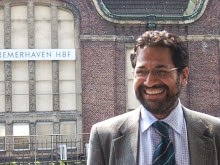
The FIR filed by the Maharashtra Police against Professor Ilina Sen tells us a lot about the official attitude of the Indian establishment towards dissent, knowledge and intellectual freedom ...
26 January 2011
The Hindu
Ilina Sen wrongly booked under Foreigners Act?
S. Arun Mohan and Siddharth Varadarajan
New Delhi: The Indian Association for Women's Studies (IAWS) has strongly contested the Maharashtra police decision to file an FIR against Ilina Sen, wife of Binayak Sen, for her alleged failure to inform the police about the participation of foreign delegates at an academic conference organised by the IAWS and the Mahatma Gandhi Antarrashtriya Vishwavidyalaya (MGAV) in Wardha last week.
Prof. Ilina Sen, who is an Executive Committee member of the IAWS and head of the MGAV's Women's Studies Department, was booked under Sections 7 and 14 of the Foreigners Act on Monday. The police also arrested the owner of a local hotel where some foreigners were staying on account of the management's failure to inform them of their arrival.
The Foreigners Act requires hotel keepers and other persons who own, occupy or control the premises where foreigners are accommodated to submit such information to the authorities in a prescribed format known as 'Form C'. It is unclear how Prof. Sen, who is a coordinator of the IAWS, has been booked under the Act given that the relevant provisions apply only to persons who furnish lodging to foreigners for payment.
Umesh Chandra Sarangi, Additional Chief Secretary (Home), told The Hindu that the conference organisers had not informed the police about their stay. “These people came and stayed in a guest house which was booked. They were organising a conference. There is a rule that whenever a conference is organised, the police should be informed about it. The Director-General of Police is looking into the case,” he said.
In fact, the Foreigners Act itself places no such obligation on Indians who invite foreigners for conferences or social events. The four Pakistani and Bangladeshi participants named in the FIR were residing on the university campus. The IAWS sources told The Hindu that three of these women scholars were in fact staying in the Vice-Chancellor's residence as personal guests while the fourth was put up at the university guesthouse. Ironically, full political and security clearance from the Ministries of Home Affairs and the External Affairs had been obtained in advance for the participation of Pakistani, Bangladeshi and Sri Lankan scholars as government rules currently prescribe in order for visas to be granted.
The FIR filed by the ATS Nagpur Unit notes that Form ‘C' as prescribed under the Foreigners Act has not been filed by the University. However, Form C pertains only to ‘Hotel Arrival Information' and does not contemplate the present situation in any manner. The distinction is relevant as Section 7 of the Act, under which Prof. Ilina Sen has been booked, will be applicable only to instances where the accommodation is paid for by foreigners. In fact, the Home Ministry in 2001 scrapped a controversial 1971 order that required persons to report the presence of foreigners in their households.
Even if one were to hold the University responsible for failing to provide the required information, the responsibility for filing a C form belongs only to those running a hotel, inn or hostel and not to the organisers of an event in which foreigners participate.
On the concluding day of the Conference, the police entered the Yatri Niwas premises in Wardha, where a large number of women participants, mostly students and teachers, were staying to attend the event.
ACTION CONDEMNED
The organisers have condemned the actions of the police and expressed their anguish over unwarranted interference from the authorities.
Mr. Sarangi denied that the police had taken action against the organisers because Prof. Sen was Dr. Binayak Sen's wife.
(With inputs from Rahi Gaikwad in Mumbai)
26 January 2011


25 January 2011
Eastern promise, western fears
 Indians may be suspicious of China and the Chinese of India. But it is the West which does not want to accept the strategic consequences of a rising Asia...
 25 January 2011
The Hindu
Eastern promise, western fears
Siddharth Varadarajan
Behind the heavy typeface that the release of confidential American diplomatic cables by WikiLeaks has generated lie smaller stories which sometimes tell us more about the way in which our world is changing than the headlines themselves.
The U.S. ambassador in Paris met Michel Rocard, a former Prime Minister of France, in October 2005 for one of those sweeping, freewheeling chats that Gallic statesmen evidently specialise in. The bulk of the conversation deals with the French political scene but at the end, M. Rocard shares his concerns about the place of France and the United States in the new world order and proposes a joint Euro-American think-tank to prepare for the future. “Speaking of the growth of India and China, along with all the other challenges confronting both of us,” the leaked cable quotes the senior French politician as saying, “We need a vehicle where we can find solutions for these challenges together — so when these monsters arrive in 10 years, we will be able to deal with them.”
So there we have it. Even as the Indian elephant and Chinese dragon circle each other warily, wondering how each will cope with the rise of the other, the Occidental mind which has enjoyed dominating the world and the global commons for two centuries is worrying about how to deal with the combined arrival of these two “monsters.”
Happily for the West, the arrivistes are not exactly on the best of terms with each other. India is too wary of China's rise to exploit the opportunities this ascent provides. For its part, Beijing — which alternates between feigning indifference towards New Delhi and fretting over whether it might join hands with a “democratic bloc” led by Washington — is so self-absorbed that it is unable to harness the externalities that India's rise has generated in the region.
In a recent article, Kishore Mahbubani spoke of the triangular relationship between India, China and the U.S. and noted how the U.S. had better relations with both India and China than the two Asian giants had with each other. By being in the middle, he argues, Washington has a strategic edge. It also has an incentive to ensure a certain amount of tension between India and China, so as to cement its own presence in Asia as an offshore balancer.
Though Mahbubani does not say so, it would be naïve to imagine the problems the Indian and Chinese sides have with one another are the product of an American conspiracy. The fact is that India and China do not know each other well and have not paid enough attention to understanding the social, political and economic dynamics of the other. As a result, misperceptions and misunderstandings abound and have given rise to suspicions and even fear. That is why it is essential that a continuous and wide-ranging dialogue take place between different stakeholders: officials, politicians, the military, scholars, journalists, artists and others. Above all, there must be engagement on the big strategic questions of our time.
In a series of interactions held recently in Beijing at the initiative of the Observer Research Foundation and the International Department of the Communist Party of China, Indian and Chinese analysts had a surprisingly frank exchange of views on the state of the bilateral relationship, the problem areas and the new areas for potential China-India cooperation.
From the Chinese side, a number of scholars spoke of four specific problem areas with India. There is, first and foremost, the unsettled boundary and the fact that border territories are disputed. Second, the presence of the Dalai Lama and the so-called ‘Tibetan government in exile' is seen as a continuing irritant, especially in the aftermath of the disturbances which shook Lhasa and some other Tibetan pockets in China in 2008. Third, and this was surprising, the scholars acknowledged that China's friendship with Pakistan was a source of friction with India. And though they differed from the Indian side in characterising the current nature of the relationship, they acknowledged the fact that “balancing India” used to be a primary Chinese motive in the past. Their argument was that the rise of the Indian economy in the past decade has forced Chinese policymakers to de-hyphenate their South Asian policy. Finally, many of the Chinese interlocutors spoke of growing strategic suspicions that are made worse by a trust deficit. “Many people in China believe Indians look down upon them,” a professor from the International Relations department of Renmin University said. “India sees itself as close to the West and is willing to be used by the U.S. in its desire to become a world power.” Other scholars echoed the same view in different ways — that India might become part of an American-led effort to gang-up against China, that many in India subscribe to the ‘China threat' thesis.
My own assessment is that the boundary dispute and Dalai Lama are not major problem areas. Indeed, my suspicion is that part of the recent brittleness in the relationship is the product of artificially accelerated efforts to settle the boundary question. As for the Tibetan spiritual leader, it is true that his presence in India is a red rag to those in China who see him as working against the unity and integrity of their country. But the Chinese side can also well appreciate the consequences of his being asked to leave India. A Hollywood exile for the Dalai Lama would only serve to raise the salience of the Tibetan issue globally. Besides, it is time China and India also start paying attention to what might happen to the Tibetan question once the present Dalai Lama is no more. And start engaging each other, and Bangladesh as the lowest riparian, on Tibetan water-related projects.
Responding to Indian queries on China's plans to harness the Brahmaputra, a scholar from the Chinese Institute of Contemporary International Relations spoke of the need for the comprehensive development of Himalayan hydropower resources. Citing Indian projects in Bhutan as a positive model, he said India's trust deficit with its neighbours like Pakistan and Nepal was coming in the way of the development of hydropower.
As far as Pakistan is concerned, it is obvious that China and India have a crucial stake in the stability of that country and need to discuss between them what they can do to help the situation there. The Chinese side is well aware of the emerging ideological and institutional fault lines in Pakistan. If there is any country other than the U.S. that has the ability to exercise leverage over the Pakistani military, it is China. Until now, however, China has been reluctant to use its influence. For more than four decades, Chinese strategic thinking on Pakistan has been dominated by the need to ‘balance' India. But with India having outgrown South Asia and Pakistan in danger of imploding as the problem of extremism and terrorism slowly gets out of control, Beijing cannot afford to remain wedded to this anachronistic mindset.
On strategic issues too, the Indian and Chinese sides have much to talk about. India and China are both officially committed to an open, inclusive architecture for the Asia-Pacific region. Both also have a stake in the freedom of navigation. During the visit to India by Chinese premier Wen Jiabao, the two countries committed their navies to joint anti-piracy operations in the Gulf of Aden. A commitment was also made to discuss the wider issue of maritime security. These are all promising new areas of cooperation that should be actively pursued. One Chinese scholar spoke of the need for strategic transparency, another made a pitch to launch new security principles by updating the Panchasila concept. Of course, such an effort is unlikely to go beyond the reiteration of homilies unless China and India both recognise that the world and their own national profiles have moved on since the 1950s. It has become a cliché to say the world is big enough to accommodate the rise of India and China. Since the world is a finite place, this means those who are today squatting on strategic space despite their leases having run out will have to be displaced. Let the West have nightmares about demons and monsters. The elephant and the dragon cannot afford to be scared of each other.
24 January 2011
The fabric of belonging
 Had the national flag which the BJP wants to unfurl in Srinagar also been dipped by them to honour the memory of the hundred young Indians who were shot dead in the valley last year, Kashmir would be a very different place ...
 24 January 2011
The Hindu
The fabric of belonging
Siddharth Varadarajan
Jammu and Kashmir is a part of India but the people of Kashmir can be forgiven for believing their country has forsaken them.
Throughout the summer of their most recent discontent, when a hundred young men and women lost their lives in police firing, leaders from the ruling and opposition parties acted as if nothing untoward had happened. Six months earlier, the mere threat of violence in Hyderabad led the Union Home Minister to declare the government had agreed to the formation of a separate state for Telangana. In Rajasthan, the blockade of national highways by agitating Gujjars produced an instant offer of dialogue and negotiation. But in Kashmir, the corpses kept piling up while the government, the Opposition (with some honourable exceptions) and civil society in the rest of India reacted with the kind of detachment reserved for death and destruction in faraway lands like Darfur and Iraq.
The fact that the public mood in the valley began to soften slightly only after an all-party delegation visited Srinagar and condoled with some of the victims' families underlined something quite unpleasant about ourselves. That the indifference of mainland India to the suffering of the ordinary Kashmiri is as much a factor in the alienation of the State as the politics of separatism and the violence of extremist groups operating with the tacit and sometimes overt backing of the Pakistani military. With characteristic indecisiveness, however, the Manmohan Singh government failed swiftly to capitalise on that initiative. When a group of interlocutors was finally appointed with a fairly open-ended mandate to listen, talk and report back, the mood in Kashmir had once again begun to harden. The fact that Dileep Padgaonkar, Radha Kumar and M.M. Ansari have still managed to make some headway in their interactions is more a result of their own personal commitment to changing the terms of New Delhi's engagement with the valley than with the attitude of the Centre and of Political India, which continue to send mixed signals.
One day, the Union Home Secretary tells reporters the government is prepared to pare down the presence of the security forces in Kashmir, the next day this statement is bluntly contradicted by the Defence Minister. The Prime Minister and Union Home Minister speak of amending the Armed Forces (Special Powers) Act while the Army Chief announces publicly that he will never accept this. In the Machchil fake encounter case, the same general declares that his soldiers — who are accused of kidnapping and killing three young Kashmiri men — can never get justice in Kashmir, as if the State is not a part of India. Only the Army, he said, will be allowed to investigate the matter. Of course, in the Pathribal fake encounter of 2000 — where the Army has taken the Central Bureau of Investigation all the way to the Supreme Court to prevent its officers from standing trial for murder — the Army has not seen fit to even proceed against them under its own authority. Surely such a cavalier attitude to justice ought not to be tolerated in an integral part of India?
The Government of India rightly protested when Beijing began treating Kashmir-born or Kashmir-domiciled Indians differently from the rest while issuing visas for travel to China. But the same government does not mind treating Kashmiri Indians differently when it comes to issuing passports for them to travel. A Srinagar-born colleague of mine whose family left Kashmir to live in Delhi as part of the forced migration of Pandits from the valley in the 1990s was recently told by the Passport Office that she had to provide additional documentation that other Indians are not required to do in order to obtain a passport. As for Kashmiris applying for Indian passports in Srinagar, a recent documentary film by Ashvin Kumar, Inshallah Football, documents the heartbreaking experience they have to endure before the country which so emotionally claims them as its own will allow them to travel abroad.
Hoisting the flag
As the Centre's three interlocutors plough a lonely furrow through the infertile and even hostile soil of distrust and alienation, patiently listening to and cataloguing popular grievances, the Bharatiya Janata Party wants to rekindle a sense of estrangement by staging a provocative and high profile yatra to Srinagar in order to hoist the Indian flag at Lal Chowk in the heart of the city's commercial centre on January 26.
There is nothing patriotic or noble about the BJP's plans and intentions. Instead of a voyage of solidarity and empathy aimed at reassuring the people of the State that the party will fight for the sacred values of truth, justice and inclusiveness which the flag embodies, the party is planning an expedition based on the flawed belief that meaningless symbolism is all that is required to win hearts and minds and cement Kashmir's status as a part of India.
If a sense of national belonging can be instilled and solidified by the mere hoisting of a flag, 60 years of official ceremonies in Srinagar ought to have ended the sense of alienation that is writ large over the valley. Even if the BJP goes ahead with their mindless yatra, it will not alter the realities on the ground one bit and would actually make the situation worse. Whatever we may say or do or wish, surely Kashmir will be an integral part of India in a meaningful sense only when the residents of Srinagar themselves throng to Lal Chowk and hoist the tri-colour themselves. The challenge for the Indian polity is to create the conditions for that to happen one day, however difficult that may seem today. But the BJP's proposed flaghoisting is not just an exercise in naivette or cynicism. It is the product of a mindset that considers Kashmir to be terra nullius, an empty landscape to be coveted and possessed rather than a land with a people and soul who acceded to India in 1947 on the basis of a covenant which must be respected in full measure and who have as much right to a life with dignity as those elsewhere in the country do.
A politician can drape himself in the national flag but it is the texture of his politics which will determine whether he truly cares for the nation and its peoples or not. Today, the Congress politician and businessman Naveen Jindal is known not for fighting a landmark case over the right of ordinary citizens to fly the flag but for his endorsement of the obscurantist tradition of khap panchayats. Ministers and officials will preside over flag hoisting ceremonies on Republic Day throughout India even as their policies and actions in the preceding year have bled the hallowed earth on which they stand dry. Patriotism is the last refuge of the scoundrel and the people of India know this only too well. If the BJP really wants to do something for the country, let them take their yatra to Karnataka. There is a large plot of land in that State which the party's chief minister signed over to his relatives. Let the process of safeguarding this country from those who are undermining its foundations begin by planting the national flag there.
20 January 2011
Musical chairs on a drifting ship

More than a reshuffle, the UPA government needs a new deck of cards and, much more urgently, a new game...
20 January 2011
The Hindu
Musical chairs on a drifting ship
Siddharth Varadarajan
Any ministerial rearrangement which leaves the big four portfolios of Home, Defence, External Affairs and Finance untouched is bound to disappoint headline writers but so underwhelming is Prime Minister Manmohan Singh's latest reshuffle that it is hard to understand the motivation or logic behind the entire exercise.
Three weaknesses
The United Progressive Alliance is suffering from three major weaknesses. The first is the public's perception — notwithstanding the ouster of Ashok Chavan from Maharashtra and A. Raja's resignation from the Union Cabinet last year — that Dr. Singh and Congress president Sonia Gandhi are unwilling to act firmly against corruption. The second is that cronyism and personal loyalties are seen as bigger virtues than efficiency. The third is that the Prime Minister himself is unwilling to lead from the front and stare down individual ministers who think they have the individual power to veto collective decisions.
So long in the making was Wednesday's reshuffle that it seemed as if Dr. Singh and Ms Gandhi might actually be willing to make the “course correction” the Prime Minister promised in his New Year's message. While the compulsions of coalition politics limit his options when it comes to the non-Congress ministers, he should have used the prevailing mood in the country to sweep aside Congress ministers who have either failed to make a positive mark or actually done damage. He could have also struck a blow for probity by ousting Vilasrao Deshmukh — indicted recently by the Supreme Court for abusing his authority when he was Chief Minister of Maharashtra — and asking Virbhadra Singh to step aside till he clears himself of charges that the High Court in Himachal Pradesh has already taken congnisance of. Had he done just that much, the Prime Minister could have overcome some of the negative atmospherics generated by the fiasco over 2G spectrum and the controversy over Central Vigilance Commissioner P.J. Thomas.
Unfortunately, none of this happened. Like old card players who never die — they just shuffle away — the non-performers in Prime Minister Manmohan Singh's cabinet have simply reshuffled their way to new ministries. And Mr. Deshmukh, whose illegal intervention in a police case in favour of a usurious moneylender ultimately cost the Maharashtra government a Rs.10 lakh fine, actually ended up getting a promotion. He has been moved from Heavy Industries to the much more crucial Rural Development portfolio, which is responsible for the rural employment guarantee programme of the government.
Sources in the Prime Minister's Office told The Hindu the reshuffle was intended to send a “perform or perish” message to ministers holding economic portfolios. Thus, Murli Deora, Kamal Nath, Virbhadra Singh and a few others who have not exactly set the Yamuna on fire with their performance were ‘demoted' to less grand ministries. Though Youth Affairs and Sports is not an economic ministry, his handling of the multi-crore Commonwealth Games too cost Mr. M.S. Gill that portfolio. One wonders, however, why these ministers weren't simply thanked for services rendered and their places given to others in the party who might do a better job all round?
The plus side
On the plus side, the biggest positive to emerge from the reshuffle is the transfer of Jaipal Reddy to Petroleum and Natural Gas, a strategic ministry that has never fully recovered from the exit in 2006 of Mani Shankar Aiyar. The pruning of Sharad Pawar's portfolio is another plus, as is the handing over of a crucial ministry like water resources to Salman Khurshid. Minority Affairs, however, will be an unnecessary encumbrance and one hopes the government will have the good sense to think out of the box and give that charge not to a minority politician but to a dynamic, secular non-minority leader with a genuine commitment to the welfare of the minorities. Taking tourism away from Kumari Selja makes no sense given the fair job she was doing; one can only hope the additional charge of Culture given to her is meant for the long-haul. As far as other changes — full cabinet rank for Salman Khurshid, Shriprakash Jaiswal and the induction of Beni Prasad Verma from Uttar Pradesh, for example — tactical considerations seem to have been uppermost in the Congress high command's mind with assembly elections in the crucial state less than a year away. Also, the ‘asset stripped' civil aviation portfolio — temporarily handed over to Vayalar Ravi — is being kept in reserve for allocation to the DMK if the political situation following the Tamil Nadu assembly elections warrants it.
Tactics, however, will take you only so far. Whatever end he hoped the reshuffle would serve, the Prime Minister is likely to find himself confronting the same political challenge tomorrow as he did yesterday: how to restore public confidence in his ability to lead a clean and efficient government. This was not the challenge the Congress faced when it got re-elected to power in 2009 and the party needs to introspect over how it has lost its way. The cabinet reshuffle indicates it is still not ready to do so. The official obfuscation over revenue losses caused by the arbitrary sale of spectrum and the confrontationist stand the Centre is taking over both the CVC and Joint Parliamentary Committee issues suggest the stalemate in Parliament is likely to continue into the Budget session. That this will be bad for Indian democracy is clear. But it is also likely to irreparably harm the political fortunes of the ruling coalition.
20 January 2011
The Hindu
Musical chairs on a drifting ship
Siddharth Varadarajan
Any ministerial rearrangement which leaves the big four portfolios of Home, Defence, External Affairs and Finance untouched is bound to disappoint headline writers but so underwhelming is Prime Minister Manmohan Singh's latest reshuffle that it is hard to understand the motivation or logic behind the entire exercise.
Three weaknesses
The United Progressive Alliance is suffering from three major weaknesses. The first is the public's perception — notwithstanding the ouster of Ashok Chavan from Maharashtra and A. Raja's resignation from the Union Cabinet last year — that Dr. Singh and Congress president Sonia Gandhi are unwilling to act firmly against corruption. The second is that cronyism and personal loyalties are seen as bigger virtues than efficiency. The third is that the Prime Minister himself is unwilling to lead from the front and stare down individual ministers who think they have the individual power to veto collective decisions.
So long in the making was Wednesday's reshuffle that it seemed as if Dr. Singh and Ms Gandhi might actually be willing to make the “course correction” the Prime Minister promised in his New Year's message. While the compulsions of coalition politics limit his options when it comes to the non-Congress ministers, he should have used the prevailing mood in the country to sweep aside Congress ministers who have either failed to make a positive mark or actually done damage. He could have also struck a blow for probity by ousting Vilasrao Deshmukh — indicted recently by the Supreme Court for abusing his authority when he was Chief Minister of Maharashtra — and asking Virbhadra Singh to step aside till he clears himself of charges that the High Court in Himachal Pradesh has already taken congnisance of. Had he done just that much, the Prime Minister could have overcome some of the negative atmospherics generated by the fiasco over 2G spectrum and the controversy over Central Vigilance Commissioner P.J. Thomas.
Unfortunately, none of this happened. Like old card players who never die — they just shuffle away — the non-performers in Prime Minister Manmohan Singh's cabinet have simply reshuffled their way to new ministries. And Mr. Deshmukh, whose illegal intervention in a police case in favour of a usurious moneylender ultimately cost the Maharashtra government a Rs.10 lakh fine, actually ended up getting a promotion. He has been moved from Heavy Industries to the much more crucial Rural Development portfolio, which is responsible for the rural employment guarantee programme of the government.
Sources in the Prime Minister's Office told The Hindu the reshuffle was intended to send a “perform or perish” message to ministers holding economic portfolios. Thus, Murli Deora, Kamal Nath, Virbhadra Singh and a few others who have not exactly set the Yamuna on fire with their performance were ‘demoted' to less grand ministries. Though Youth Affairs and Sports is not an economic ministry, his handling of the multi-crore Commonwealth Games too cost Mr. M.S. Gill that portfolio. One wonders, however, why these ministers weren't simply thanked for services rendered and their places given to others in the party who might do a better job all round?
The plus side
On the plus side, the biggest positive to emerge from the reshuffle is the transfer of Jaipal Reddy to Petroleum and Natural Gas, a strategic ministry that has never fully recovered from the exit in 2006 of Mani Shankar Aiyar. The pruning of Sharad Pawar's portfolio is another plus, as is the handing over of a crucial ministry like water resources to Salman Khurshid. Minority Affairs, however, will be an unnecessary encumbrance and one hopes the government will have the good sense to think out of the box and give that charge not to a minority politician but to a dynamic, secular non-minority leader with a genuine commitment to the welfare of the minorities. Taking tourism away from Kumari Selja makes no sense given the fair job she was doing; one can only hope the additional charge of Culture given to her is meant for the long-haul. As far as other changes — full cabinet rank for Salman Khurshid, Shriprakash Jaiswal and the induction of Beni Prasad Verma from Uttar Pradesh, for example — tactical considerations seem to have been uppermost in the Congress high command's mind with assembly elections in the crucial state less than a year away. Also, the ‘asset stripped' civil aviation portfolio — temporarily handed over to Vayalar Ravi — is being kept in reserve for allocation to the DMK if the political situation following the Tamil Nadu assembly elections warrants it.
Tactics, however, will take you only so far. Whatever end he hoped the reshuffle would serve, the Prime Minister is likely to find himself confronting the same political challenge tomorrow as he did yesterday: how to restore public confidence in his ability to lead a clean and efficient government. This was not the challenge the Congress faced when it got re-elected to power in 2009 and the party needs to introspect over how it has lost its way. The cabinet reshuffle indicates it is still not ready to do so. The official obfuscation over revenue losses caused by the arbitrary sale of spectrum and the confrontationist stand the Centre is taking over both the CVC and Joint Parliamentary Committee issues suggest the stalemate in Parliament is likely to continue into the Budget session. That this will be bad for Indian democracy is clear. But it is also likely to irreparably harm the political fortunes of the ruling coalition.
12 January 2011
Sorry people, we're hanging up on you
 The Manmohan Singh government is digging an even bigger hole for itself by claiming there was no loss of revenue from the sweetheart sale of 2G spectrum to favoured corporate houses...
 12 January 2011
The Hindu
Sorry people, we're hanging up on you
Siddharth Varadarajan
“Milord,” cunning lawyers have argued in countless Hindi movies, “how can there have been a murder when there is no dead body?” I was reminded of this line when I heard Kapil Sibal — who has been performing as an understudy at the Ministry of Communications and Information Technology ever since A. Raja was ousted on corruption charges — bravely defending the legacy of his predecessor at a press conference. By attacking the Comptroller and Auditor General's 2G spectrum scam report and claiming the government lost no revenue despite the fact that “procedural irregularities in the implementation of the first-come first-served policy” may have occurred, Mr. Sibal has done the political equivalent of removing the “dead body” from the crime scene and then declaring his clients innocent. For if the government lost no money through the sale of spectrum in 2008, it stands to reason that the politicians, bureaucrats and businessmen who are today being investigated could not have made any money either. Illegitimate profits cannot be conjured out of thin air — which is what spectrum essentially is. There is no dead body milord.
Sadly for Prime Minister Manmohan Singh and Congress president Sonia Gandhi, who no doubt prepped Mr. Sibal to make his ill-advised arguments, the CAG report is full of incriminating corpses. And their ghosts are likely to stick around long enough to haunt the ruling party at the time of the next general election.
The central thrust of Mr. Sibal's argument is that the PAC used flawed logic to arrive at the conclusion that the sale of Universal Access Service licenses by the Department of Telecom in 2008 led to a revenue loss of Rs.1,76,000 crore. But here's what he chose not to say. The CAG itself acknowledged in its concluding chapter that the amount of loss could be debated but “the fact that there has been loss to the national exchequer in the allocation of 2G spectrum cannot be denied.”
Indeed, the CAG made separate calculations based on four different methodologies in order to demonstrate the flawed nature of the licensing system the DoT ran. The figure cited by Mr. Sibal came from using the 3G spectrum auction proceeds as a guide to the revenue the government gave up by not auctioning 2G spectrum. Other methods used were looking at the sale of equity by shell-company licensees Swan Telecom and Unitech. Both of these companies sold a chunk of their otherwise worthless equity to established operators, thereby providing a helpful indication of what the licenses they had bought for a song were truly worth. Extrapolating from those sales figures, the CAG estimated that the government short-changed itself by anywhere from Rs.57,666 crore to Rs.69,626 crore.
The CAG report methodically establishes how the great spectrum robbery of 2008 was essentially a scam within a scam. The original scam was designed to benefit the universe of existing and potential telecom operators by selling them a scarce resource — spectrum — on a first come, first served (FCFS) basis at a seven-year-old price that had no bearing on current market conditions. Given the exponential increase in teledensity between 2001 and 2008 — by some estimates, the number of mobile subscribers had already risen from four million to 300 million and was expected to continue to grow at a rapid clip — the failure to use an efficient price discovery mechanism meant the government was prepared to forsake an enormous amount of revenue in order to benefit operators fortunate enough to get hold of new spectrum.
But having scripted super profits for the lucky telecom companies in the spectrum allocation process, it was inevitable that the politicians and bureaucrats running the show would take the next step. The only way to accumulate rent from companies benefiting from a giveaway that is available to all as a matter of policy is to use one's allocative power to favour some over others. This was the genesis of the second scam in which a handful of applicants — many of whom were completely unqualified to be applying for telecom licenses at all — were cherry-picked by the DoT in an arbitrary subversion of the first come, first served process. The CAG report demonstrates how Swan, in which the Anil Dhirubhai Ambani Group had a key stake, and Unitech were among the beneficiaries of this. Bank drafts and guarantees were prepared in advance by some companies who were unofficially tipped off so that their completed applications for spectrum could be submitted literally within minutes and hours of the official call going out.
Mr. Sibal, who tore into the CAG, was sporting enough to admit there may have been some wrongdoing in the manner in which the FCFS policy was implemented. At the same time, he insisted the policy of charging 2001 prices was correct and that a 2G spectrum auction would have led to an increase in the price of telecom services. What he ignores is the fact that the cost of telecom services emerging from the 2G allocation will be a function not of the absurdly low price at which the government sold spectrum but of the prevailing tariff rate in the market and also the higher resale price at which this precious commodity finally enters the system. To paraphrase an argument first made by Sunil Jain in the Financial Express last year, there was indeed an auction for 2G spectrum whether Mr. Sibal approves of auctioning or not. But this auction was conducted not by the government, as it should have been, but by the companies who benefited from the arbitrary manner in which spectrum ended up getting allocated. They simply turned around and resold what they had received to the highest bidder.
Mr. Sibal also sought to argue that the government policy on spectrum allocation — of underpricing it or even giving it away free — was justified in the name of keeping the cost of basic telephony down. He compared the Rs.17 a minute cost of a mobile phone call a decade back with the 30 paise per minute rate today to prove his point but this is a flawed argument. Most technology-driven consumer goods and services experience a declining price curve over time. I paid $1,000 as a graduate student in New York for my first laptop computer in 1990. It was a no-brand, 386 chip, 40MB hard drive heavyweight monster whose battery lasted about an hour if I was lucky. Today, $1,000 will buy you a powerful notebook and decent variants can be bought for as little as $300. It also cost me $2 a minute to call my parents back home (which is why I rarely did so). The last time I was in the U.S., I could call India for eight cents a minute. The drop in call rates has nothing to do with subsidised spectrum as Mr. Sibal would have us believe, but with competition, increases in productivity and the global ebb and flow of technological change and obsolescence which allowed Indian companies to buy 2G network equipment at a relatively inexpensive cost. In any case, even at the supposedly low call rates in India, telecom operators are making serious money. The last thing they need is a free handout in the form of an FCFS spectrum allocation policy, that too one which is rigged.
The government's argument about keeping mobile call rates low may have had some credibility if the logic was applied consistently. But everything in India is contingent on whose asset is being sold to whom. When a public asset like spectrum is to be sold to a private company like Anil Ambani's Swan Telecom, or to Tata or others, we are told the price must be kept low even if there is a revenue loss. When a public asset like food grain is to be sold to the poor under the proposed Right to Food Act, the same people say prices cannot be kept low because this would lead to a revenue loss. When a public resource like Krishna-Godavari (KG) gas comes into the hands of an industrialist like Mukesh Ambani, the price must be kept high even if this means consumers end up paying a higher price for electricity and fertilizers. From 2G to KG to CWG the system's logic and rules will always be designed to allow maximum profits for those with real connections.
The CAG in its report has demonstrated how “the entire process of allocation of UAS licenses lacked transparency and was undertaken in an arbitrary, unfair and inequitable manner … which gave unfair advantage to certain companies over others.” It was this “unfair advantage” which allowed “certain companies” to earn revenue that rightly belonged to the government. So compelling is the charge of corruption on a massive scale in the spectrum licensing matter that the Supreme Court has said it will monitor the progress of investigations by the CBI.
Public disenchantment with the corrupt ways of our political and business establishment is running so high that Prime Minister Manmohan Singh was forced to promise in his New Year greetings a “course correction” that would “cleanse governance” in India. If Mr. Sibal's arguments are any indication, however, Dr. Singh's New Year resolutions have not lasted very long at all. If the UPA government continues to remain in denial, it will pay a heavy political price. At the time of the next general election, when Congress managers scratch their heads and wonder where on earth the seats to form the next government are going to come from, Mr. Sibal's arithmetic will be remembered as the point where the game which was not going the party's way anyway finally slipped out of its hands.
Subscribe to:
Posts (Atom)