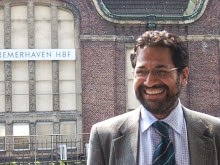
‘Trip to Washington did happen, but it was private visit, not junket' ...
31 December 2010
The Hindu
Singed by WikiLeaks, Indian official says U.S. cable a lie
Siddharth Varadarajan
New Delhi: A former Indian official criticised for making unauthorised contact with the United States embassy and angling for a junket in order to “feed” American views on Iran into the Indian system, has accused a senior American diplomat of fabricating the contents of the confidential cable — published by WikiLeaks earlier this month — which “outed” him.
“I cannot answer for what [the former U.S. Charge d'Affaires Geoffrey] Pyatt might or might not have reported and if he did send such a cable, why he should have done so,” K.V. Rajan, a former secretary in the Ministry of External Affairs and a former member of the Prime Minister's National Security Advisory Board (NSAB) told The Hindu.
In the cable titled ‘Iran manipulating Indian elite opinion makers' of May 4, 2007, Mr. Pyatt — who is now the Principal Deputy Assistant Secretary for South Asia at the U.S. State Department — said Mr. Rajan sought an urgent meeting to discuss a Tehran-sponsored visit to Iran by Indian opinion-makers. According to the cable, Mr. Rajan said he had turned down the invitation but gave a list of the other invitees to the U.S. Embassy.
“To counter this new and worrying effort to reach out to Indian opinion makers, Mr. Rajan proposed a visit to the U.S., starting May 14, in his NSAB capacity, for five to seven days, to talk to officials, think tanks, and the intelligence community to discuss ways to understand better the U.S. assessments of Iran. He would expect this to feed into NSAB discussion of Iran policy options,” the embassy cable said. “To counter this insidious new Iranian effort, we recommend Rajan receive meetings, if possible, with xxx,” the cable concluded.
WikiLeaks redacted the names of the senior U.S. officials Mr. Pyatt wanted Mr. Rajan to meet. But The Hindu has been able to establish that the U.S. embassy sought meetings with four senior intelligence officials: Deputy National Security Adviser Elliott Abrams, National Intelligence Council (NIC) Vice-Chair David Gordon, NIC Deputy South Asia Officer John Dister and CIA Director of Intelligence John Kringen.
Mr. Rajan, who coincidentally travelled to Washington D.C. shortly after the cable was sent, denies meeting these or other officials during that trip.
The Hindu published details of the Rajan cable on December 18. Mr. Rajan, who was travelling at the time and could not be reached for comment, said upon his return: “It is true that an invitation was addressed to me by the Iranian government in my capacity as member, National Security Advisory Board.' After checking with the Ministry of External Affairs, I declined as it would have been inappropriate to have accepted such an invitation. I have no idea about what happened subsequently and certainly have no recollection about discussing the matter with any foreign diplomat, apart from conveying my apologies to the Iranians. I can emphatically confirm that I have never discussed the Iran non-visit with U.S. officials.”
Asked why Mr. Pyatt would fabricate a conversation which never took place in a confidential cable that was not meant to be read by anyone outside the U.S. system, Mr. Rajan said he could not answer for what the U.S. diplomat might or might not have reported.
He admitted travelling to the U.S. in May-June 2007, but denied that visit was arranged by the U.S. government. “I visited the U.S. and some European countries during that period in connection with seminars and conferences. The U.S. government/Embassy were in no way involved,” he said.
The U.S. trip “was for a conference and celebration of the silver jubilee of Washington Times,” Mr. Rajan said, when asked for details of the visit. “I did not meet a single one of the persons you have mentioned. Indeed, I can confirm that I did not meet any other official of the U.S. government either, before during or after the visit to discuss any other subject pertaining to foreign policy,” he added.
Describing himself as “not a particular favourite of the U.S. embassy,” he said: “My only guess as to the sudden affection they developed later is a gross misunderstanding of the reasons for my declining the Iran invite.”
With the State Department advising its missions and posts abroad not to engage with any questions stemming from the leaked cables, attempts to clarify matters with the U.S. embassy drew a blank.
Speaking on background, however, MEA officials said it was unlikely the U.S. embassy would invent a conversation or meeting which never took place. Indeed, South Block has been struck by how accurately the leaked cables have captured the contents of sometimes complicated meetings between senior American and Indian officials on a whole range of topics. “I think I'm going to go with Mr. Pyatt on this one,” a senior official said. “Look at the people Mr. Pyatt wanted Mr. Rajan to meet. Even if the meetings never worked out, a career diplomat would be mad to get State to pitch for top guys at the NIC and CIA on the basis of some made up story.”
31 December 2010


18 December 2010
Carrying anti-Iran tales, top official angled for U.S. junket
 Ratting out on his pals for an imaginary offence, he pushed for a trip to the United States ...
 18 December 2010
The Hindu
Carrying anti-Iran tales, top official angled for U.S. junket
Siddharth Varadarajan
Sandeep Dikshit
New Delhi: India's first major embarrassment from the Wikileaks closet came tumbling out on Friday with the revelation that a top official had initiated unauthorised contact with the United States embassy to complain about Iran and pitch for a U.S. visit, where he could receive inputs that would then “feed the [Indian] discussion of Iran policy options”.
On May 4, 2007, K.V. Rajan — described in a confidential cable by U.S. Charge d'affaires Geoffrey Pyatt as “Former Secretary of the Ministry of External Affairs and then Chairman of the Prime Minister's National Security Advisory Board (NSAB)” — sought an urgent meeting with the U.S. embassy to inform it that he and a number of other Indian “politicians, scholars and commentators” had been invited by Iran on an “all-expenses-paid trip” to visit nuclear installations there and meet officials.
“Rajan told the Charge [Pyatt] that this trip was part of an effort of the Iranian government to encourage anti-American, pro-Muslim scholars and think-tanks in India to influence Prime Minister [Manmohan] Singh's supporters to take a more pro-Iranian, anti-U.S. view, and that his presence on the delegation would have handed Iran a Public Relations coup. In light of his suspicions, Rajan cancelled at the last minute, citing a sudden family emergency.” The cable then notes that Mr. Rajan provided the embassy a list of invitees.
“To counter this new and worrying effort to reach out to Indian opinion-makers”, the U.S. Charge d'Affaires wrote, “Rajan proposed a visit to the United States starting May 14 in his NSAB [chaiman] capacity for five-seven days to talk to officials, think tanks, and the intelligence community to discuss ways to better understand U.S. assessments of Iran.” Mr. Rajan “would expect this to feed the NSAB discussion of Iran policy options”, the confidential cable titled ‘New Iranian Mischief' added.
After hearing him out and noting reports of a visit to Iran's heavy water reactor at Arak that had appeared in The Hindu and The Asian Age, the cable records Mr. Pyatt's recommendation: “To counter this insidious new Iranian effort, we recommend that Rajan receive meetings, if possible, with [xxx]”. The names of his recommended interlocutors are blanked out.
Mr. Rajan was unavailable for comment and it is not known if the proposed trip materialised. But Indian government officials speaking to The Hindu on background said it was most inappropriate for an NSAB member to have approached the U.S. embassy in this way.
M.K. Rasgotra, the actual chairman of the NSAB at the time — Mr. Rajan having been a mere member of the board, it is not known why Mr. Pyatt described him as its head — reacted angrily to the revelation that a board member had approached the U.S. embassy to provide information and propose a trip for himself. “Firstly, I was chairman and there was never any mention of this bloody nonsense. I never sought to go out on any one's account nor did any member approach me to discuss this. He was clearly acting on his own. I am really surprised.”
Mr. Rasgotra, a former foreign secretary, said that all NSAB members take an oath of secrecy. Speaking on background, a former official of the National Security Council Secretariat said NSAB members are meant to provide reports only to the Government of India. “They are not meant to approach foreign embassies/governments. It is not their job to be doing diplomacy.”
The names of the respected Indian commentators who visited Iran in April 2007 are blacked out in the cable but their identities are no secret: Vikram Sood, former head of Research and Analysis Wing, India's external intelligence agency; A. Gopalakrishnan, former head of the Atomic Energy Regulatory Board; Anuradha and Kamal Chenoy from Jawaharlal Nehru University; Bharat Karnad from the Centre for Policy Research; and Amit Baruah, the then Diplomatic Correspondent of The Hindu.
Correspondents from this newspaper and other publications routinely visit foreign countries on official invitations. Asked for his reaction to Mr. Rajan's apprehensions about the Iran trip, Mr. Sood said he was amused at his presumption that seasoned commentators and ex-officials would be unable to form their own opinions on places they visited.
15 December 2010
Time to reset the India-China relationship
 Sixty years have already elapsed without the boundary issue being settled. Waiting a few more years should not be a problem for either side, especially if it helps to 'deterritorialise' the relationship ...
 December 15, 2010
The Hindu
Time to reset the India-China relationship
Siddharth Varadarajan
When Atal Bihari Vajpayee and Jiang Zemin decided in 2003 to appoint Special Representatives (SRs) to explore and presumably accelerate “the framework of a boundary settlement” between India and China, little did they imagine that their vast but disputed borderlands would end up casting a dark shadow on the overall bilateral relationship seven years later.
The Line of Actual Control in the western and eastern sectors may be extraordinarily tranquil but the artificially speeded up prospect of a boundary settlement has increased the salience of territoriality at a time when the relationship most needs a de-territorialised agenda.
China and India are confronting the same set of challenges that their spectacular rise has exposed them to, from globalisation and its imbalances to transnational security threats, environmental degradation, piracy, maritime security and political instability in various parts of Asia. As the two preeminent powers of the Asian region, India and China have an enormous responsibility to discharge — and discharge jointly. The burden they carry is too great to allow either the kind of assertive, ‘go-it-alone' strategy the Chinese seem to favour or the ‘bandwagoning with an off-shore balancer' that the Indians appear to prefer.
Instead of focussing inward on their disputed border, the two countries need to look together at the wider region and its challenges and see how the pooling of equities they do so well on global issues like trade, financial rebalancing and climate change can also occur on the Asian front. But this is not happening.
Two years ago, the Chinese side implicitly started questioning the status of Jammu and Kashmir by giving Indians domiciled in the State a loose-leaf ‘stapled' visa instead of the regular visa given to Indians from elsewhere. That China regarded Arunachal Pradesh as disputed and was pressing a claim in the SRs talks for what it calls ‘Southern Tibet' was well known. But the stridency of its assertions — especially its objections to Indian leaders visiting the north-eastern State — took the Indian side by surprise.
On their part, some Indian military commanders muddied the waters by making irresponsible public pronouncements which have fuelled both the jingoism and insecurity of a hyper-nationalist media and middle class. The suggestion made on background by some Indian officials that China's claims to the whole of Arunachal Pradesh violated the “political principles and parameters” governing the boundary settlement agreed to by both sides (because of the reference there to due regard being paid to the wishes of settled populations) may also have pushed Beijing into a more assertive mode. After all, from the Chinese point of view, if that were to mean all settled areas automatically belong to India then why are the SRs still negotiating?
Whatever the causes, however, it is clear that the prioritised quest for a boundary settlement, far from bringing the two countries closer, has emerged as a source of irritation and even tension.
In their own way, it seems as if both countries are aware of this negative dynamic. That is why, at their 13th round of talks in 2009 and again at the 14th round in Beijing last month, the two SRs opened a door for a wider discussion on issues of political and strategic concern. Hopefully, this new discussion will help ‘de-territorialise' the relationship.
The broad contours of the way New Delhi looks at Beijing were spelt out in a remarkable speech to the Observer Research Foundation by Foreign Secretary Nirupama Rao on December 3.
Ms Rao touched on all the prickly issues from stapled visas for Kashmiris to the imbalance in trade, Chinese hydro projects on the Brahmaputra and the Sino-Pakistani relationship. But she also said the view that India and China are rivals “is an over-generalisation and over-simplification of a complex relationship which encompasses so many diverse issues.”
In the wider strategic community, there are other issues which tend to get flagged such as the ‘string of pearls' thesis and the fear that China is “encircling” India by building close relations with its smaller South Asian neighbours like Nepal and Sri Lanka. But these fears are not uniformly shared within the government.
As one examines the future of the relationship, it is useful to flesh out the areas where Indian and Chinese interests may actually diverge or converge.
If we divide Indian foreign policy analytically into three concentric circles encompassing South Asia, Asia and the world, then it is primarily at the Asian level that the two powers are rubbing up against each other. Within South Asia, which India would like to develop as a cohesive economic space, the primary obstacle is Pakistan. To be sure, Pakistan benefits a great deal from the military and economic help it receives from China, especially in the nuclear and missile spheres. But even in the absence of an axis with Beijing, the binding constraint in South Asia remains the role of the Pakistani military establishment in determining the fate of that country.
Elsewhere in South Asia, it may hurt Indian pride to see a major infrastructure project in Hambantota, Sri Lanka, say, go to a Chinese firm, but this is because Indian companies did not bother to avail of the opportunity.
In any case, physical infrastructure of this kind is not a zero sum game.
Last year, I happened to give a talk on national security to senior executives from a company with very diverse business interests. One executive asked me whether India ought to be worried by a report he had read recently of China planning to connect Nepal to Tibet by rail. Before I could answer, another executive put up his hand. He was from the clothing division and spoke about how the company's factory in Nepal imports fabric from China by sea via Kolkata. Each journey takes six to eight weeks. “If a rail link comes up from Tibet, I'll be able to bring in my shipments within ten days,” he said.
The wider point is that as China grows, Chinese companies will increase their presence in South Asia, especially India. By the same token, Indian businesses and economic interests are also getting entrenched across Asia, including South East and East Asia, where Japanese dominance has already made way for both China and South Korea. These developments would become “threatening” if they are imbued with a strategic dynamic that is powerful enough to overturn the imperatives of geography. In both South Asia and East Asia, for the foreseeable future at least, this is unlikely.
Globally, other than at the highest table — the United Nations Security Council — India and China have more in common with each other than with other big powers. True, Chinese companies have made spectacular commercial inroads in Africa but many of the infrastructure projects they have embarked on will generate multiplier effects that will create space for Indian and other companies to get involved. But it is on the question of Asia — East Asian security and the related question of maritime security in the Indian Ocean — that India and China seem, at least superficially, to be working at cross purposes.
From the Chinese point of view, preventing a U.S.-India axis in Asia is a key priority.
As New Delhi draws closer to Washington, Beijing feels it necessary to make its own overtures towards the Indians but also to take “defensive” measures of one kind or another. That is why China has alternated between criticism and negative rhetoric, on the one hand, and blandishment on the other. But this is a risky strategy. Overshoot with the negativity and you run the risk of driving India into willing American arms. Overshoot with the platitudes and the Indians may end up taking you for granted.
It is my sense that the Chinese inability to deal with the dynamics of the Indo-U.S. relationship is responsible, in large measure, for the up-and-down perturbations we have seen in the bilateral trend line since 2004.
India, too, has allowed itself to be paralysed by the prospect of a Sino-American axis and has tended to retreat into a strategic shell whenever the concept of G-2 rears its unwelcome head. Today, with G-2 in retreat and the Obama administration repeating the Sino-centric overtures to India that George W. Bush did, New Delhi needs to play its cards wisely. Prime Minister Singh should explain to Premier Wen that India wants strong relations with both China and the U.S., that it does not see one as a substitute for the other and that it certainly does not intend to sacrifice one for the other.
Second, that India and China need to work closely together on issues of Asian security and the emerging security architecture, and should not leave the heavy lifting that may be required to outside powers.
Third, given China's critical dependence on shipping, especially energy, across the Indian Ocean, and given India's strategic location at the centre of east-west SLOCs, the two countries ought to cooperate more on broad maritime issues, including anti-piracy, marine pollution and ensuring the openness of the sea commons.
Broadening the regional and global agenda is the best way to move away from the rancour that the boundary question has started to generate. Sixty years have already elapsed without it being settled. Waiting a few more years should not be a problem for either side.
Subscribe to:
Posts (Atom)