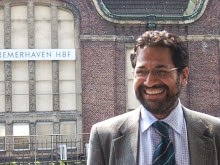
Indian officials hope U.S. will now ease up on its pressure ...
28 October 2010
The Hindu
India signs nuclear liability treaty
Siddharth Varadarajan
New Delhi: India on Wednesday signed the Convention on Supplementary Compensation for Nuclear Damage (CSC), thereby delivering on the last of its commitments stemming from the landmark 2005 nuclear agreement with the United States.
The international covenant — which provides a framework for channelling liability and providing speedy compensation in the event of a nuclear accident — was signed at the International Atomic Energy Agency offices in Vienna by Dinkar Khullar, India's Ambassador to Austria. The IAEA is the “depository” of the CSC, which has so far been signed by 14 countries and ratified by four, including the U.S.
The CSC will enter into force only when at least five countries with a minimum of 4,00,000 units of installed nuclear capacity ratify the treaty. Even if India ratifies it — and Indian officials say this is unlikely to happen soon — the CSC will not enter into force unless at least one or two countries with a large civilian nuclear programme also do so.
With India signing the CSC and the Obama administration issuing the requisite ‘Part 810' licensing certifications, the stage is now set for the Nuclear Power Corporation of India Ltd. to begin full-fledged commercial negotiations with General Electric and Westinghouse for supply of two 1,000-MWe reactors. Three rounds of discussions have already been held, Indian officials say, but these have largely been exploratory in nature.
India promised the U.S. in 2008 that it would sign the CSC, a treaty that requires signatories to pass a domestic liability law in conformity with a model text. Washington's aim was to ensure that its companies were legally exempted from any liability burden in the event of an accident occurring in an American-supplied nuclear reactor.
Though India passed its liability law last month, the U.S. has objected to Sections 17(b) and 46 of the Act which open the door for legal action against nuclear suppliers if an accident is caused by faulty or defective equipment. Washington says these provisions violate the CSC, a charge New Delhi rejects.
With GE and Westinghouse lobbyists up in arms, the U.S. side initially suggested that the Manmohan Singh government find a way to delete or negate the two offending sections. When the impossibility of this was pointed out, they suggested that NPCIL be asked contractually to accept the entire liability burden of its suppliers in the event of an accident. This suggestion has also been vetoed.
Leaving aside the explosive political implications of a public sector company granting a free pass to an American supplier, legal advisers have pointed out that neither NPCIL nor the government can sign away the provisions for tortious and criminal liability that have been embedded in the new law.
Now that the CSC has been signed, Indian officials hope the U.S. will ease up on its pressure. “We have delivered on all our commitments. Now there is nothing which stands in the way of American companies having commercial negotiations for the sale of their reactors,” a senior official said.
The CSC provides no forum for signatories to challenge each other's national laws. Article XVI allows for arbitration as well as adjudication by the International Court of Justice, in the event of a dispute. But the U.S. entered a reservation while ratifying the Convention in 2008 declaring “that it does not consider itself bound by [these] dispute settlement procedures.” When it eventually ratifies the treaty, India is likely to make a similar declaration.
That would leave the Supreme Court of India as the only forum competent to rule on the compatibility of the Civil Liability for Nuclear Damages Act, 2010 with India's international obligations stemming from its accession to the CSC.
28 October 2010


14 October 2010
What India can bring to the high table
 The U.N. Security Council needs a strong and independent voice on the burning issues of our time, not some feeble echo of a stale Western chorus...
 14 October 2010
The Hindu
What India can bring to the high table
Siddharth Varadarajan
At an informal interaction with members of the Indian strategic community during the visit to New Delhi of General James Jones in July, an American official asked whether there was any decision the Obama administration could take that would be as ‘totemic' for the bilateral relationship as the Bush administration's July 2005 offer of a nuclear deal had been.
When it was suggested that an endorsement of India's candidature for a permanent seat in a reformed United Nations Security Council might arguably fit the bill, one official said the question was indeed being studied actively in Washington as part of the preparatory work for President Barack Obama's November visit. “But any decision will likely depend on our assessment of the extent to which India is likely to play a responsible role as a permanent member”.
I was reminded of that conversation when External Affairs Minister S.M. Krishna told journalists on Wednesday that India's election as a non-permanent member of the UNSC with the support of 187 of the world body's 192 member states provided an opportunity for the country to “establish its credentials and credibility in handling issues which come up with a degree of responsibility.”
The key question, of course, is the metric one uses to measure “responsibility”. As the principal empowered organ of the U.N. system, the Security Council deals with questions of international security that are often intensely political. During the Cold War, the rivalry between the United States and the former Soviet Union meant the biggest questions of war and peace tended to be settled far away from the horse-shoe table around which the 15 members of the UNSC sat. But ever since the end of the bipolar division of the world, the work of the Security Council has undergone a quantitative and qualitative transformation. Consider this statistic. Prior to 1990, the total number of resolutions passed by it over 45 years was 646. In the 20 years since then, however, a total of 1295 resolutions have been passed, the last being No. 1942 of September 29, 2010, authorising a temporary increase in the military and police personnel contingents of UNOCI, the United Nations Operation in Côte d'Ivoire.
India, incidentally, has sent soldiers for that operation and has historically been one of the top contributors to U.N. peacekeeping efforts around the world. Much of the UNSC's expanded docket has to do with the increase in peacekeeping responsibilities, the discharge of which is mostly without major controversy. But political considerations come into play on issues where the United States and its allies, especially Israel, or other big powers, have their own stake and want the Security Council to take a decision on a particular course of action. It is on these sorts of questions that India's performance as a “responsible stakeholder” in the international system will likely be tested.
Consider an example. In June this year, Brazil and Turkey, both non-permanent members of the Security Council, voted against a resolution imposing new sanctions on Tehran. Both countries had just helped to broker a crucial agreement under which Iran would have sent out a considerable part of its low-enriched uranium stock in exchange for the eventual supply of medical-grade enriched uranium for use in a research reactor. That agreement might well have served as a first step in the process of building confidence and trust between Iran and the West but the U.S. went out of its way to scuttle those prospects by insisting on the imposition of new punitive sanctions.
In the eyes of many if not most countries, Brazil and Turkey acted highly responsibly by voting against the sanctions resolution and insisting that the U.N. pursue the path of diplomacy and compromise rather than confrontation and coercion. How might India have voted had it been on the Security Council this summer? Would it have voted against, like Ankara and Brasilia? Or abstained, like Lebanon? Or voted for the resolution, like the remaining 12? Around the time the issue was being discussed, Prime Minister Manmohan Singh and senior Indian officials had said on the record that India did not believe the imposition of sanctions would help resolve anything. Having helped to send the Iran file to New York by voting with the United States at the International Atomic Energy Agency in 2005 and 2006, India now realises the Security Council has not played a particularly useful role in finding a peaceful solution to the problem. But it is one thing to criticise sanctions in abstract and another to cast a negative ballot at the Security Council. When such a situation arises again, as it surely will in the next two years, there will be no shortage of pundits in India who will argue that New Delhi has more to gain by siding with the U.S. than by sticking to its position. “There is no way we can become a permanent member if we antagonise Washington”, we will be told, so let us use our non-permanent seat to demonstrate how “responsible” we really are.
The problem, of course, is that whatever Washington's expectations might be, the rest of the world values India precisely because of its ability to reason for itself and stick to its own positions. If the non-permanent seat India has just won is indeed to become a stepping stone for a permanent seat, the Manmohan Singh government will have to focus less on convincing the U.S. about how “responsible” it can be. It should instead work hard to demonstrate how a restructured Security Council built around the inclusion of rising powers like itself, Brazil and South Africa stands a better chance of solving the world's problems than the present outdated arrangement. Fortuitously, all three IBSA countries will be on the UNSC at the same time, as will the BRIC group.
Even as its salience in international affairs has increased, the UNSC has been singularly unsuccessful in dealing with new and emerging crises like terrorism and piracy or resolving existing problems like the illegal Israeli occupation of Palestinian and Syrian territory. For 13 long years, the Security Council remained seized of the Iraq file and maintained sanctions over that unfortunate country; and then, when the U.S. defied its mandate by illegally invading and occupying Iraq, it remained a mute and powerless spectator. There is a structural problem with the Council which runs must deeper than the existence of veto power in the hands of the P-5. Today, despite the growing American ability to mobilise all permanent members behind its initiatives, as in the case of Iran and even North Korea, the UNSC has not managed to make much headway because it is unrepresentative and because the solutions it proposes lack credibility.
At the end of the day, this is the strongest argument India and other aspirants for permanent seats can make. This will mean conceiving of, and pushing for, innovative approaches to the world's major problems, even if this rubs the United States or any other power the wrong way. Yes, any of the P-5 can veto the General Assembly's eventual recommendations for permanent membership as and when these emerge from the text-based negotiations now underway in New York. The U.S., for example, may well decide that an independent-minded India will not be an asset on an expanded Security Council. But if it were to ever take the extreme step of vetoing India's candidature, it would also have to then deal with the diplomatic, political and economic consequences of such an act.
01 October 2010
Force of faith trumps law and reason in Ayodhya case
 Legal, social and political repercussions likely to be damaging ...
 1 October 2010
The Hindu
NEWS ANALYSIS
Force of faith trumps law and reason in Ayodhya case
Legal, social and political repercussions likely to be damaging
Siddharth Varadarajan
New Delhi: The Lucknow Bench of the Allahabad High Court has made judicial history by deciding a long pending legal dispute over a piece of property in Ayodhya on the basis of an unverified and unsubstantiated reference to the “faith and belief of Hindus”.
The irony is that in doing so, the court has inadvertently provided a shot in the arm to a political movement that cited the very same “faith” and “belief” to justify its open defiance of the law and the Indian Constitution. That defiance reached its apogee in 1992, when a 500-year old mosque which stood at the disputed site was destroyed. The legal and political system in India stood silent witness to that crime of trespass, vandalism and expropriation. Eighteen years later, the country has compounded that sin by legitimising the “faith” and “belief” of those who took the law into their own hands.
The three learned judges of the Allahabad High Court may have rendered separate judgments on the title suit in the Babri Masjid-Ramjanmabhoomi case but Justices Sudhir Agarwal, S.U. Khan and Dharam Veer Sharma all seem to agree on one central point: that the Hindu plaintiffs in the case have a claim to the disputed site because “as per [the] faith and belief of the Hindus” the place under the central dome of the Babri Masjid where the idols of Ram Lalla were placed surreptitiously in 1949 is indeed the “birthplace” of Lord Ram.
For every Hindu who believes the spot under the central dome of the Babri Masjid is the precise spot where Lord Ram was born there is another who believes something else. But leaving aside the question of who “the Hindus” referred to by the court really are and how their actual faith and belief was ascertained and measured, it is odd that a court of law should give such weight to theological considerations and constructs rather than legal reasoning and facts. Tulsidas wrote his Ramcharitmanas in 16th century Ayodhya but made no reference to the birthplace of Lord Rama that the court has now identified with such exacting precision five centuries later.
The “faith and belief” that the court speaks about today acquired salience only after the Vishwa Hindu Parishad and Bharatiya Janata Party launched a political campaign in the 1980s to “liberate” the “janmasthan”.
Collectives in India have faith in all sorts of things but “faith” cannot become the arbiter for what is right and wrong in law. Nor can the righting of supposed historical wrongs become the basis for dispensing justice today. In 1993, the Supreme Court wisely refused to answer a Presidential Reference made to it by the Narasimha Rao government seeking its opinion on whether a Hindu temple once existed at the Babri Masjid site. Yet, the High Court saw fit to frame a number of questions that ought to have had absolutely no bearing on the title suit which was before it.
One of the questions the court framed was “whether the building has been constructed on the site of an alleged Hindu temple after demolishing the same”. Pursuant to this question, it asked the Archaeological Survey of India to conduct a dig at the site. This was done in 2003, during the time when the BJP-led National Democratic Alliance government was in power at the Centre. Not surprisingly, the ASI concluded that there was a “massive Hindu religious structure” below, a finding that was disputed by many archaeologists and historians.
The territory of India – as of many countries with a settled civilisation as old as ours – is full of buildings that were constructed after pre-existing structures were demolished to make for them. Buddhist shrines made way for Hindu temples. Temples have made way for mosques. Mosques have made way for temples. So even if a temple was demolished in the 16th century to make way for the Babri Masjid, what legal relevance can that have in the 21st century? And if such demolition is to serve as the basis for settling property disputes today, where do we draw the line? On the walls of the Gyanvapi mosque in Varanasi can be seen the remnants of a Hindu temple, perhaps even of the original Vishwanath mandir. Certainly many “Hindus” believe the mosque is built on land that is especially sacred to them. The denouement of the Babri case from agitation and demolition to possession might easily serve as a precedent for politicians looking to come to power on the basis of heightening religious tensions.
Even assuming the tainted ASI report is correct in its assessment that a Hindu temple lay below the ruins of Babri Masjid, neither the ASI nor any other expert has any scientific basis for claiming the architects of the mosque were the ones who did the demolishing. And yet two of the three High Court judges have concluded that the mosque was built after a temple was demolished.
From at least the 19th century if not earlier, we know that both Hindus and Muslims worshipped within the 2.77 acre site, the latter within the Babri Masjid building and the former at the Ram Chhabutra built within the mosque compound. This practice came to an end in 1949 when politically motivated individuals broke into the mosque and placed idols of Ram Lalla within. After 1949, both communities were denied access though Hindus have been allowed to offer darshan since 1986. In suggesting a three way partition of the site, the High Court has taken a small step towards the restoration of the religious status quo ante which prevailed before politicians got into the act. But its reasoning is flawed and even dangerous. If left unamended by the Supreme Court, the legal, social and political repercussions of the judgment are likely to be extremely damaging.
Subscribe to:
Posts (Atom)