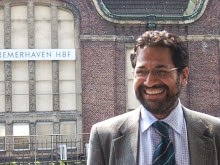
The announcement's finally be made. I wrote about Obama's ambassadorial pick for India and what the might mean for bilateral relations last month... You can access that story here.
Update: Alyssa Ayres and Thomas McLarty have a useful op-ed on Roemer up at forbes.com (June 1, 2009)
29 May 2009


26 May 2009
Only diplomacy can reverse North Korea’s nuclear status
 Given the impact a nuclear Korean peninsula will have on Japan and the rest of Asia, Beijing and Washington have an incentive to formulate a joint approach towards DPRK...
27 May 2009
The Hindu
Only diplomacy can reverse North Korea’s nuclear status
Given the impact a nuclear Korean peninsula will have on Japan and the rest of Asia, Beijing and Washington have an incentive to formulate a joint approach towards DPRK.
Siddharth Varadarajan
In the politics of international brinkmanship, nothing succeeds like failure or the fact that the world thinks one has failed.
The more Western analysts and governments sought to deride North Korea’s ability to develop and deliver weapons of mass destruction, the greater was the determination of the “Korean masses” to demonstrate the robustness of their Beloved Leader’s “deterrent”. On Monday, Kim Jong Il’s nuclear scientists delivered a bomb that was considerably bigger than the 0.5 kilotonne yield they produced in 2006 but small enough to fit on the warhead of a missile.
The United States has condemned Pyongyang for brazenly defying the resolutions of the UN Security Council and India has described the test as a violation of North Korea’s international commitments. Both these comments are slightly off the mark. North Korea has indeed defied the UN, but one may question the right of the Security Council to single out a country for censure when eight others already possess nuclear weapons, including three that are, like Pyongyang, not party to the Nuclear Non-proliferation Treaty. As for violating its own commitments, North Korea, unlike India, never announced a test moratorium.
That said, the latest test is a provocative, desperate act that will increase tension in East Asia. North Korea’s leaders are also guilty of violating good sense and reason in believing nuclear weapons will make them more secure. But condemning Kim Jong Il and his comrades is easy. Figuring out the right diplomatic strategy to deal with the fall-out is more difficult. The UNSC condemned North Korea in April after a rocket launch. That condemnation drew an explicit threat from Pyongyang that it would be “compelled to take additional self-defensive measures … includ(ing) nuclear tests”. The North Koreans have now delivered on that threat. Next will be the resumption of fissile material production. If the world’s powers want to stop this needless escalation, it’s time to take the Democratic Peoples Republic of Korea, as the country is formally called, seriously.
Bill Clinton had the right approach when he finalized the Agreed Framework with North Korea during his presidency in 1994. Unfortunately, George W. Bush undermined and scuttled that agreement by falsely accusing the DPRK of running a hidden uranium enrichment programme. The U.S. scrambled to recover lost ground when North Korea activated its withdrawal from the NPT but the groundless imposition of financial sanctions again queered the pitch. Finally, in October 2006, thanks to the ineptitude of the Bush administration’s diplomacy, a nuclearised North Korea was foisted on the world.
The nuclear test of 2006 had a very low yield and was variously described as a “dud” and a “fizzle”. However, once the Comprehensive Test Ban Treaty Organisation (CTBTO) detected noble gases, thereby confirming the non-conventional nature of the explosion, the world should have realized the world’s ninth nuclear weapon state had arrived. But that never happened. Careless handling of the situation has allowed North Korea to now refine its weapon design and solve whatever “technological difficulties” it experienced in 2006.
Regardless of what one thinks of nuclear weapons and the states that have them, possession is nine-tenths of the law. And the laws of deterrence, diplomacy and realpolitik meant Pyongyang could no longer be treated the way it had been before 2006. Once it went nuclear, the DPRK became as much of a threat to international peace and security as the other eight nuclearised states. However, the U.S. managed to persuade the UN Security Council to single out North Korea and imposed sanctions on it. To be sure, the Six Party Talks were also revived around a new framework with Chinese assistance but U.S. leaders and military commanders, not to speak of their allies in Japan, still viewed the DPRK with condescension and even contempt.
As part of the verification process agreed to in the Six Party Talks in 2007, North Korea declared a modest plutonium stockpile of 37 kilos. On a visit to Pyongyang in February 2009, the American academic, Selig Harrison, was told that this plutonium had already been “weaponised” and would not be available for inspection, disablement or even denuclearisation until the wider issue of U.S.-North Korea relations was settled satisfactorily. Depending on design and yield, 37 kilos of Pu translates into anything from five to 10 nuclear bombs. Despite this reality, the U.S. continued to regard the DPRK as a non-nuclear weapon state. In the run up to its recent “satellite” launch, for example, Japanese and American officials and analysts openly spoke about their “right” to shoot down the North Korean rocket. Such threats are never bandied about so casually while speaking of a nuclear adversary.
For a state looking to protect itself from the threat of aggression and externally-induced regime change, this continuous ridicule meant only one thing: keep testing your nuclear weapons and missiles till the world is ready to take you seriously.
The explosive yield of Monday’s nuclear test – which showed up at 4.7 on the Richter scale at monitoring stations around the world – should decisively settle the debate over North Korean technological capabilities in the WMD field. And even if the “satellite” the DPRK sought to launch never made it to orbit, the fact remains that the Taepodong-2 rocket it used succeeded in hitting an impact area in the Pacific Ocean more than 2,000 miles away exactly as planned.
For both the U.S. and China, the North Korean problem is something that cannot be ignored because its denouement could affect the strategic choices Japan and the wider Asian region takes. As a recent Congressional Research Service report notes, the nuclear status of the Korean peninsula will be a key factor in any future debate in Japan over that country’s non-nuclear status. “Any eventual reunification of the Korean Peninsula could further induce Japan to reconsider its nuclear stance,” the February 2009 report titled Japan’s Nuclear Future noted. “If the two Koreas unify while North Korea still holds nuclear weapons and the new state opts to keep a nuclear arsenal, Japan may face a different calculation,” it said, citing some Japanese analysts as describing a nuclear-armed unified Korea as “more of a threat than a nuclear-armed North Korea.”
With an eye on Japanese doubts about the credibility of U.S. extended deterrence in the wake of the 2006 North Korean test, Condoleezza Rice, who was Secretary of State at the time, stressed America’s “will and capability to meet the full range, and I underscore full range, of its deterrence and security commitments to Japan”. But unlike China, which would see a nuclearised Japan as an unmitigated strategic nightmare, Washington’s concerns vis-à-vis Tokyo are a by-product of its relations with Beijing. For some hawks on the fringe of the American debate, for example, a nuclear Japan could serve as a welcome pressure point on a China that is rapidly modernizing its armed forces. Other, more mainstream hawks believe the North Korean tests represent the failure of diplomacy and advocate greater coercion and even military pressure on Pyongyang to roll back its programme. Both of these approaches are foolish, especially given the renewed focus in Washington on Sino-U.S. cooperation.
In his Prague speech earlier this month, President Barack Obama used overly muscular language against the DPRK but all he achieved was another nuclear test. Today, there is no reason to believe louder condemnation and tougher sanctions by the Security Council will produce a different outcome.
There are two reasons to believe diplomacy will work. For one, China has a major incentive to bring the DPRK back into the dialogue process. Second, for all its petulance and irrationality, North Korea is the only nuclear weapon state that has expressed a willingness to give up its weapons in the context of regional denuclearisation. Israel refuses to even entertain such a bargain and India and Pakistan will not abandon their weapons till the Big Five are ready to do so. If the stalemate persists, the DPRK may well abandon the goal of a denuclearised Korean peninsula, thereby triggering a wider arms race. Instead of that outcome, the international community needs to act with restraint, avoid coercive steps and work towards reviving the Six Party Talks process. Which, at the end of the day, is still the only roadmap the world has for a peaceful resolution of the problem.
24 May 2009
Manmohan must be bold on Pakistan
 The more India delays the resumption of dialogue, the better it is for the Taliban and all those who want the peace process to fail...
 25 May 2009
The Hindu
Manmohan must be bold on Pakistan
The more India delays the resumption of dialogue, the better it is for the Taliban and all those who want the peace process to fail.
Siddharth Varadarajan
Fresh from his election victory, Prime Minister Manmohan Singh needs to move quickly and decisively to break the logjam in India’s relations with Pakistan.
In the wake of last November’s terrorist attacks on Mumbai, the government suspended the composite dialogue process and placed its armed forces on high alert. The military establishment in Pakistan, which was perhaps never fully comfortable with the direction in which the peace process with India had gone over the past few years, took advantage of the situation to move its forces to the border and generate international concern about the danger of war. The crisis coincided with the transition to the Obama presidency and tension between the two neighbours fitted in nicely with the notion of an extended AfPakInd zone in need of stabilization.
India fought off the idea of explicit linkage between Kashmir and Afghanistan but that does not free New Delhi from the responsibility of trying to shape the strategic choices Pakistan faces on both its western and Indian frontiers.
Dr. Singh and his foreign policy team – especially Foreign Secretary Shiv Shankar Menon and National Security Advisor M.K. Narayanan – did well in the days immediately after the Mumbai attack to temper India’s response. The Prime Minister correctly analysed the fractured and transitional nature of Pakistan’s polity and came up with the policy of ‘flexible containment’ in order to isolate those sections of the establishment across the border who were the most unremittingly hostile towards India. With others, the idea was to try and have business as usual.
This policy was fine in theory except for the fact that the principal step India took in this direction –suspension of the composite dialogue – did little to “contain” the threat posed by jihadi terrorism and their backers in the Pakistani military establishment.
There has been some progress on the Pakistani side on the two demands raised by India – arrest and prosecution of the Mumbai conspirators, and the dismantling of the infrastructure of terror – but mainly because of international and internal pressure on Islamabad and not out of a longing to go back to the dialogue with India. And today, in the face of this reality, Indian policy has begun to drift in the direction of containment of a more general kind. Pakistani journalists were not given visas to cover the Indian elections, an absurd decision by any yardstick. Trade across the Line of Control and Wagah is booming and officials on both sides need to discuss what can be done to facilitate and expand border commerce. But because the composite dialogue remains suspended, no forward movement is possible, not even on issues which are unambiguously in India’s interest.
Nor is there clarity on how serious India is about its two immediate goals. How else can one explain the unconscionable delay in correcting the equally unconscionable mix-up in DNA samples that New Delhi handed over in March of the Mumbai attack terrorists? Or the fact that two weeks were wasted for no reason in handing Ajmal Kasab’s confessional statement to the Pakistani authorities despite the trial court granting permission for this on May 2? As for the demand for dismantling the infrastructure of terror, the Indian side has no clear metric on the basis of which such a demand can be deemed to have been fulfilled. “We will know when they have done it and they will know that we know” is what senior Indian officials say when pressed on this point.
Let us be clear that India’s two demands are just and there can be no resiling from them. Its current approach, too, has much to commend it. But the Prime Minister needs to ask if flexible containment might soon start producing diminishing returns and if so, whether it is time to switch to a policy of flexible engagement.
A policy of flexible engagement would involve four elements.
First, resumption of dialogue on all non-Kashmir issues such as trade and Sir Creek coupled with reversion to the liberal visa regime for Pakistani opinionmakers, activists, businesspersons etc.
Second, the Kashmir component of the dialogue too can be revived immediately provided the Government of Pakistan is in a position to tell India that all domestic stakeholders are willing to claim ownership over whatever has been achieved in the back-channel discussions between Dr. Singh and former President Pervez Musharraf.
Third, India should express its willingness to add other subjects as standalone components of the dialogue such as integrated water management – an emerging concern in Pakistan – once the requisite bilateral confidence has been built up on the terrorism front.
Fourth, a bilateral dialogue on Afghanistan could also be considered to allay concerns in Pakistan and India about each other’s intentions.
Is the Zardari-Gilani set-up in Pakistan in a position to deliver positive outcomes to India on terrorism and other issues? There are reasons to believe it might be. For one, the fact that Islamabad never exploited the Indian delays in the handing over of evidence to justify derailing the Mumbai investigation surely counts for something, as do the arrests it made. Second, the military action against the Taliban in Buner and Swat appears finally to have turned into a genuine attack on the terrorists rather than the phony war it seemed all these weeks. Islamabad may still not fully change course on anti-India terrorism but Dr. Singh will lose nothing by trying a new approach. He will also take away from the Pakistani military the one argument they have used to resist fully committing themselves to the fight against the Taliban and al-Qaeda: that India remains hostile to the idea of peace.
The key element in this entire scheme is speed. The longer Dr. Singh delays the switch from flexible containment to engagement, the harder it will be to get off the treadmill to nowhere we are currently on.
The perpetrators of Mumbai, whoever they were, did not want Pakistan to be at peace with India. Let them not have their way.
19 May 2009
Humility in victory, introspection in defeat
 If the Congress party needs to guard against the triumphalist revival of ‘Congress culture’, both the Left and the Bharatiya Janata Party must also re-evaluate their political strategy...
 19 May 2009
The Hindu
Humility in victory, introspection in defeat
If the Congress party needs to guard against the triumphalist revival of ‘Congress culture’, both the Left and the Bharatiya Janata Party must also re-evaluate their political strategy.
Siddharth Varadarajan
With the poorly conceived, programmatically agnostic Third Front promising little more than political instability and the Bharatiya Janata Party standing for greater social turmoil and division, the victory of the Congress is a vote for calm, centrist stability of the kind the country has not seen for more than two decades. That voters have attached a premium to both the formation of a stable government and to the pursuit of social-democratic policies should come as no surprise given the spectres of economic hardship, terrorist violence and communal polarization that haunt our collective psyche today. The only irony is that the Left and the Congress, whose partnership for four out of the past five years provided the United Progressive Alliance both the aura of stability and the caché of populism, should have ended up such bitter rivals.
In the run up to the general election, the coming together of major challenges like the world financial crisis, the implosion of Pakistan and the rising tide of religious intolerance within India and the region had shifted the matrix of rational policy in such a manner that the issues on which the Left and Congress had parted company last year made no sense at all to voters in 2009.
On most issues of consequence, domestic and foreign, the distance between centrist and leftist policy was getting eroded. Having resisted the National Rural Employment Guarantee scheme when activists first mooted the idea in 2004, the Congress took it up seriously only after the Left parties made it a priority. Even then, conservative elements within the ruling establishment like Montek Singh Ahluwalia of the Planning Commission remained skeptical and sought to limit the central government’s fiscal commitment to it. Only when the economic slowdown hit India in 2008 -- and the importance of NREGA as both a politically convenient safety net for the poor and an accelerator-multiplier to kickstart the economy became apparent -- did the Congress make its implementation a priority. The Congress may have been a late and even reluctant convert; but what matters finally is that the party and Left ended up on the same page.
On other economic matters which divided the Congress and Left like financial sector liberalization, the fact that the Indian banking and insurance sectors were insulated from the global turmoil which felled giants like AIG and Lehman Brothers provided a further basis for the two sides to speak the same broad language.
Instead of celebrating the return of the social-democratic paradigm and using this to leverage a further shift away from neoliberal dogma, however, the Left found itself holding the can on the one free-market policy its rural support base viscerally opposed: land acquisition. If nationally, the CPI(M) and its allies were pilloried for a leftism that was largely declaratory, the Left Front paid the price in its bastion of West Bengal for the “rightism” of its policies that allowed Mamata Banerjee to emerge as a defender of the peasantry’s right to till the soil.
Consider the irony: the Left broke with the Congress because it felt the latter had deviated from the Common Minimum Programme of 2004. But in 2009 it allied itself to a diverse set of political parties without any programme other than the desire to establish a “non-Congress, non-BJP” government. So it was that the Left found itself at election time with allies like the Telugu Desam Party, the All-India Anna Dravida Kazhagam, Biju Janata Dal and Bahujan Samaj Party – groups that had no interest in pushing the direction of national economic policy one way or the other and which had all, in recent times, been closely associated with the BJP and its communal politics. This programmatic dilution of the ‘Third Front’ allowed the grouping to look strong on paper even thought it was devoid of any political ballast.
But even this might not have proved fatal except for another factor: As a result of its break with the Congress over an issue that was not so decisive to the direction of Indian foreign policy in the long run – the nuclear deal – the Left facilitated the creation of a coalition that went on to storm the seemingly impregnable red fortress of Bengal.
To be sure, there were and are valid reasons for the Communist Party of India (Marxist) to have wanted to build a Third Front. But its failure to articulate a positive pro-people programme around which such a front could be established rendered the exercise electorally and politically futile. As it looks towards rebuilding itself in Kerala and Bengal and enlarging its prospects as a genuinely national alternative, the Left will have to be self-critical about its preference for conjuring up expedient top-down coalitions rather than organic, bottom-up alliances based on the kind of struggles and movements the communists know best. Unless it does so, the parliamentary communist movement will find itself increasingly squeezed by Maoist extremism on the left and the electoral machine of ‘bourgeois’ parties on the right against which it cannot easily compete.
If the Left needs to introspect, what of the BJP, which paid the price for believing that the Indian voter would prefer divisiveness and strife to the comforting anchor of centrism?
The rot in the party runs so deep that it cannot be reversed by the resignation of L.K. Advani. The very fact that its spokesmen thought Narendra Modi’s name would generate a wave in favour of the BJP despite the Supreme Court ordering a probe into his role in the 2002 mass killing of Muslims in Gujarat shows the extent to which they are out of touch with the pulse of the country. But since the party did relatively better in Gujarat and Karnataka, especially the coastal region where Christians, Muslims and ‘’immoral’’ Hindus have been targeted by the sangh parivar, it is possible the RSS will conclude that religious polarization is a good electoral strategy for the BJP to pursue. If this is the direction the party takes, its capacity to generate tension and insecurity in civil society will increase even if its national political prospects continue to remain dim.
As for the Congress, the party needs to guard against the hubris that usually accompanies the kind of dramatic, unexpected victory it has just received.
The INC defeated the Left fair and square but must realize its success owes more to the social-democratic elements of its economic policies than to the ‘reforms’ the party’s more affluent backers espouse. Second, vanquishing the politics the BJP stands for requires more than electoral success. The socio-economic and administrative support structures on which the politics of communalism thrives need to be dismantled through careful, sensitive intervention. The party must resist the old Congress way of pandering to identity politics as a low-cost way of doing the right thing by India’s diverse electorate. India’s Muslims, for example, want equal opportunities and justice, not the banning of a book or the expulsion of a Taslima Nasreen. Providing these will involve taking on entrenched interests and attitudes, especially in the police and administration, something the Congress has always shied away from doing.
Finally, the re-election of the UPA must not be seen as a license to indulge in the ‘Congress culture’ of the past. The public got a glimpse of that culture when some leaders started pushing for Rahul Gandhi to be made Prime Minister as soon as the scale of the party’s victory became apparent. Sonia Gandhi did well to nip these demands in the bud. If she can go further by pensioning off entrenched interests and democratizing the functioning of the party’s leadership, the Congress will be better placed to meet the expectations of those who have voted for it.
18 May 2009
Watch me on the new government's challenges @ CNN-IBN
 I took part in an interesting hour-long discussion on CNN-IBN last night with Kapil Sibal and Lord Meghnad Desai on the new government's challenges. We spoke about the economy, reform, Pakistan, Obama and the problems of intenal security. The anchor was Karan Thapar and the video can be watched online here.
17 May 2009
Left is out but UPA foreign policy may not swing right
 The world is not what it was when Left parties withdrew support...
 17 May 2009
The Hindu
Left is out but UPA foreign policy may not swing right
The world is not what it was when Left parties withdrew support
Siddharth Varadarajan
New Delhi: The support of the Left parties for four out of the five years of the United Progressive Alliance government may have been a constraint on the foreign policy of Prime Minister Manmohan Singh but the impressive victory registered by the Congress in the 2009 election will not necessarily lead to major realignments on the external front.
For, if the Indian political terrain has shifted decisively against the Left, the world too is not what it was when the Communist parties withdrew their support from the UPA last August over the India-U.S. nuclear deal. The victory of Barack Obama in the United States, the onset of the severest global financial crisis since the Great Depression and the implosion in Pakistan have made the international environment much more complicated. Even if there has been no fundamental change in the hegemonic impulses driving big power politics in Asia and the world, the certitudes and equations of the Bush era do not obtain in the same neat manner as before.
Until last year, the Left was worried about India getting co-opted into an American strategy of containing China; today, it is the Indian strategic elites who worry about Washington’s Beijing policy and the prospect of a loose condominium between the world’s biggest powers.
What this fear of 'G-2' or 'Chimerica' will mean for India’s U.S. policy is not clear. The American side still wants to ramp up military-to-military relations. And its top two priorities in this regard are defence sales especially fighter aircraft — and the rapid conclusion of a Logistics Supply Agreement allowing U.S. forces in the region easier access to Indian facilities. The Left had opposed the LSA and other agreements on end-use verification but sections of the Indian defence establishment also have their reservations. Will the possibility of an American strategic understanding with China, unlikely though it seems — nudge the UPA government towards a closer military embrace with the U.S.? Or will it make New Delhi more wary? The decimation of the Left removes a political obstacle for the Congress but does not decisively settle this dilemma either way.
The other big foreign policy challenge the new government will have to confront is the fallout from the triangular dynamics between the U.S., Iran and Israel. The Obama administration is pushing for a tightening of sanctions but if the U.N. Security Council does not oblige, New Delhi’s cooperation with a unilateral blockade will be sought. How India will respond, especially in the face of Tel Aviv’s rejection of the peace process with Palestine is an open question.
On Pakistan, the victory of the Congress will make a calibrated easing of bilateral tension more likely. The Manmohan Singh strategy of flexible containment is anyway based on the recognition that not all stakeholders in Pakistan have the same attitude towards India as the military and ISI. Seeking creative ways of resuming the dialogue process while maintaining bilateral and international pressure on Islamabad on terrorism will likely be one of the first priorities of the new foreign policy team in South Block.
The resurgence of the DMK in Tamil Nadu means Sri Lanka will continue to remain a foreign policy challenge for the UPA. Indeed, the imminent elimination of the LTTE is only going to increase the pressure on New Delhi to be more proactive in safeguarding the legitimate rights and aspirations of the Sri Lankan Tamils. Nepal will also have to be a top priority. Much as the Maoists there resent New Delhi’s failure to back civilian supremacy over the military in its northern neighbour, the defeat of the BJP means the danger of an even more dramatic return to the past is over.
14 May 2009
The nuclear deal cannot be reopened
Renegotiation is not desirable, even if it were an option. But the next government can always decide not to buy American reactors if it doesn’t like the terms on offer...
A preview of my next piece...
The nuclear deal cannot be reopened
Renegotiation is not desirable, even if it were an option. But the next government can always decide not to buy American reactors if it doesn’t like the terms on offer.
Siddharth Varadarajan
In the course of the election campaign, several leaders from L.K. Advani and Yashwant Sinha of the Bharatiya Janata Party to Prakash Karat of the Communist Party of India (Marxist) and even Pranab Mukherji of the Congress have spoken of ''reworking'', ''not implementing'' or ''reexamining'' the nuclear deal with the United States.
In an interview last week to Sheela Bhatt of rediff.com, Mr. Sinha, a former external affairs minister, said, ''I believe we should not implement the nuclear deal at all… I am saying do not take those steps required to implement the deal like changing domestic laws''. His party’s prime ministerial candidate told the Indian Express that international agreements ''are normally not scrapped only because of a change of government''. But since the BJP “always regarded national
security as a prime consideration'', the party would ''review'' and ''examine'' the agreement to ensure it did not ''put constraints on our strategic autonomy'' if it were to form the next government.
As for the Left, Mr. Karat told Karan Thapar on CNN-IBN on May 11 that a government of which it was a part would seek to rework the nuclear deal. Despite the signs of indifference and even hostility on nuclear matters emanating these days from the White House and the Democratic party in general, the CPI(M) leader expressed his optimism about India extracting a better deal if the ‘123 agreement’ were to be reworked. ''I think with a Democratic administration, Obama administration, we can talk about reworking this deal''. The Left parties ''look with expectation to President Obama'', he said, adding that ''the understanding which was there with President Bush got this agreement through. I think there'll be no serious problems with the new administration if we can get things reworked… I think the Democratic
administration will be prepared to at least open up and discuss what we want done''.
On his part Mr. Mukherjee provided yet another straw in the wind. Asked by NDTV on May 7 whether a future Congress-led government might ''relook''' the nuclear deal if the Left insisted on such a step as a condition for support, he was noncommittal. ''I'm neither ruling out nor saying that it is possible'', he said.
The problem with the election-eve rhetoric on renegotiation is that the ''nuclear deal'' refers not to a single document or text but to a complex set of undertakings and commitments by India and the international community of which the bilateral agreement on civil nuclear cooperation with the U.S. is just one part.
Of these, the most important element is clearly the 45-nation Nuclear Suppliers Group’s decision last September to lift its export ban on India. Of course, that exemption would not have been possible without what preceded it: the July 2005 Indo-U.S. agreement, the Indian separation plan, the Hyde Act passed by the U.S. Congress in December 2006, the ‘123 agreement’ between New Delhi and Washington and, finally, the approval of the India-specific safeguards agreement by the International Atomic Energy Agency last August.
Some of these initial steps cannot be reversed without jeopardizing the NSG exemption but some are today quite irrelevant. If India were openly to renege on its separation plan, for example, and not offer up for safeguards in a phased manner the reactors it said would be designated civilian, this might prompt some members of the NSG to seek withdrawal of the exemption. An Indian nuclear test might also trigger such a move, though the 45 countries that make up the NSG’s membership would have to agree unanimously to terminate cooperation. But an Indian failure to purchase equipment from the U.S. under the ‘123 agreement’ will have no direct bearing on the wider edifice of nuclear cooperation that has been erected.
Even as far as India’s sovereign commitments go, it is not as if a future government will have no leeway other than abrogation or non-implementation. For example, the Indian safeguards agreement is very clear on the manner in which the separation plan is to be implemented. Only when lifetime fuel supply arrangements are concluded to India’s satisfaction will the individual civilian reactors be expected to go under safeguards. If such arrangements cannot be made for one reason or another, no additional reactor needs to be safeguarded. But the country could still buy fuel from abroad for those reactors which were safeguarded from before like Tarapur and
RAPS, something it was unable to do prior to last year’s NSG exemption.
The election rhetoric also obscures the fact that what is popularly called the “nuclear deal” is in fact several deals now – with the U.S., of course, but also with Russia, France and Kazakhstan. And that these deals do not come with a uniform set of rules. Individual supplier nations have their own laws, some less onerous than others, for the supply of nuclear equipment and material. And it is entirely up to India to decide where it wants to send its business. Reactor deals with France and Russia are already at an advanced stage of implementation. Uranium supplies have also been tied up with France, Russia and Kazakhstan. There is little sense in seeking to “rework” or “renegotiate” these agreements.
With the U.S., however, a considerable about of diplomatic, commercial and legislative legwork remains before bilateral nuclear cooperation can actually begin. Reprocessing arrangements have yet to be concluded and American companies want India’s liability laws amended. On reprocessing, it is highly unlikely that the Obama administration will accommodate Indian concerns and agree to dilute the unacceptable positions the Bush administration took. Even if a satisfactory text emerges, a future government in New Delhi might still have legitimate concerns about the differences in interpretation the two countries have on the meaning of key sections of the 123 agreement. Reworking these will be a political and diplomatic impossibility. A much easier option would be to simply resolve not to spend the Indian taxpayer’s money on American nuclear equipment.
This is the ultimate option for India if it has reservations about the final contours of bilateral civil nuclear commerce with the U.S. And the option is best exercised quietly, with dignity and decorum, rather than by seeking to renegotiate a deal whose wider geographical benefits India has no reason to complain about or compromise.
A preview of my next piece...
The nuclear deal cannot be reopened
Renegotiation is not desirable, even if it were an option. But the next government can always decide not to buy American reactors if it doesn’t like the terms on offer.
Siddharth Varadarajan
In the course of the election campaign, several leaders from L.K. Advani and Yashwant Sinha of the Bharatiya Janata Party to Prakash Karat of the Communist Party of India (Marxist) and even Pranab Mukherji of the Congress have spoken of ''reworking'', ''not implementing'' or ''reexamining'' the nuclear deal with the United States.
In an interview last week to Sheela Bhatt of rediff.com, Mr. Sinha, a former external affairs minister, said, ''I believe we should not implement the nuclear deal at all… I am saying do not take those steps required to implement the deal like changing domestic laws''. His party’s prime ministerial candidate told the Indian Express that international agreements ''are normally not scrapped only because of a change of government''. But since the BJP “always regarded national
security as a prime consideration'', the party would ''review'' and ''examine'' the agreement to ensure it did not ''put constraints on our strategic autonomy'' if it were to form the next government.
As for the Left, Mr. Karat told Karan Thapar on CNN-IBN on May 11 that a government of which it was a part would seek to rework the nuclear deal. Despite the signs of indifference and even hostility on nuclear matters emanating these days from the White House and the Democratic party in general, the CPI(M) leader expressed his optimism about India extracting a better deal if the ‘123 agreement’ were to be reworked. ''I think with a Democratic administration, Obama administration, we can talk about reworking this deal''. The Left parties ''look with expectation to President Obama'', he said, adding that ''the understanding which was there with President Bush got this agreement through. I think there'll be no serious problems with the new administration if we can get things reworked… I think the Democratic
administration will be prepared to at least open up and discuss what we want done''.
On his part Mr. Mukherjee provided yet another straw in the wind. Asked by NDTV on May 7 whether a future Congress-led government might ''relook''' the nuclear deal if the Left insisted on such a step as a condition for support, he was noncommittal. ''I'm neither ruling out nor saying that it is possible'', he said.
The problem with the election-eve rhetoric on renegotiation is that the ''nuclear deal'' refers not to a single document or text but to a complex set of undertakings and commitments by India and the international community of which the bilateral agreement on civil nuclear cooperation with the U.S. is just one part.
Of these, the most important element is clearly the 45-nation Nuclear Suppliers Group’s decision last September to lift its export ban on India. Of course, that exemption would not have been possible without what preceded it: the July 2005 Indo-U.S. agreement, the Indian separation plan, the Hyde Act passed by the U.S. Congress in December 2006, the ‘123 agreement’ between New Delhi and Washington and, finally, the approval of the India-specific safeguards agreement by the International Atomic Energy Agency last August.
Some of these initial steps cannot be reversed without jeopardizing the NSG exemption but some are today quite irrelevant. If India were openly to renege on its separation plan, for example, and not offer up for safeguards in a phased manner the reactors it said would be designated civilian, this might prompt some members of the NSG to seek withdrawal of the exemption. An Indian nuclear test might also trigger such a move, though the 45 countries that make up the NSG’s membership would have to agree unanimously to terminate cooperation. But an Indian failure to purchase equipment from the U.S. under the ‘123 agreement’ will have no direct bearing on the wider edifice of nuclear cooperation that has been erected.
Even as far as India’s sovereign commitments go, it is not as if a future government will have no leeway other than abrogation or non-implementation. For example, the Indian safeguards agreement is very clear on the manner in which the separation plan is to be implemented. Only when lifetime fuel supply arrangements are concluded to India’s satisfaction will the individual civilian reactors be expected to go under safeguards. If such arrangements cannot be made for one reason or another, no additional reactor needs to be safeguarded. But the country could still buy fuel from abroad for those reactors which were safeguarded from before like Tarapur and
RAPS, something it was unable to do prior to last year’s NSG exemption.
The election rhetoric also obscures the fact that what is popularly called the “nuclear deal” is in fact several deals now – with the U.S., of course, but also with Russia, France and Kazakhstan. And that these deals do not come with a uniform set of rules. Individual supplier nations have their own laws, some less onerous than others, for the supply of nuclear equipment and material. And it is entirely up to India to decide where it wants to send its business. Reactor deals with France and Russia are already at an advanced stage of implementation. Uranium supplies have also been tied up with France, Russia and Kazakhstan. There is little sense in seeking to “rework” or “renegotiate” these agreements.
With the U.S., however, a considerable about of diplomatic, commercial and legislative legwork remains before bilateral nuclear cooperation can actually begin. Reprocessing arrangements have yet to be concluded and American companies want India’s liability laws amended. On reprocessing, it is highly unlikely that the Obama administration will accommodate Indian concerns and agree to dilute the unacceptable positions the Bush administration took. Even if a satisfactory text emerges, a future government in New Delhi might still have legitimate concerns about the differences in interpretation the two countries have on the meaning of key sections of the 123 agreement. Reworking these will be a political and diplomatic impossibility. A much easier option would be to simply resolve not to spend the Indian taxpayer’s money on American nuclear equipment.
This is the ultimate option for India if it has reservations about the final contours of bilateral civil nuclear commerce with the U.S. And the option is best exercised quietly, with dignity and decorum, rather than by seeking to renegotiate a deal whose wider geographical benefits India has no reason to complain about or compromise.
13 May 2009
Media ethics and the SIT report on Gujarat
.jpg) Reporters should be careful about claiming to have “access” to explosive confidential documents when all they might have are a few paragraphs selectively planted on them by vested interests. SIDDHARTH VARADARAJAN wonders why three weeks down the line the TOI reporter has not done more exclusives if indeed he had access to the report...
Reporters should be careful about claiming to have “access” to explosive confidential documents when all they might have are a few paragraphs selectively planted on them by vested interests. SIDDHARTH VARADARAJAN wonders why three weeks down the line the TOI reporter has not done more exclusives if indeed he had access to the report...13 May 2009
The Hoot
The Hoot
Media ethics and the SIT report on Gujarat
Siddharth Varadarajan
In the face of the Gujarat government’s persistent refusal to investigate and prosecute the most heinous crimes committed during the 2002 anti-Muslim riots in the state, the Supreme Court last year set up a Special Investigating Team to inquire into 14 specific incidents of mass violence. The decision followed a petition by the National Human Rights Commission, which had wanted the Central Bureau of Investigation to be given charge since the Gujarat police was clearly unable and unwilling to conduct an honest probe. Later, the Citizens for Justice Peace, an NGO led by Teesta Setalvad, also joined the case.
The SIT, headed by the respected former CBI director, R.K. Raghavan, but staffed by police officers drawn from the state force, submitted its report to the SC on March 2, 2009. The court treated the report as confidential since it was akin to a chargesheet. However, a copy was provided to the “accused”, i.e. the Gujarat government, as well as to Harish Salve, amicus curiae in the case. Gujarat was asked to submit its reply to the SIT’s findings on April 13. Meanwhile, based on its own investigations, the SIT began proceeding against functionaries of the Gujarat government and sangh parivar for their involvement in the riots such as Mayaben Kodnani, Jaideep Patel and senior police officers.
On April 13, Gujarat counsel Mukul Rohtagi provided the state government’s response to the SIT report before the court. Neither the SIT nor Mr. Raghavan made fresh submissions that day. As expected, the Gujarat government highlighted those aspects of the SIT’s findings which, it felt, showed the authorities in a relatively good light. Since the BJP state government had argued from day one that its handling of the violence was exemplary and that allegations of official complicity were the product of NGO bias, its counsel sought to portray the SIT report as an indictment not of the administration but of Ms. Setalvad and other activists. There was nothing unusual about this strategy. Petitioners and respondents often interpret or distort official documents to bolster their own case. But what was unusual was the manner in which a major newspaper, The Times of India, chose to report the day’s proceedings.
On April 14, its court reporter, Dhananjay Mohapatra, ran a sensational story quoting the SIT and Raghavan as accusing Ms. Setalvad and her NGO of “spicing up” the Gujarat riot incidents. The TOI also reported the SIT as saying she had “cooked up macabre tales of wanton killings”.
Mohapatra writes: “In a significant development, the SIT led by former CBI director R K Raghavan told the Supreme Court on Monday that the celebrated rights activist cooked up macabre tales of wanton killings. Many incidents of killings and violence were cooked up… and false witnesses were tutored to give evidence about imaginary incidents, the SIT said in a report submitted before [the court] ... Rohtagi also said that 22 witnesses, who had submitted identical affidavits before various courts relating to riot incidents, were questioned by the SIT which found that they had been tutored and handed over the affidavits by Setalvad and that they had not actually witnessed the riot incidents”. The TOI also said the SIT had found “no truth” in certain incidents “widely publicized by the NGOs” such as the gouging out of the foetus of a pregnant Muslim woman, Kausar Bano, and the dumping of bodies into a well by rioters at Naroda Patiya.
Let us be clear about what this report tells us. First, a series of claims is made about the purported contents of the SIT report. In this narrative, the SIT, far from indicting the rioters and their instigators as the Supreme Court had mandated them to do, is arguing that many incidents never happened and that the witnesses providing evidence are all unreliable. Second, a distinct but false impression is created that the source of these astonishing claims is the SIT head, Raghavan, who, the reporter asserts, “told the Supreme Court on Monday” all of the things that he then goes on to state as fact.
The reality is that neither the SIT nor Mr. Raghavan made any submission on April 13. That the Gujarat counsel is likely the source for the purported contents of the SIT report is made clear by the fact that the only attributed quotations in the story belong to Mr. Rohtagi. But since the respondent could hardly be considered an objective, the reporter chose to slur over this fact.
As expected, within hours of the story appearing, the blogosphere and about how the Gujarat government had been unfairly maligned all these years. Even a liberal columnist like Pratap Bhanu Mehta jumped the gun with an instant op-ed attacking not just Ms. Setalvad but all “secular interlocutors”. In a flash, a report that actually formed the basis for the indictment of a sitting minister in the Modi government got converted into an indictment of “secularists” and NGOs in general!
Though Mr. Rohtagi cannot be faulted for spinning the story on behalf of his clients, the episode underlines the need for reporters and editors to be careful about the use of selective leaks from a motivated source. When Ms. Setalvad noted that the SIT had made no fresh submission on April 13 and that the paper had gone by what the Gujarat government argued in court, the TOI editors were gracious enough to publish her rebuttal. However, the waters were further muddied by the reporter’s counter-claim that his original story was based on the findings of the SIT and that even though the report was confidential, “the TOI has access to the report”.
In order to prove this “access”, the reporter quoted sentences from four pages. The essence of these quotes were (1) that some witnesses had brought written statements which turned out to be at variance with what they subsequently deposed before the investigating officer, and (2) that a particular police officer had not been derelict in his duty during the riots as the activists had alleged. But the evidence offered only amounted to a watered down version of two of the less significant claims he had originally made. And he offered no quotations from the SIT report to buttress his more sensational allegations.
I have no way of knowing whether Mohapatra’s claims in these two instances are accurate or not. But what is strange is that a reporter who has access to a document that is brimming with information about the Gujarat riots and its executioners found nothing newsworthy other than the purported allegations about Ms. Setalvad. Even assuming those allegations are an accurate summary of what the SIT has written – and there are reasons to doubt this is the case – it speaks volumes for the reporter’s news sense that this is all he bothered to report. It is as if a defence correspondent “has access” to the still classified Henderson-Brooke report on the 1962 war and does an exclusive story not on its contents and main findings about who was responsible for India’s defeat but on the role of a minor ‘villain’.
Even if the reporter made a judgment call and chose to highlight the Setalvad matter on day one, surely, he would have come across other material worth reporting on subsequent days? It is rumoured, for example, that the SIT report takes a contrary view to the Banerjee committee’s finding on the Godhra incident of February 27, 2002 that the train fire was the result of an accident and not a fire. But despite having “access”, even this crucial angle was not explored. Three weeks on, the fact that the reporter has not provided further details of the contents suggests either that he no longer “has access” to the full report, or, more likely, never had access to the full report in the first place other than the bits and pieces conveniently made available by interested parties.
The authors of this selective leaking thought a planted story would destroy the credibility of the Gujarat government’s critics but the strategy has not worked. The Supreme Court has criticized the motivated, distorted leak of a confidential document and said it will not allow anyone to derail its investigation. The fact that the court has now asked the SIT to probe serious charges against Mr. Modi and more than 60 influential Sangh Parivar leaders and state officials and given the Team a supervisory role in the riot case prosecutions is a timely reminder of the fact that it is the administration of Gujarat that is in the dock and not those who are insisting that justice be done.
12 May 2009
The Prachanda Interview Pt. II: ‘The perception that Nepal is tilting to China is exaggerated’
 The Maoists want an integrated Nepal army to be loyal to the state, not their own party, insists Prime Minister Prachanda in the second and final part of his interview to me in Kathmandu...
12 May 2009
The Hindu
‘The perception that Nepal is tilting to China is exaggerated’
The Maoists want an integrated Nepal army to be loyal to the state, not their own party, insists Prime Minister Prachanda.
Siddharth Varadarajan
Kathmandu: Hours after Nepal’s Prime Minister resigned last week on the question of civilian supremacy over the army, a videotape of a speech he made to PLA combatants 18 months ago was leaked to the media. The aim was to discredit Prachanda since the speech showed him boasting about how the Maoists would eventually take over the Nepal Army. In the second and concluding part of his interview to The Hindu, the Maoist leader explains the contents of that speech, his party’s understanding of army integration and India’s fears about a ‘China tilt’ in Nepali policy. Excerpts:
Why should the generals and political parties not be afraid of integrating the Peoples Liberation Army cadres in the Nepal Army? In your leaked speech of January 2, 2008, you said unit-wise integration is good because “that way our units will remain with us.” Doesn’t this formulation create danger of a state within state? If some units are loyal to one party after integration, this will create a problem, won’t it?
First of all, we should not compare the integration process with the January 2008 speech. That was said in very different circumstances. There was uncertainty about whether elections would be held and I needed to boost the morale of my cadres. That cannot be compared to the current situation, after the election and formation of a government Secondly, as far as I understand the process of integration, only those cadres who are physically fit should be integrated in the army. And I think it would be preferable to have unit-wise integration. This is not because we want to remould the whole army according to the Maoist understanding. We want to integrate them. When Maoist cadres are taken [as individuals] into different battalions of the NA, they will take 3-4 years to be really integrated because the PLA cadre are not very professional. They are more political and ideological. And there is necessity of democratising the NA, because it has not been very democratic in its functioning and nature. Now, to do this in a planned way, it’s quite important to have separate units of the PLA coming under the NA’s direct command. Only then can they be really integrated.
So you don’t expect the former PLA units will remain loyal to your party after integration in the army?
They must be loyal to the state, to the government. We don’t have any confusion on this question.
The principle of civilian supremacy over the military cuts both ways. Tomorrow, a non-Maoist government might feel these former PLA units or officers are not loyal and may wish to act against them. Would that be acceptable to you?
Yes, this is acceptable to me. According to the constitution, the elected government can take action if they challenge civilian supremacy, if they challenge the decision of the government.
For example, by siding with your party…
Exactly. There is no confusion in my mind.
Your critics say the 30-year service rule is being applied to retire senior people in different fields as a way for the Maoists to capture the state.
This is wrong. The 30-year provision was there previously in the police. And we established it in the armed police and police. But we do not have the intention to apply it in the army, where the situation is quite different. Although there was a debate and discussion on this, I clearly stated my position, even in public, that in the army, the 30 year issue will not be applicable.
The Shaktikhor video has also created doubts about the size of the PLA. There you said, “We were at 7,000 to 8,000. If we had reported that, we would have had 4,000 left after verification. Instead we claimed 35,000 and now we have 20,000.” Don’t you think this admission makes the integration process more difficult?
No, I don’t think so
There is a demand for re-verification, for example.
That is not going to happen. We had two kinds of regular forces during the Peoples War: central and regional forces. Both were PLA cadres and 35,000 was the combined figure. What I said in the videotape was about the central force, whose number was 7-8,000 at that time. The regional forces were near about 25-27,000. During the peace process, regional and central forces were merged and taken into cantonments. And they were scaled down to 20,000. In fact, during the Peoples War, we also had a militia of irregulars, 65-70,000 strong. We wanted them to be integrated or rehabilitated as well but the government and all major political parties did not agree because the state would not be able to handle such a big force. So it was suggested that this militia should be changed into a political organization. In this way the Young Communist League (YCL) emerged.
In your interview to The Hindu in April 2008, you said you wanted to convert the YCL into a development-oriented organisation. But we haven’t heard much about that, and again, there are allegations of criminal activities by the YCL.
The YCL has changed from a political to a social and development organisation. There is also a lot of exaggeration about the activities of the YCL; all the positive things they are doing in the development and social sector are not covered by the media. The media only reports things when something bad is done by an individual connected to the YCL. And in those incidents where members are involved, we are taking action against them.
Maoist cadres have targeted the media in the past — there was the attack on Himal Khabarpatrika, for example. Can you assure us the party will not tolerate such acts?
We are in favour of freedom of the press. But even in democratic countries and old democratic parties there will always be some incidents. In the Himal incident, some of our workers were involved. But I took the initiative and brought them into police custody.
India played a positive role in the peace process and the transformation of Nepal to a republic. But now, it appears as if there is distrust between the Maoist leadership and the Indian government. Why?
Because there has been a very mechanical and subjective analysis of the situation by the Indian side. Especially on the question of the so-called tilt to China. With the Indian political leadership busy with elections, security and bureaucratic officials are perhaps driving policy. And a highly exaggerated perception exists about what is
going on here.
Indian officials say a huge number of Chinese delegation have visited Nepal recently. And they wonder why your defence minister paid a “secret visit” to China.
This is also baseless. Last year, because of the Tibet situation, the Chinese side got more sensitive about Tibet-related activities going on in Nepal. I would like to say clearly that not a single delegation came to Nepal on my invitation. The initiative came solely from the Chinese side. As for this “secret visit” of our defence minister, that was no “secret” at all. It was also not much of a “visit.” Some of our ministers went to Tatopani near the border during Deepavali. From there, they crossed the border and went to Khasa and spent the night. Everybody from Kathmandu wants to go to Tatopani and sometimes stay in Khasa to shop.
There are also apprehensions on the updated Nepal-China friendship treaty being negotiated. Do you intend to hold wider consultations on this before proceeding?
Time and again I have proposed that we should have continuous discussion, so that we can clear any confusion. We have a very specific type of relation with India — an open border, history, culture. When I was in Delhi, I tried to explain why our relations are unique. With China, we have our own specific nature of relations — because of the Himalayan range. One should not confuse this issue. As for the treaty, there is still so much discussion to be held between the parties here. Nothing is going to be signed in a hurry. Certainly, I was not going to sign anything during the trip I had scheduled to Beijing before this crisis.
The Indian side says the Maoists send mixed signals. When you came to Delhi, you spoke of 10,000 MW joint hydroelectric projects, an East-West railway. But at the Kharipati party convention in December, existing projects like Arun-III were called a manifestation of “Indian expansionism.”
There is no confusion. I don’t know what kinds of documents India received from Kharipati. There was serious discussion and debate on different issues and it is possible someone has seen different documents and taken them to be the final ones. If there are such references, in my assessment that was not the final document. There are different documents and maybe some tendency inside the party [to look at things that way] but in the final document a more pragmatic conclusion is there. I stand by my position that the east-west railway is very important for us, and without India it cannot be fulfilled. I have talked about the Chisapani project. I am in favour of having those kinds of megaprojects with India’s cooperation, although in some issues, like Pancheshwar on the Mahakali, there is serious confusion among the masses here. Unless we clear this, it is difficult to go ahead there. But on Karnali, there is no problem from our side. (Concluded)
11 May 2009
The Prachanda Interview Pt. I: ‘India should have defended civilian supremacy in Nepal’
Allowing the military chief to prevail today will condemn the country to a fate similar to Pakistan, says Nepal’s Prime Minister, Prachanda...
11 May 2009
The Hindu
‘India should have defended civilian supremacy in Nepal’
Allowing the military chief to prevail today will condemn the country to a fate similar to Pakistan, says Nepal’s Prime Minister, Prachanda.
Siddharth Varadarajan
Kathmandu: In an interview on the circumstances leading to the dismissal of his country’s army chief and his own subsequent resignation, Prime Minister Prachanda of Nepal tells The Hindu the Maoists will prefer to sit in the opposition rather than see the authority of a democratically elected government undermined. Excerpts:
Controversy has surrounded your decision to sack General Rookmangad Katawal as army chief. He had defied civilian authority since December on the recruitment issue but was going to retire soon. Why precipitate a political crisis when his tenure was ending anyway?
When the question of recruitment came, we knew what was at stake was the Comprehensive Peace Agreement and its implementation. So we discussed the issue within government and also tried to convince other political parties that this man is trying to challenge civilian supremacy. That this is a question of principle — either we assert civilian supremacy or army supremacy will get established. A serious debate took place with different political parties and ultimately, I acted because the other major political party in the government besides the Maoists — the United Marxist-Leninists — agreed to take action against Katawal. It is only then that I asked some questions of the army chief and tried to take action against him.
Who were the UML leaders who agreed with this?
Top central leaders like [Jhalanath] Khanal, [Ishwar] Pokharel and Bam Dev Gautam agreed that Katawal is always trying to challenge the elected government and that this will create a very bad situation in the coming days and therefore we should take some action. And when UML leadership agreed, I also discussed with the leadership of the Madhesi Forum (MJF). They too agreed to go ahead. Today, the MJF is sticking to its position but the UML reversed itself later on.
In the cabinet, when it became clear that UML was no longer on board, why did you feel it necessary to go ahead with the dismissal, knowing it would trigger a major crisis?
Because it is a question of principle, it is a question of making history in this country. If we surrender to this army chief or to army supremacy, this will create a very big problem in coming days. Therefore, we preferred to stand firmly. Even if I should have to resign from the government, I must establish civilian supremacy in Nepal.
So you were looking at the experience of Pakistan?
Exactly, we discussed here what happened in Pakistan, and how in India, civilian supremacy has been established from 1947 up to this time.
And that is the model you wanted to follow for Nepal?
Exactly, I discussed this question with different political leaders, that we have to learn from the experience of India in this issue, not Pakistan.
But India went along with President Ram Baran Yadav’s decision to rescind the cabinet order and reinstate the general. Did that disappoint you?
Well, we expected that India would take a consistent position in favour of civilian supremacy because of its own traditions and because it had supported the struggle for democracy here. In fact, I want to make it clear that before taking any action against Katawal, I told the Indian Ambassador, Rakesh Sood, that if it is possible, could you please send a message that I want to have a serious discussion on this issue and if either the foreign secretary or some other senior person can come here to talk. We knew some confusion is there between the Maoist-led government and India on this question. I wanted to settle this issue through interaction and discussion with high-level officials from Delhi. But unfortunately, the ambassador informed me that this cannot happen now because the election campaign is going on, that nobody is there, that it is very difficult.
So you wanted the Indian leadership to be on board before you took action against Katawal?
Exactly.
But they say you promised you would not act without wide consultations, and that you didn’t stick to that assurance.
Let me clarify. When the question of this army chief was in debate, right from the beginning of the recruitment issue last December, I tried to consult with different stakeholders, even with Indian officials, that this man is not comfortable with the peace process, not comfortable with civilian supremacy. And, therefore, I want to take some action against him. So the debate was there, just after the recruitment issue came. They said, yes, but it is not good to take action now, let him go in the natural way. But these negative things continued. Even then, before taking action, I had said I would consult with the different political parties. And there were 15 days of consultations.
Some people say the change in the UML’s position was the result of Indian pressure. Do you agree?
That would be going too far. Inside UML there was a heavy pressure for the leadership and maybe some sorts of pressure from Delhi also.
The media is speculating that the Maoists had reached out to Lt. General Kul Bahadur Khadka, that you wanted him as army chief because of some understanding. What is the truth?
All these rumours are baseless and completely wrong. We see no difference between Khadka or Chattra Man Singh Gurung or other generals. Our concern is with Katawal, who is acting against civilian supremacy. And we tried to convince other political parties, and even some members of the international community, that we don’t have any preference that Khadka should be the next chief. He is second in command and when we take action against the chief, the second will naturally come. But we did not have any hidden agenda or hidden interaction with Khadka.
And there was no plan to give him an extension, since has only a few weeks to go till retirement?
No. In fact, we made him acting chief. If we wanted to make him chief in that way for an extended period, we would not have made him only acting chief in our cabinet decision. So he was to be acting chief and we were open to discuss about the chief [after his retirement] — to either make Gurung or some other general. Some people think we are trying to manipulate Khadka in favour of the Maiosts. These baseless rumours are meant to confuse the people.
Why was the army recruitment issue so important for you? And what was the need to deny an extension to the eight brigadiers as recommended by Gen. Katawal? I am told many of them were highly competent, professional officers.
It was agreed that there should be no recruitment by the Nepal Army or Peoples Liberation Army until integration and rehabilitation of the PLA is complete. In fact, the UN wrote a letter to us saying the proposed army recruitment should be stopped as it violates the CPA. After this, we wrote to Katawal saying it should be stopped. But he defied us. As for the brigadiers, there have been so many instances in the past when an officer’s tenure ended and extension was not given. So this time too, in the case of the eight brigadiers who had reached the end of their tenure, we felt that to address change, to give opportunity to new officers, we should do this. And not only in the army but in the police, 10-11 officers were not given extension. If I don’t give opportunity to new officers, the old status quo will be maintained, it will not be consistent with the movement for change.
Some of your leaders have said that unless Katawal’s reinstatement is revoked, the Maoist bloc will not allow the Constituent Assembly to function. Wouldn’t that be an irresponsible thing to do?
We believe the president should correct his extraconstitutional action and we are not going to disrupt the CA functioning for the time being. Previously, the Nepali Congress had disturbed the functioning of parliament on the issue of the chief and in a counterattack we are also stopping it because NC taught us to do these kind of activities! But we are not going to have a continuous kind of programme like that, we will let the CA function and elect the government.
So you are not going to stand in the way?
No.
And can you rejoin government?
We will not be part of the government if the president does not correct his instruction on Katawal.
Could a possible compromise be restoring the status quo ante before the dismissal but with the CA passing a resolution firmly establishing the principle that the civilian government alone has the right to take decisions about the military and not the president?
On the issue of the principle, we will agree with that kind of proposal. But right now, in the process of forming the government, it is not possible to form an agreement on that line. We will be in the opposition in that situation.
Do you feel the Maoists will gain electorally in the future by staying in the opposition now?
We haven’t thought of the next election, we are thinking about civilian supremacy. If we go into opposition, it will mainly be for civilian supremacy. The Maoists struggled hard for a CA when others were against it, we fought hard for a Republic and now for civilian supremacy. People will ask why other parties are silent, how come only the Maoists are fighting for this. The image of the party has gone up in the hearts and minds of the people. This is our victory.
(Tomorrow: Prachanda on India’s fears about China, and the problem of integrating Maoist combatants into the Nepal army.)
11 May 2009
The Hindu
‘India should have defended civilian supremacy in Nepal’
Allowing the military chief to prevail today will condemn the country to a fate similar to Pakistan, says Nepal’s Prime Minister, Prachanda.
Siddharth Varadarajan
Kathmandu: In an interview on the circumstances leading to the dismissal of his country’s army chief and his own subsequent resignation, Prime Minister Prachanda of Nepal tells The Hindu the Maoists will prefer to sit in the opposition rather than see the authority of a democratically elected government undermined. Excerpts:
Controversy has surrounded your decision to sack General Rookmangad Katawal as army chief. He had defied civilian authority since December on the recruitment issue but was going to retire soon. Why precipitate a political crisis when his tenure was ending anyway?
When the question of recruitment came, we knew what was at stake was the Comprehensive Peace Agreement and its implementation. So we discussed the issue within government and also tried to convince other political parties that this man is trying to challenge civilian supremacy. That this is a question of principle — either we assert civilian supremacy or army supremacy will get established. A serious debate took place with different political parties and ultimately, I acted because the other major political party in the government besides the Maoists — the United Marxist-Leninists — agreed to take action against Katawal. It is only then that I asked some questions of the army chief and tried to take action against him.
Who were the UML leaders who agreed with this?
Top central leaders like [Jhalanath] Khanal, [Ishwar] Pokharel and Bam Dev Gautam agreed that Katawal is always trying to challenge the elected government and that this will create a very bad situation in the coming days and therefore we should take some action. And when UML leadership agreed, I also discussed with the leadership of the Madhesi Forum (MJF). They too agreed to go ahead. Today, the MJF is sticking to its position but the UML reversed itself later on.
In the cabinet, when it became clear that UML was no longer on board, why did you feel it necessary to go ahead with the dismissal, knowing it would trigger a major crisis?
Because it is a question of principle, it is a question of making history in this country. If we surrender to this army chief or to army supremacy, this will create a very big problem in coming days. Therefore, we preferred to stand firmly. Even if I should have to resign from the government, I must establish civilian supremacy in Nepal.
So you were looking at the experience of Pakistan?
Exactly, we discussed here what happened in Pakistan, and how in India, civilian supremacy has been established from 1947 up to this time.
And that is the model you wanted to follow for Nepal?
Exactly, I discussed this question with different political leaders, that we have to learn from the experience of India in this issue, not Pakistan.
But India went along with President Ram Baran Yadav’s decision to rescind the cabinet order and reinstate the general. Did that disappoint you?
Well, we expected that India would take a consistent position in favour of civilian supremacy because of its own traditions and because it had supported the struggle for democracy here. In fact, I want to make it clear that before taking any action against Katawal, I told the Indian Ambassador, Rakesh Sood, that if it is possible, could you please send a message that I want to have a serious discussion on this issue and if either the foreign secretary or some other senior person can come here to talk. We knew some confusion is there between the Maoist-led government and India on this question. I wanted to settle this issue through interaction and discussion with high-level officials from Delhi. But unfortunately, the ambassador informed me that this cannot happen now because the election campaign is going on, that nobody is there, that it is very difficult.
So you wanted the Indian leadership to be on board before you took action against Katawal?
Exactly.
But they say you promised you would not act without wide consultations, and that you didn’t stick to that assurance.
Let me clarify. When the question of this army chief was in debate, right from the beginning of the recruitment issue last December, I tried to consult with different stakeholders, even with Indian officials, that this man is not comfortable with the peace process, not comfortable with civilian supremacy. And, therefore, I want to take some action against him. So the debate was there, just after the recruitment issue came. They said, yes, but it is not good to take action now, let him go in the natural way. But these negative things continued. Even then, before taking action, I had said I would consult with the different political parties. And there were 15 days of consultations.
Some people say the change in the UML’s position was the result of Indian pressure. Do you agree?
That would be going too far. Inside UML there was a heavy pressure for the leadership and maybe some sorts of pressure from Delhi also.
The media is speculating that the Maoists had reached out to Lt. General Kul Bahadur Khadka, that you wanted him as army chief because of some understanding. What is the truth?
All these rumours are baseless and completely wrong. We see no difference between Khadka or Chattra Man Singh Gurung or other generals. Our concern is with Katawal, who is acting against civilian supremacy. And we tried to convince other political parties, and even some members of the international community, that we don’t have any preference that Khadka should be the next chief. He is second in command and when we take action against the chief, the second will naturally come. But we did not have any hidden agenda or hidden interaction with Khadka.
And there was no plan to give him an extension, since has only a few weeks to go till retirement?
No. In fact, we made him acting chief. If we wanted to make him chief in that way for an extended period, we would not have made him only acting chief in our cabinet decision. So he was to be acting chief and we were open to discuss about the chief [after his retirement] — to either make Gurung or some other general. Some people think we are trying to manipulate Khadka in favour of the Maiosts. These baseless rumours are meant to confuse the people.
Why was the army recruitment issue so important for you? And what was the need to deny an extension to the eight brigadiers as recommended by Gen. Katawal? I am told many of them were highly competent, professional officers.
It was agreed that there should be no recruitment by the Nepal Army or Peoples Liberation Army until integration and rehabilitation of the PLA is complete. In fact, the UN wrote a letter to us saying the proposed army recruitment should be stopped as it violates the CPA. After this, we wrote to Katawal saying it should be stopped. But he defied us. As for the brigadiers, there have been so many instances in the past when an officer’s tenure ended and extension was not given. So this time too, in the case of the eight brigadiers who had reached the end of their tenure, we felt that to address change, to give opportunity to new officers, we should do this. And not only in the army but in the police, 10-11 officers were not given extension. If I don’t give opportunity to new officers, the old status quo will be maintained, it will not be consistent with the movement for change.
Some of your leaders have said that unless Katawal’s reinstatement is revoked, the Maoist bloc will not allow the Constituent Assembly to function. Wouldn’t that be an irresponsible thing to do?
We believe the president should correct his extraconstitutional action and we are not going to disrupt the CA functioning for the time being. Previously, the Nepali Congress had disturbed the functioning of parliament on the issue of the chief and in a counterattack we are also stopping it because NC taught us to do these kind of activities! But we are not going to have a continuous kind of programme like that, we will let the CA function and elect the government.
So you are not going to stand in the way?
No.
And can you rejoin government?
We will not be part of the government if the president does not correct his instruction on Katawal.
Could a possible compromise be restoring the status quo ante before the dismissal but with the CA passing a resolution firmly establishing the principle that the civilian government alone has the right to take decisions about the military and not the president?
On the issue of the principle, we will agree with that kind of proposal. But right now, in the process of forming the government, it is not possible to form an agreement on that line. We will be in the opposition in that situation.
Do you feel the Maoists will gain electorally in the future by staying in the opposition now?
We haven’t thought of the next election, we are thinking about civilian supremacy. If we go into opposition, it will mainly be for civilian supremacy. The Maoists struggled hard for a CA when others were against it, we fought hard for a Republic and now for civilian supremacy. People will ask why other parties are silent, how come only the Maoists are fighting for this. The image of the party has gone up in the hearts and minds of the people. This is our victory.
(Tomorrow: Prachanda on India’s fears about China, and the problem of integrating Maoist combatants into the Nepal army.)
Delhi missed chance to resolve Nepal crisis
Maoists will not block new government, says Prachanda in an interview to The Hindu...
11 May 2009
The Hindu
Delhi missed chance to resolve Nepal crisis
Siddharth Varadarajan
Kathmandu: As the Maoist-led government in Nepal moved towards dismissing Army chief Rookmangad Katawal in the beginning of May, Prime Minister Prachanda sent an urgent message to India seeking the presence here of a high-level envoy to help forge an eleventh hour political consensus affirming civilian supremacy over the military.
Revealing this in an interview to The Hindu at his official Baluwatar residence on Sunday, Mr. Prachanda said he asked Ambassador Rakesh Sood to request New Delhi to send Foreign Secretary Shiv Shankar Menon or some other senior official for talks on the increasingly tense standoff over the Army chief. With quiet encouragement from India, parties like the United Marxist-Leninist were changing their stand and siding with the general. “We knew some confusion is there between the Maoist-led government and India on this question,” said the Prime Minister.
“I wanted to settle this issue through interaction and discussion with high-level officials from Delhi. But unfortunately, the ambassador informed me that this cannot happen now because the election campaign is going on, that nobody is there, that it is very difficult.”
Mr. Prachanda also said he believed the long election season in India meant the country’s security and bureaucratic establishment were now calling the shots on Nepal policy and that a “mechanical and subjective analysis” of the situation “especially on the question of Nepal’s so-called tilt to China” had coloured South Block’s perception of the civil-military issue.
The Nepalese Prime Minister acknowledged that several Chinese officials had visited Nepal in recent months but said “not a single delegation” had come on his invitation. “The initiative for these visits came solely from the Chinese side,” mainly because of the Tibet crisis.
He said his government had no intention of concluding a new friendship treaty with China without discussions among all Nepali political parties as well as with New Delhi.
Giving a glimpse of the strategy the Maoists will adopt in the face of the attempts by other parties to form a new government, Mr. Prachanda said his party would sit in opposition if President Ram Baran Yadav’s “extraconstitutional instruction” reinstating Gen. Katawal was not withdrawn.
11 May 2009
The Hindu
Delhi missed chance to resolve Nepal crisis
Siddharth Varadarajan
Kathmandu: As the Maoist-led government in Nepal moved towards dismissing Army chief Rookmangad Katawal in the beginning of May, Prime Minister Prachanda sent an urgent message to India seeking the presence here of a high-level envoy to help forge an eleventh hour political consensus affirming civilian supremacy over the military.
Revealing this in an interview to The Hindu at his official Baluwatar residence on Sunday, Mr. Prachanda said he asked Ambassador Rakesh Sood to request New Delhi to send Foreign Secretary Shiv Shankar Menon or some other senior official for talks on the increasingly tense standoff over the Army chief. With quiet encouragement from India, parties like the United Marxist-Leninist were changing their stand and siding with the general. “We knew some confusion is there between the Maoist-led government and India on this question,” said the Prime Minister.
“I wanted to settle this issue through interaction and discussion with high-level officials from Delhi. But unfortunately, the ambassador informed me that this cannot happen now because the election campaign is going on, that nobody is there, that it is very difficult.”
Mr. Prachanda also said he believed the long election season in India meant the country’s security and bureaucratic establishment were now calling the shots on Nepal policy and that a “mechanical and subjective analysis” of the situation “especially on the question of Nepal’s so-called tilt to China” had coloured South Block’s perception of the civil-military issue.
The Nepalese Prime Minister acknowledged that several Chinese officials had visited Nepal in recent months but said “not a single delegation” had come on his invitation. “The initiative for these visits came solely from the Chinese side,” mainly because of the Tibet crisis.
He said his government had no intention of concluding a new friendship treaty with China without discussions among all Nepali political parties as well as with New Delhi.
Giving a glimpse of the strategy the Maoists will adopt in the face of the attempts by other parties to form a new government, Mr. Prachanda said his party would sit in opposition if President Ram Baran Yadav’s “extraconstitutional instruction” reinstating Gen. Katawal was not withdrawn.
08 May 2009
Why India’s communists wield influence
 The Wall Street Journal Asia asked me to do a piece on why the Communists in India are such a key player in the national elections. Here's my two cents worth of analysis [and apologies in advance for the rather silly headline, for which the WSJ desk is entirely to blame!]...
8 May 2009
Wall Street Journal
OPINION ASIA
MAY 8, 2009
Indian Communist Chic
The Left Front stands to be a big electoral winner.
By SIDDHARTH VARADARAJAN
From Today's Wall Street Journal Asia.
At first blush it may seem a paradox to some that India, the world's largest democracy, is also home to one of the world's most politically influential Communist movements outside of China. But India's coalition of Communist parties, known as the Left Front, isn't disappearing any time soon. They may very well gain influence after the results of India's national election are announced May 16.
If they do, the Left Front could reshape Indian policy abroad as well as at home. The Communists can be expected to call for policies that India's elites, who aspire to greater liberalization of the economy and closer corporate and strategic ties with the U.S., may well find unpalatable. They might seek to slow down the pace of military-to-military and nuclear cooperation between the two countries. The Left Front would also want the government to build closer economic and political ties with Russia, China and perhaps even Iran.
The Left Front has gained power not so much because of the popularity of its program but because it has positioned itself as a kingmaker between India's two largest parties, the Congress Party of Prime Minister Manmohan Singh, and the right-wing Bharatiya Janata Party. Although the Left Front has never held more than 12% of seats in Parliament, it has wielded more influence over the past five years than ever before. In 2004, the support of the Left Front was crucial to the ability of Mr. Singh's Congress-led coalition to form a majority government. Today, Congress is wondering whether that scenario might repeat itself this year.
Because of this dynamic, the Left Front could gain in influence in this election even if they win fewer seats in parliament than their current 64. Aware of their own strength as powerbrokers, the Communists have moved aggressively to capitalize on it. On the eve of the election, they resurrected a loose coalition of leftist and regional parties known as the Third Front to present voters with a viable national alternative to the two big players. The group is disparate in terms of leaders and ideologies, but it is expected to perform well in states like Andhra Pradesh, Orissa, Tamil Nadu and Uttar Pradesh.
If the BJP were to do extremely well in this election, the Left Front might play little or no role in government. But in a best-case scenario for the Left, if the Third Front does well it might well become a magnet for regional parties previously allied with one of the major parties. With coherent national policies and several decades of administrative experience in Bengal and Kerala, the Communists are a logical pole toward which regional players can gravitate. And if the Communists are the single largest formation within the front, they might even stake claim to lead the new government. The front-runner under such a scenario would be Buddhadeb Bhattacharya, the leader of the Communist Party of India (Marxist) who, as chief minister of West Bengal, is, paradoxically, seen as an investor-friendly administrator.
Part of the reason India's Communists have been able to remain relevant is the long-term decline in the electoral fortunes of the Congress and the BJP. Its policies too have appeal. While parties like the BJP inflame religious passions for political ends, the Left is seen as a consistent defender of minority rights and secular values. As the economy slows down in the face of worldwide recession, the Communists are also credited with saving India from a worse fate by blocking Congress efforts at banking and insurance deregulation and strongly rooting for an employment guarantee scheme for millions of poor families in the countryside.
The Communists' ideological pragmatism has also contributed to their political success. Whatever the Communists might say in Delhi about the evils of economic reform, their state-level governments have tended to be pro-business. In Bengal, for example, the Marxist-led government of Mr. Bhattacharya came under fire from human-rights activists, Maoists and leftist intellectuals for attempting compulsorily to acquire land from peasants on behalf of large corporate investors like the Tatas.
The Communists are not unstoppable, though. The problem for the Left is that the pragmatism which makes them such an important player in the superstructure of Indian politics is also eroding their traditional support among workers and peasants at the base. The Marxist party's emphasis on parliamentary politics and top-down coalition building has not helped it to expand its influence nationally. As the party and its allies vacate the space for "revolutionary" politics, Maoist insurgents have moved in to fill the void, establishing a strong presence in nearly 20% of the country's districts. In Bengal and Kerala, unpopular policies -- including those that smack of the "neoliberalism" the comrades excoriate -- are likely to produce setbacks for the Communists in the present election. In the long run, these trends might well lead to their permanent weakening as a parliamentary force.
Yet in 2004, the two biggest national parties together polled fewer than half of all votes cast, the first time this had ever happened in countrywide polling. The story this time is not likely to be very different. The Communists, therefore, are going to remain a force to be reckoned with, at least for this election cycle and in the future too.
Mr. Varadarajan is associate editor of the Hindu in New Delhi.
07 May 2009
India’s Nepal policy in disarray
 By going along with the undemocratic machinations of the Nepal army brass, New Delhi is undermining the peace and stability it helped to bring about in South Asia’s newest republic...
 7 May 2009
The Hindu
India’s Nepal policy in disarray
By going along with the undemocratic machinations of the Nepal army brass, New Delhi is undermining the peace and stability it helped to bring about in South Asia’s newest republic.
Siddharth Varadarajan
After siding with General Rookmangad Katawal in his brazen defiance of the civilian government in Kathmandu, India has predictably washed its hands of the consequences by claiming “what is happening in Nepal is internal to Nepal.” The reality is that South Block is up to its neck in the crisis that has emerged there and India is likely to suffer the consequences if the imbalance in civil-military relations that has been recklessly introduced in yet another part of South Asia is not corrected quickly and amicably and the peace process unravels.
Indian officials acknowledge interceding on Gen. Katawal’s behalf as the confrontation between the Nepal Army chief and the elected government began escalating last month. Even before the Maoists, who emerged as the single largest party in the Constituent Assembly last April, took charge of the coalition government, the army chief had placed himself on a collision course with the former rebels. However, despite him publicly opposing the integration of Maoist combatants in the NA — a key principle of the Comprehensive Peace Agreement which ended the nine-year civil war between the People’s Liberation Army and the state — the Maoists made it clear they had no objection to Gen. Katawal serving out his tenure so long as he recognised the supremacy of civilian authority. In reality, the army chief never respected this understanding. He remained firmly opposed to the democratisation of the army and did his best to scuttle integration.
Matters came to a head in recent weeks when he disobeyed specific orders from the government on matters central to the implementation of the CPA. For one, he went ahead with a drive to recruit new soldiers, a move calculated to stir trouble within the Maoists, whose combatants have been cooling their heels for more than two years in anticipation of their integration into the national army. He also defied the government by pushing to extend the tenure of eight senior officers.
With Pakistan and Bangladesh still suffering the consequences of khaki over-reach and New Delhi harbouring reservations about the ‘militarist’ mindset in Sri Lanka, one would have thought the last thing India should want for Nepal is an army that refuses to implement the orders of a duly constituted civilian authority. Yet India did little to get the NA to back off and focussed its entire efforts on urging Prime Minister Pushpa Kamal Dahal Prachanda to swallow the rank insubordination of the army brass. When the Maoist leader said he would strive for political consensus before taking the drastic step of dismissing Gen. Katawal, New Delhi queered the pitch by sending clear signals to parties like the Unified Marxists-Leninists and the Nepali Congress that they should oppose the Maoists.
The end result: the Cabinet went ahead and exercised its prerogative to replace the army chief, while the Unified Marxist-Leninists walked out, thereby reducing Prachanda’s government to a minority. At this stage, the President of Nepal, whose role as Commander in Chief is meant to be exercised strictly in accordance with Cabinet instructions, overstepped his constitutional authority and “reinstated” Gen. Katawal. As a result of which Prachanda took the moral high ground and resigned.
The exercise of presidential power in this manner violates what is a settled principle in democratic systems where parliament is sovereign. One only has to think of the consequences of what might have happened if Admiral Vishnu Bhagwat, who was unjustly sacked as Navy chief by the Vajpayee government in 1998, had been reinstated by President K.R. Narayanan over the objections of the Union Cabinet. Parliamentary systems often provide for the head of state to be commander in chief of the armed forces. But the head of state is not allowed to use that authority against the advice of a lawfully constituted government.
Even as they deny any involvement in the denouement of the crisis, Indian officials defend the actions of the Nepal President, Ram Baran Yadav, citing the lack of consensus within the governing coalition as reason enough for the dismissal order to be countermanded. South Block also believes that the Maoists were out to gain control of the NA and, thereby, turn Nepal into a “one-party state”, an allegation closely mirroring the arguments the Nepal army brass itself made in a recent presentation to defence attachés stationed in Kathmandu.
If replacing one 60-year-old Army veteran with another is all it takes for the Maoists to establish a monopoly over the instruments of force in Nepal, then the situation there is clearly much more fragile than anyone has ever imagined. The reality is far more prosaic. The Maoists are a divided house. Pragmatists like Prachanda, who led the transformation of the party, are under fire from hardliners who still command the loyalty of the PLA. The only way to resolve this tension is to implement the promise of integration so that the PLA no longer remains a standalone entity. Far from leading to the capture of the Nepal army, integration would essentially help complete the transformation of the Maoists into a purely political force. Which is why a responsible section of the Nepal brass sees some merit in this process; but not so Gen. Katawal or his backers inside and outside the country.
In any democracy governed by a multi-party coalition, the principal check against the biggest coalition member taking unilateral decisions is the assembly of legislators. No doubt the Maoists acted hastily, perhaps even irresponsibly, in allowing the current crisis to come to a head. After all, Gen. Katawal is due to retire three months from now. The Nepali Congress and the UML argue that the hurry was prompted by the fact that Lt General Kul Bahadur Khadka, the army’s second in command who is said to take a more benign view of integrating the PLA than Gen. Katawal, has just four weeks to retire. And once he does, Lt. Gen. Chhatra Man Singh Gurung, an officer in the traditional conservative mould, would become army chief upon the retirement of Gen. Katawal. Though rumours about the individual inclination of these top officers have been swirling around Kathmandu for weeks, the three generals made a joint appearance on television on April 30 to emphasise their unity.
In defence of their action dismissing the army chief, the Maoists say the issue at stake was not the fate of this particular army chief but the principle of civilian control. Allowing Gen. Katawal to get away with his defiance of the government would set a bad precedent for his successors. And in a fragile democracy emerging from a conflict in which the army had been the principal agent of the monarchy, such an unhealthy tendency had to be nipped in the bud.
As a coalition itself, the Manmohan Singh government is not unaware of the checks and balances that Parliament as an institution provides. The Congress went ahead and concluded the nuclear deal despite knowing it had just lost its majority but when opposition leaders met the President to complain, they were politely told it was up to Parliament to reject or accept what the Prime Minister had done. A vote of confidence was convened which Dr. Singh duly won. Similarly, in Nepal, the forum to undo the Maoists’ decision to dismiss the army chief was the CA. The UML could have moved a vote of no-confidence and, if Prachanda was unable to win support from other quarters, his government would have been voted out. A new government would then have been formed which could have immediately reversed the dismissal order. This is the way a democracy would have functioned. There was no need to resort to extra-constitutional manoeuvring, certainly not in order to defend an army chief who clearly has no respect for the boundaries of his authority.
By involving itself in this unseemly process, New Delhi has sacrificed the prospects of long-term democratic stability in Nepal for the short-term satisfaction of undermining the Maoists. That India played a signal role in helping the Maoists make the transition from a guerrilla force to parliamentary party in the first place only shows the extent to which the authorities here seem to lack a consistent or coherent approach towards their northern neighbour. Earlier, in the midst of Jan Andolan II in April 2006, New Delhi sent Karan Singh on an ill-advised mission to see if the monarchy could somehow be saved. And now, again, it has erred in backing the military over the civilian side. For the present, an all-party national government without the Maoists can easily be formed. But the crucial task of integrating the PLA with the Nepal Army will remain unfulfilled and this will slowly eat away at the innards of the peace process.
Obama administration wants India to sign NPT
 By linking the Fissile Material Cut-off Treaty to the goal of ending “arms race” in South Asia, Washington's key arms control negotiator waves another red rag in India's face...
 7 May 2009
The Hindu
Obama administration wants India to sign NPT
Siddharth Varadarajan
New Delhi: In a foretaste of the changing nuclear atmospherics emanating from Washington, a senior American envoy told an international conference on Tuesday that getting India to sign the non-proliferation treaty (NPT) “remains a fundamental objective of the United States.”
Signing the NPT would be tantamount to India giving up its nuclear weapons, a goal that Washington has not seriously pressed for nearly a decade.
Though the Bush administration didn’t explicitly abandon universal adherence to the treaty as an objective, the demand was never made that India sign the NPT, at least not after the landmark July 2005 Indo-U.S. nuclear agreement. Just prior to that, at the May 2005 Review Conference (RevCon) of state parties to the NPT, the U.S. said it “hope[d] countries still outside [the NPT] will join the Treaty, which they can do only as non-nuclear weapon states” but stopped short of naming any countries.
On May 5, however, Assistant Secretary of State for verification, compliance and implementation, Rose Gottemoeller, went full tilt in her prepared statement for the NPT prepcom for the 2010 RevCon, not just naming India but equating its status with Pakistan, Israel and North Korea. The fact that this was done without any reference to, or defence of, the India exception that Washington sought and achieved at the International Atomic Energy Agency and Nuclear Suppliers Group last year has raised eyebrows in New Delhi.
The central principle embodied in the July 2005 agreement was that India would indefinitely maintain unsafeguarded, non-civilian nuclear facilities.
Equally galling for New Delhi was the South Asian tilt Ms. Gottemoeller gave to the proposed Fissile Material Cut-off Treaty (FMCT). Such a treaty, she said, could help destabilising arms races in regions such as South Asia. India does not accept this regional linkage, preferring to see an international agreement banning the production of nuclear weapon-making material as a step in the direction of universal disarmament.
By way of contrast, the French statement at the same conference, which also spoke of universality, at least acknowledged the reality that India was abiding by non-proliferation norms. “Until [universal adherence] is completed, we must get now, through dialogue, India, Israel and Pakistan to come as close as possible to the international standards for non-proliferation and export control,” its ambassador said, adding, “Progress has been made in this direction, especially by India, but much effort remains to be done.”
In fairness to the Obama administration, the U.S. statement to the 2007 NPT prepcom also said it was important to reaffirm the importance of achieving universality of the NPT. But this theme did not figure anywhere in the American stand at the prepcom last year.
Taking President Barack Obama’s recent remarks in Prague on the Comprehensive Test Ban Treaty one step further, the U.S. envoy said that not only will American ratification be immediately and aggressively pursued but Washington will also launch a diplomatic effort to bring on board the other states whose ratifications are required for the treaty to enter into force.
India is among the handful of countries whose ratification is needed. The others include Pakistan, China and Iran.
Though the idea of India signing the NPT is absurd, Indian officials say it would not be wise to dismiss the latest American statement out of hand. Hundred days into the Obama administration, the absence of any public defence of the Indo-U.S. nuclear deal at an international forum suggests a lower level of commitment to the agreement than the Bush administration displayed. "The question is how does Mr. Obama come at India", a senior official told The Hindu. "If he is going to look at India through the NPT-non NPT prism, then there is a problem".
What also worries the Indian side is the impact the new U.S. attitude will have on other countries. "When the Americans start saying something, you can expect the international chorus to begin", the official said.
Though the heavy lifting on the nuclear deal has already been done, some loose ends still remain for India to deal with. The NSG, for example, is still considering a total ban on the sale of enrichment and reprocessing equipment for non-NPT signatories, something the exemption last year did not prohibit.
On Monday, the NSG troika of Germany, Hungary and South Africa will hold consultations with Indian officials in New Delhi, the first such meeting since the 45-nation cartel decided to allow nuclear commerce with India last September.
01 May 2009
Where silence prevails, justice will not
 Narendra Modi is unwilling to even apologise for the Gujarat massacres because neither religious India nor political India considers his involvement a liability...
2 May 2009
The Hindu
Where silence prevails, justice will not
Narendra Modi is unwilling to even apologise for the Gujarat massacres because neither religious India nor political India considers his involvement a liability.
Siddharth Varadarajan
When Aman Kachroo was murdered by fellow students in a distant medical college in Himachal Pradesh last month, some politicians tried to appropriate his death to the narrative of forcible displacement that Kashmiri Pandits were subjected to by terrorist violence in the 1990s. Had the valley’s Hindus not felt compelled to flee, they argued, young Aman might well have studied in Srinagar, where the academic and social culture would not have allowed such wanton violence to be visited on a student in the name of “ragging”. Despite his death reflecting this invisible dimension of the larger tragedy of exile, however, the Kachroo family asked the politicians to back off. Aman died not because he was a Kashmiri Pandit or because the community was in exile but because of the insensitivity of the educational and law enforcement systems of the country. And his family was determined to make sure the lessons are learned and such tragedies never repeated.
The Kachroo family’s dignity and steadfastness reminded me of a meeting I had in September 2003 with a delegation of Kashmiri Pandits from the Hindu Welfare Society of Kashmir. They wanted something to be done to enable the community to return to their homeland without fear. Apart from official indifference, what angered the Pandits was the manner in which “Hindu” politicians had tried to exploit their plight. ''Since 1990, groups like the VHP and RSS have played politics with the fate of the Hindus of Kashmir,'' Sanjay Tickoo, a young Pandit from Srinagar, told me. ''Riots were organised in Gujarat in our name. But tell me, what do the poor Muslims of Gujarat have to do with our plight?'', he asked.
That conversation – and the heartfelt manner in which one set of victims was attempting to reach out to another -- moved me so much, I wrote about it at the time. And I bring it up again now because of a recent statement by Sri Sri Ravishankar on the condition of relief camps run by the Sri Lankan government for Tamil refugees displaced by the war against the LTTE in the Vanni. These camps, he said, had better facilities than “those the Indian Government has provided for the Kashmiri pandits and those provided for Sri Lankan Tamils in Tamil Nadu.”
For Ravishankar to draw a parallel with Indian camps for Lankan refugees was entirely appropriate. I also applaud him for reminding us of the terrible conditions in which thousands of Pandits, who are now entering the 20th year of their displacement, are forced to live in camps in Jammu. But I must confess to feeling bad that Sri Sri, who is one of India’s most influential godmen, missed an opportunity to prick our conscience by remembering the callousness of the Indian authorities towards other internally displaced persons like the Muslims of Gujarat or the Christians in the Kandhamal district of Orissa. During the 2002 riots, the Gujarat government played no role whatsoever in setting up relief camps for the victims. Even today, an unconscionable number of Muslim IDPs there eke out a living under the most parlous of circumstances. And in Orissa, impoverished Christians who want to return to their villages are unable to do so because of the demand by Hindu missionaries that they first give up their faith.
Like the Pandits, the Muslims and Christians have also been forgotten by all of us. Ravishankar missed an opportunity to build collective awareness and empathy towards the three groups who are all victims of the Indian state’s indifference.
This omission of Muslims and Christians from the story of displacement is, I believe, not accidental or innocent. It is of a piece with the new age guru’s elliptical moral orbit which appears to be drawing him closer and closer to the sangh parivar. One manifestation of this is his pronouncement on various topics like the Babri Masjid. Another is the warning issued to his Art of Living foundation by the Election Commission that its Mantranaad programme in Gujarat not be misused to lend political support to any political party during the ongoing election. The warning was sent following a complaint by the Congress which alleged the foundation was backing the Bharatiya Janata Party. But the omission is also symptomatic of a wider silence maintained by most Hindu religious figures over the blatant distortion and misuse of their great religion by organizations like the RSS, Vishwa Hindu Parishad, Bajrang Dal, Ram Sene, Shiv Sena and BJP.
Whenever terrorist incidents suspected to be the handiwork of jihadi groups take place, dozens of Muslim clerics issue immediate statements of condemnation. It is a different matter that our media usually doesn’t bother to report these statements. But when the large-scale killing of Muslims was orchestrated in Gujarat in 2002 by organizations claiming allegiance to Hinduism with the backing of the state administration, hardly any Hindu religious preacher stood up to denounce the profaning of their faith by these politically motivated groups. And this in a region where the concept of ahimsa was born and took deep roots, and where the followers of influential preachers like Morari Bapu or Asaram Bapu or sects like the Swaminarayans run into millions.
Is there a connection between this silence and Gujarat Chief Minister Narendra Modi’s refusal to speak when he was asked by a persistent television reporter whether he intended to apologise to the country for the Gujarat killings in the same manner that the Congress party now had for the 1984 massacres? Mr. Modi first replied that he had already given many interviews. When the reporter asked what he meant, he kept silent. When the question of an apology was again raised, he remained silent and gestured for a glass of water. And he refused to utter a word on the subject. When those who are tasked by the almighty to introspect prefer the comforting shores of silence, why should a mere politician be any different?
Now we are told that the BJP will create a regular “consultative mechanism” with religious leaders if it comes to power. In a letter to “1,000 religious heads of all denominations”, the party’s prime ministerial candidate, L.K. Advani, said that a government he heads would “seek on a regular basis” their guidance “on major challenges and issues facing the nation”. Among the two names the BJP confirmed sending this letter to was Sri Sri Ravishankar. The other was Baba Ram Dev. Were such a “consultative mechanism” to ever get established, it is unlikely that the spiritual heads who stuck to their vow of silence during Gujarat or Orissa would remain tongue-tied. Apart from making a mockery of the constitutional separation of religion and state, as the Left parties and the Congress have pointed out, this mechanism could easily metamorphose into something truly malignant. As in Pakistan, where Sufi Mohammed has tasted the sweet blood of appeasement, the opinions of our seers on everything except the misuse of religion in politics will flow thick and fast.
When Mr. Advani was presented with a “lifetime achievement award” by NDTV in January, he was asked by Prannoy Roy what he considered his greatest accomplishment to be. The BJP leader said it was the rathyatra he led as part of the Ayodhya agitation. That agitation led to the demolition of the Babri masjid, an event that Mr. Advani had once described as the “saddest day” of his life. But when Prannoy asked what was the one thing he regretted about his life, he said it was the fact that he belonged to an occupation where so many of his peers were corrupt!
What explains Mr. Advani’s unwillingness to introspect over how his greatest accomplishment could have ended in that “saddest day”? Could his unwillingness be the product of our unwillingness to ask such questions? Everyone agrees that the presence of Jagdish Tytler at the scene of an attack on a gurudwara in 1984 is enough to render him ineligible for public office. And yet we do not regard the presence of senior BJP leaders at the scene of the mosque’s demolition or the burning of Gujarat as being enough to morally disqualify them for the job of Prime Minister. Is this because the Congress party has more of a conscience than that of the BJP? No. It is because influential sections of our society – corporate leaders, religious personalities, media commentators, strategic analysts and everyone else who is in the business of forming and influencing the groupthink that goes by the name of ‘public opinion’ in India – do not consider 1992 and 2002 as crimes on par with the 1984 genocide of the Sikhs.
Unless that changes, we can forget about apologies and remorse. As for justice, I’m not holding my breath.
Subscribe to:
Posts (Atom)