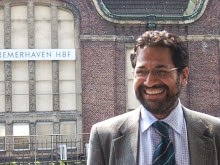
[All] hell broke lose when Ambassador Husain Haqqani came to the stage and urged the people also to listen to those who disagree with them.
“Stop pontificating (bhashan band karo),” shouted the audience.
“If this is how you treat your speakers, why do you invite them,” asked the ambassador. “If you invite people who differ with you on certain issue, you must also listen to them.”
But people were not in a mood to listen. Desperate and angry, the ambassador held the microphone tight and shouted: “Today you are insulting me but tomorrow when you need passports, you will come to me.”
This proved to be the proverbial straw that broke the camel’s back. People lunged to the stage. A lady doctor, Ghazala, tore the microphone away from the ambassador. Others tried to grab him but he evaded them.
“Listen to me. Let me explain. Please try to understand what I am saying,” the ambassador appealed. “We do not want to listen to you. Get out,” the audience shouted back.
This forced the US diplomatic security guards to intervene. They came to the stage to save the Pakistani ambassador from angry Pakistanis and took him away.
30 June 2008
If you're a diplomat, don't try this without supervision...
Hussain Haqqani, Pakistan's ambassador to the United States, was booted out of a meeting of Pakistani American doctors on Sunday. The docs were upset at a speaker from the MQM, whose party helped Musharraf disrupt the lawyers' movement in Karachi in May 2007. This is when Haqqani stepped in to try and pacify the gathering. The Dawn's account is hilarious. Here's the operative part:


A story too good to check
 Several Indian newspapers fell victim to a hoax about the arrest near Goa of a supposed Nazi war criminal named ‘Johann Bach’. Apart from the media’s alarming ignorance, the episode also reveals our fascination for unconfirmed news from “intelligence’ sources.
1 July 2008
The Hindu
Stories that are too good to check
Siddharth Varadarajan
On Sunday, an email message from ‘Hamman Smit’, press officer from ‘Perus Narpk’ from Shede Road in Berlin arrived in the inbox of several journalists in Goa and Bangalore. The message identified ‘Perus Narpk’ as the “intelligence wing of the German Chancellor’s core” (sic) and claimed credit for the arrest on the Karanataka-Goa border of a fugitive Nazi war criminal named Johann Bach who was responsible for the killing of 12,000 Jews in the ‘Marsha Tikash Whanaab’ concentration camp. The email contained a press release full of outlandish details about the operation, including the claim that the octogenarian Bach had revealed his identity to a holidaying Israeli couple during a rave party in Goa, and had stolen an 18th century piano from a museum in ‘East Berlin’ which he was trying to sell through a local newspaper.
The email was literally full of clues suggesting it was a hoax. The author revealed he was “hamming”, his office was on ‘Shady’ road and the rather un-Germanic ‘Perus Narpk’ was an anagram for ‘Super Prank’. Even if the journalists did not know there was no concentration camp with the name ‘Marsha Tikash Whanaab’, a quick search on the Internet might have at least triggered a warning light. And yet, a number of hacks and their editors rushed to print with this sensational story without bothering to check any of its hilarious details.
The Telegraph ran the story on Monday under the headline ‘Goa piano ‘thief’ found to be Nazi war fugitive’. It quoted “Intelligence Bureau officials” saying that Mr. Bach had come to India via Argentina, Bulgaria and Canada. The story was accompanied by a world map showing how Mr Bach criss-crosed the world before ending up in Goa. The word ‘unconfirmed’ was inserted parenthetically next to Yemen, suggesting that the newspaper had confirmed all other aspects of the story. And how was this terrible criminal caught? The newspaper provided this breathless account: “Goa’s beaches are frequented by young Israeli couples, most of them seeking leisure after a term of compulsory military service in their country. Bach, mistaking the couple for Americans, told them he had “managed” a Nazi concentration camp during the war. The German authorities put two and two together when they realised that the museum from where the piano was stolen was located close to a concentration camp in Berlin. They already knew that the camp was run by a young man named Bach, who was never caught after the war”.
The Indian Express went one step ahead of its competitors with an exclusive detail, noting in its headline that the ‘Nazi war crimninal’ had already been “airlifted to Berlin”. Clearly, if the story was too good for journalists to check, it was too good for the police to deny: “Though local police and intelligence agencies in Karnataka said they were “unaware” of the operation”, the Express noted, “Karnataka Additional DGP for Intelligence, Shankar Bidari, said his office had received information of the arrest on Saturday morning. He also said the alleged war criminal had been moved to Germany.” The only saving grace in the newspaper’s account was its attempt to cross-check the story with the German authorities: “Officials at the German embassy, when contacted, said they had received no information of the arrest in Goa”.
The Deccan Herald, which had all the usual details, also informed its readers that the arrested Nazi was “a brilliant musician like his illustrious 18th Century namesake” and later “rose high in the Nazi hierarchy”. The newspaper also said that Mr. Bach’s whereabouts “have been kept a secret” and that he would be put on trial “at the International Court of Justice, The Hague”. Rediff.com complained about the unhelpful attitude of the Indian police. “Although so much information regarding Bach has surfaced”, it wrote, “both the Karnataka and Goa police continue to opt for the denial mode… The Belgaum police, when questioned as to what Bach was doing in the jungles at Khanapur, said they were unaware of any such arrest.”
This brilliant hoax was the handiwork of ‘Penpricks’ a journalists’ collective in Goa whose blog, is dedicated to discovering “the rotund flanks and the shaggy underbelly of the Goan media. And of course, the rare honest rib”. One of its more celebrated exposes was the debunking of a story run by CNN-IBN about the Russian mafia taking over land in Goa. Penpricks also criticized The Herald for offering to strike a deal for the sale of lead editorials after it posed as a business house interested in positive coverage.
But even if the immediate target of Penpricks was the Goan media, it has succeeded in exposing the underbelly of the Indian media as a whole. Indeed, there is nothing surprising about the hoax receiving such widespread play in the national press. For though the ‘Johann Bach’ story was outlandish, it was no more so than the reports regularly put out by Indian police departments about the arrest of terrorism suspects.
It is easy to laugh at the gullibility of reporters and editors in the ‘Bach’ case but is our profession any less gullible when it uncritically regurgitates improbable, unverified and unverifiable details provided by the police in virtually all terrorism cases? Do any of us ever stop to ask how the police is able to reveal intimate details about a suspect’s prior movements and associations within hours of arresting him? One of the country’s worst kept secrets is that the police admit to having arrested a suspect days and sometimes even weeks after first taking him into custody. During this period of custody, the suspect is worked over and only after there is nothing more to extract is his “arrest” announced to the media. More often than not, the suspect will be paraded before photographers and journalists who will faithfully note down every ‘fact’ provided to them by the police. Some of these ‘facts’ may well be true; but in accepting them at face value, that too from a source whose tendency to distort and mislead is legendary, are we really all that different from the victims of Perus Narpk?
17 June 2008
In Syria, a cautious balance between Pan-Arabism and Islamism
Diplomatic Notebook: India has a vital interest in the establishment of peace and stability in West Asia. It is time to step up our engagement.

17 June 2008
The Hindu
DIPLOMATIC NOTEBOOK
In Syria, a cautious balance between Pan-Arabism and Islamism
Siddharth Varadarajan
Syrian President Bashar al-Assad’s statement that a “rising India” could help “balance” the Middle East peace process ought to be seen by New Delhi as an opportunity to deepen its engagement with a region that is of vital strategic and economic interest to it.
The area that the Commerce Ministry calls “West Asia and North Africa,” or WANA, accounts for 20.92 per cent of Indian merchandise exports and is the second most important export destination for the country after the European Union, which accounts for 20.93 per cent, according to Commerce Ministry data for the first quarter of 2007-2008. Since exports to the region are increasing by approximately 30 per cent every year, faster than for Europe, WANA will be the single most important market for Indian companies by the end of the year. And then there is labour and investment too. The six Gulf countries are home to nearly three million Indian workers (who remit some $6 billion annually) and Indian public and private sector companies have cumulatively invested more than $10 billion across the region. Add to this the fact that the bulk of our crude oil, natural gas and phosphates is also sourced from the region and one immediately realises there is no place in the world quite as crucial to India’s well-being as this.
Festering disputes in the region include the Israeli occupation of Palestinian and Syrian territory, instability in Lebanon, the conflict in Iraq, and the American pressure on Iran over its peaceful nuclear programme. And these are just the major ones. It would take a brave Prime Minister or Foreign Minister of India to presume New Delhi could help resolve any of these complex problems, especially those which have lingered for decades on end. And yet, India cannot wish the problems of the region away either. For in most of these cases, the dominant approach being pursued by the major powers is likely to increase — rather than decrease — the prospects for instability and conflict. Whether we like it or not, President Assad is right when he says that India is going to be affected by the region’s problems.
The Prime Minister has a Special Envoy for the Middle East, the able diplomat Chinmay R. Gharekhan, but no one seriously expects India to insert itself as a mediator between Damscus and Tel Aviv or between Israel and the Palestinians. What New Delhi can achieve by stepping up its engagement, however, is some “balance” in an otherwise imbalanced process. Disputes become more acute when one side succeeds in isolating or marginalising the other, as Israel and the U.S., with the partial complicity of the Europeans, have managed to do to the Palestinians. The tragedy that is unfolding in the Gaza strip thanks to the inhuman Israeli blockade, for example, poses as urgent a humanitarian challenge to the world as any other. If India were to be as generous with its assistance there as it has been, for example, to the Karzai government in Afghanistan, the political and strategic impact would be at least as great. And it would help send a signal to the Zionist state and its backers that the Palestinians are not without friends who care. Similarly, seeking mutually beneficial economic ties with Damascus and Tehran at a time when Washington is attempting to isolate both regional powers would be of enormous assistance to that section within the U.S. establishment which favours dialogue with America’s “enemies” in the region rather than the use of sanctions and force.
***
One of the casualties of the U.S. pressure on Damascus, at least according to President Assad, is the pace of political reform in Syria. When the younger Assad inherited the presidency from his late father, Hafez al-Assad, in 2000, he cultivated the image of a moderniser who wanted to ease up on some of the restrictions that had made his country one of the most closed and repressive states in the region. Even after the short-lived ‘Damascus Spring’ of openness — which prompted some disquiet within the ruling Ba’ath establishment — Dr. Assad persisted with small measures. He liberalised access to Internet (though blogs are being blocked since 2006) and allowed private newspapers, magazines and radio stations. The contents of these tend closely to mirror the official notion of news but Syrians are free to tune in to foreign news channels like A l-Jazeera for a more objective account of what is happening in the region.
I asked President Assad what his vision of Syrian politics was like for the next five years. Reform was needed along all “axes” of life in Syria, he said, but he had sought to move the fastest along the economic axis where there was the greatest urgency. Some of the “reforms” the regime has embarked upon are no doubt bold. Subsidies are being cut and most recently, heating oil prices were raised some 300 per cent.
On the question of democracy, the President raised the spectre of both Algeria and Lebanon where free and fair elections produced sectarian outcomes and led eventually to violence. “They had good laws but the circumstances were not good.” Within Syria, he said, the government was beset by one emergency after another: the intifada in Palestine, the problems in Lebanon, 9/11 and the fallout in the region including terrorist attacks inside the country. Then came the Iraq invasion and the pressure from Washington, including the imposition of sanctions. But Dr. Assad says he still intends to move along the political front. On the anvil: an upper house of Parliament to allow “the participation of different currents” (i.e. those not affiliated to the Ba’ath-led National Progressive Front), a new administrative law to have, in his words, “freer and more dynamic elections,” and third, a new modern party law to provide a legal basis for opposition parties.
Pressed about the Algerian example — where the Army staged a coup to block the Islamic Salvation Front which won the 1991 elections — Assad argued that the establishment of democracy in Syria depended on a harmonious relationship between the two pillars of Pan-Arabism and Islamism. “If you don’t have good relations between the pan-Arabism and the Islamic, you will have problems. And that’s what happened, maybe in the early 1960s. We had this division between the Islamic and the pan-Arabist. They looked at it as very secular; and in the past they used to think that secular meant atheist — against God, and this one supports God. So, they had a conflict with each other. That is why it wasn’t easy for us to have real democracy. This is one of the reasons of course. Now you need to have good relations in order to have democracy.”
***
Social and personal life in Syria remains refreshingly free of the meddlesome diktats common to much of the Middle East. Those who wish to drink alcohol are free to do so. Pork is available for Christians. Yoga has a small but loyal following. Restaurants do not down their shutters out of deference to those fasting during Ramzan and middle class boys and girls conduct themselves in much the same way their counterparts in Mumbai or Delhi might.
And yet, visiting Damascus after a gap of 24 years, it is hard not to notice the fact that society seems to have become more religious. The number of women wearing the hijab has increased, for example. According to one Syrian analyst, closer observance of religious practices has become more pronounced amongst the affluent. “Wealthy women here drive SUVs, and wear the hijab,” he noted. Islamic social charity organisations like the Qubaysis have grown in size and reach and are tolerated by the strongly secular government provided they do not engage in political activity. Organisations like these had the “right to practise any kind of activity related to Islamic teachings but not in politics,” President Assad said, reiterating his view that Syria, which was a “mosaic” of peoples of different faiths, would never allow “sectarian currents” to enter political life.
His sense of caution about the pace of political change is shared by many on the street who otherwise quietly give vent to their frustration about rising prices, corruption or even the domination of the “clique from Latakia,” the hometown of the Assad family. “The opposition here is in total disarray and lacks credibility,” said one man. “If the election law were liberalised tomorrow, it is the Islamists who would emerge as the most organised force against the government. And that won’t be such a good thing for Syria.”

The two faces of President Assad: Side-by-side wall posters in Damascus capture the modernising face of the young Syrian leader Assad as well as the more traditional one, as the head of a state where political reform has yet to encompass a legal role for the opposition.
17 June 2008
The Hindu
DIPLOMATIC NOTEBOOK
In Syria, a cautious balance between Pan-Arabism and Islamism
Siddharth Varadarajan
Syrian President Bashar al-Assad’s statement that a “rising India” could help “balance” the Middle East peace process ought to be seen by New Delhi as an opportunity to deepen its engagement with a region that is of vital strategic and economic interest to it.
The area that the Commerce Ministry calls “West Asia and North Africa,” or WANA, accounts for 20.92 per cent of Indian merchandise exports and is the second most important export destination for the country after the European Union, which accounts for 20.93 per cent, according to Commerce Ministry data for the first quarter of 2007-2008. Since exports to the region are increasing by approximately 30 per cent every year, faster than for Europe, WANA will be the single most important market for Indian companies by the end of the year. And then there is labour and investment too. The six Gulf countries are home to nearly three million Indian workers (who remit some $6 billion annually) and Indian public and private sector companies have cumulatively invested more than $10 billion across the region. Add to this the fact that the bulk of our crude oil, natural gas and phosphates is also sourced from the region and one immediately realises there is no place in the world quite as crucial to India’s well-being as this.
Festering disputes in the region include the Israeli occupation of Palestinian and Syrian territory, instability in Lebanon, the conflict in Iraq, and the American pressure on Iran over its peaceful nuclear programme. And these are just the major ones. It would take a brave Prime Minister or Foreign Minister of India to presume New Delhi could help resolve any of these complex problems, especially those which have lingered for decades on end. And yet, India cannot wish the problems of the region away either. For in most of these cases, the dominant approach being pursued by the major powers is likely to increase — rather than decrease — the prospects for instability and conflict. Whether we like it or not, President Assad is right when he says that India is going to be affected by the region’s problems.
The Prime Minister has a Special Envoy for the Middle East, the able diplomat Chinmay R. Gharekhan, but no one seriously expects India to insert itself as a mediator between Damscus and Tel Aviv or between Israel and the Palestinians. What New Delhi can achieve by stepping up its engagement, however, is some “balance” in an otherwise imbalanced process. Disputes become more acute when one side succeeds in isolating or marginalising the other, as Israel and the U.S., with the partial complicity of the Europeans, have managed to do to the Palestinians. The tragedy that is unfolding in the Gaza strip thanks to the inhuman Israeli blockade, for example, poses as urgent a humanitarian challenge to the world as any other. If India were to be as generous with its assistance there as it has been, for example, to the Karzai government in Afghanistan, the political and strategic impact would be at least as great. And it would help send a signal to the Zionist state and its backers that the Palestinians are not without friends who care. Similarly, seeking mutually beneficial economic ties with Damascus and Tehran at a time when Washington is attempting to isolate both regional powers would be of enormous assistance to that section within the U.S. establishment which favours dialogue with America’s “enemies” in the region rather than the use of sanctions and force.
***
One of the casualties of the U.S. pressure on Damascus, at least according to President Assad, is the pace of political reform in Syria. When the younger Assad inherited the presidency from his late father, Hafez al-Assad, in 2000, he cultivated the image of a moderniser who wanted to ease up on some of the restrictions that had made his country one of the most closed and repressive states in the region. Even after the short-lived ‘Damascus Spring’ of openness — which prompted some disquiet within the ruling Ba’ath establishment — Dr. Assad persisted with small measures. He liberalised access to Internet (though blogs are being blocked since 2006) and allowed private newspapers, magazines and radio stations. The contents of these tend closely to mirror the official notion of news but Syrians are free to tune in to foreign news channels like A l-Jazeera for a more objective account of what is happening in the region.
I asked President Assad what his vision of Syrian politics was like for the next five years. Reform was needed along all “axes” of life in Syria, he said, but he had sought to move the fastest along the economic axis where there was the greatest urgency. Some of the “reforms” the regime has embarked upon are no doubt bold. Subsidies are being cut and most recently, heating oil prices were raised some 300 per cent.
On the question of democracy, the President raised the spectre of both Algeria and Lebanon where free and fair elections produced sectarian outcomes and led eventually to violence. “They had good laws but the circumstances were not good.” Within Syria, he said, the government was beset by one emergency after another: the intifada in Palestine, the problems in Lebanon, 9/11 and the fallout in the region including terrorist attacks inside the country. Then came the Iraq invasion and the pressure from Washington, including the imposition of sanctions. But Dr. Assad says he still intends to move along the political front. On the anvil: an upper house of Parliament to allow “the participation of different currents” (i.e. those not affiliated to the Ba’ath-led National Progressive Front), a new administrative law to have, in his words, “freer and more dynamic elections,” and third, a new modern party law to provide a legal basis for opposition parties.
Pressed about the Algerian example — where the Army staged a coup to block the Islamic Salvation Front which won the 1991 elections — Assad argued that the establishment of democracy in Syria depended on a harmonious relationship between the two pillars of Pan-Arabism and Islamism. “If you don’t have good relations between the pan-Arabism and the Islamic, you will have problems. And that’s what happened, maybe in the early 1960s. We had this division between the Islamic and the pan-Arabist. They looked at it as very secular; and in the past they used to think that secular meant atheist — against God, and this one supports God. So, they had a conflict with each other. That is why it wasn’t easy for us to have real democracy. This is one of the reasons of course. Now you need to have good relations in order to have democracy.”
***
Social and personal life in Syria remains refreshingly free of the meddlesome diktats common to much of the Middle East. Those who wish to drink alcohol are free to do so. Pork is available for Christians. Yoga has a small but loyal following. Restaurants do not down their shutters out of deference to those fasting during Ramzan and middle class boys and girls conduct themselves in much the same way their counterparts in Mumbai or Delhi might.
And yet, visiting Damascus after a gap of 24 years, it is hard not to notice the fact that society seems to have become more religious. The number of women wearing the hijab has increased, for example. According to one Syrian analyst, closer observance of religious practices has become more pronounced amongst the affluent. “Wealthy women here drive SUVs, and wear the hijab,” he noted. Islamic social charity organisations like the Qubaysis have grown in size and reach and are tolerated by the strongly secular government provided they do not engage in political activity. Organisations like these had the “right to practise any kind of activity related to Islamic teachings but not in politics,” President Assad said, reiterating his view that Syria, which was a “mosaic” of peoples of different faiths, would never allow “sectarian currents” to enter political life.
His sense of caution about the pace of political change is shared by many on the street who otherwise quietly give vent to their frustration about rising prices, corruption or even the domination of the “clique from Latakia,” the hometown of the Assad family. “The opposition here is in total disarray and lacks credibility,” said one man. “If the election law were liberalised tomorrow, it is the Islamists who would emerge as the most organised force against the government. And that won’t be such a good thing for Syria.”
BOOK REVIEW: The geopolitics of oil

 Two books analyse the outlook of international oil and the shifting terrain of world power.
17 June 2008
The Hindu
The geopolitics of oil
Siddharth Varadarajan
UNITED STATES FOREIGN OIL POLICY SINCE WORLD WAR I — For Profits and Security: Stephen J. Randall; McGill-Queen’s University Press, 3430 McTavish Stree, Montreal, Quebec H3A 1X9, Canada. (U.S.) $ 24.95.
BLOOD OF THE EARTH — The Battle for the World’s Vanishing Oil Resources: Dilip Hiro; Penguin, 11, Community Centre, Panchsheel Park, New Delhi-110017. Rs. 450.
More than any other mineral in the 20th century, crude oil has been central to the shifting distribution and balance of global power. As both of the books under review emphasise, the importance of oil was known to every major and presumptive power ever since the invention of the internal combustion engine allowed the conversion of merchant and military fleets from coal to diesel from the 1890s onwards. The race for oil was a fact of international geopolitics in the interwa r years and was deemed to be of sufficient significance for the post-Second World War era that Roosevelt took a secret detour after meeting Stalin and Churchill at Yalta in 1945 to rendezvous with Ibn Saud in the Suez Canal. There, the two leaders discussed the terms of an enduring grand bargain Washington was to strike with Saudi Arabia involving oil and security.
And yet, as late as 1951, the 28-nation International Materials Conference hosted by the U.S. in Washington, D.C., could conclude its deliberations by not including petroleum among the commodities the Western powers considered “strategic raw material critical for defence and economic stability.” What explains this paradox? Optimism about the overabundance of the resource? Or American complacency in the face of the size and reach of its own multinational petroleum corporations? Stephen. J. Randall leans towards the latter answer, though his finely detailed book provides adequate evidence of the seriousness with which successive generations of policymakers took the question of U.S. foreign oil policy.
Shortage
Whether that policy was effective or not is a different matter. Whenever there were shortages or huge increases in price, legislators and officials tended to introspect about the nature of America’s international oil policy. The first full-blown international oil crisis of 1973-4 triggered an inquiry by the Senate Foreign Relations Committee (SFRC) into the history and operations of the multinational oil companies. The question the committee asked was why the U.S. — which was the world’s major domestic producer of oil and oil products — had ended up with an apparent shortage of the resource despite the global involvement and reach of its oil MNCs. And the answer they came up with was that the U.S. lacked a coherent and aggressive oil policy.
Randall’s research grew out of a desire to test the SFRC’s analysis with reference to the new era which began after World War I. His book was first published in 1985, in the aftermath of the Iranian revolution and the oil price spike which followed. The new, expanded second edition brings the story forward to the present, though its most rigorously argued and documented sections are still the ones dealing with the interwar years.
U.S. oil policy
Contrary to the SFRC’s assessment, Randall argues that U.S. foreign oil policy had been remarkably coherent and aggressive over a long period of time. This is not to say there had not been pushes and pulls in different directions at different times. One fault line in the policy matrix was between the U.S. government and American corporations. Another was between laissez-faire bureaucrats and statist policymakers like Harold Ickes, who oversaw the Petroleum Administration for War and later the short-lived Petroleum Reserves Corporation. Ickes believed that the purely free-enterprise approach to foreign oil development was inadequate to securing America’s interests abroad. In institutional terms, he lost the debate, but the rise of a new global adversary in the form of the Soviet Union by the end of World War II saw the barriers between private enterprise and state initiative — if ever they existed in a serious form at all — dissolve at least as far overseas oil interests were concerned.
According to Randall, American foreign oil policy always emphasised three goals: the acquisition of foreign petroleum reserves, the breaking down of traditional spheres of interest of competing international powers, and the containment of nationalism in the oil producing states. Here, there was remarkable continuity between the administrations of Wilson, Coolidge, Hoover and Roosevelt in the interwar years. The same pattern persisted throughout the Cold War and broadly speaking, one could argue that U.S. oil policy continues to be animated by these three concerns today.
Dilip Hiro’s book is a remarkably broad and well-written account of the state of the play in the international oil arena today. He devotes considerable space to the historical evolution of the industry. Much of this material would be familiar to readers of Daniel Yergin’s seminal The Prize (Free Press, 1993), though Hiro’s contemporary, journalistic treatment will perhaps prove more accessible to the lay reader.
Three challenges
Blood of the Earth is filled with the kind of reportage and factual detail that have helped cement Hiro’s position as one of the world’s most competent chroniclers of contemporary events. Though Hiro does not reference Randall, it is clear that modern oil geopolitics must continue to negotiate its way through the three challenges – the race for reserves, the rise of producer nationalism and the rivalry between established and rising powers – which the U.S. successfully overcame in the last century in order to establish its global hegemony. That is why the most important and fascinating sections of his book are those dealing with the rise of China and India, the myth of the Caspian oil bonanza and the struggle over competing pipeline routes. Hiro is also alive to the role the U.S. military has played in protecting American overseas oil interests. The fearsome war-making architecture of U.S. Central Command in the Middle East, for example, grew out of the “Rapid Deployment Force” set up by the Carter and Reagan administrations to deal with the risk of oil resources in the region falling into the hands of a hostile regime. As the oil resources of Central Asia opened up in the 1990s, Centcom’s mandate was expanded to cover the Caspian littoral.
Despite their wide-ranging narratives, neither Hiro nor Randall addresses the issue of the link between oil geopolitics and the role of the dollar as an international reserve currency. David E. Spiro’s The Hidden Hand of American Hegemony: Petrodollar Recycling and International Markets (Cornell University Press, 1999) is still perhaps the only book-length treatment of a question whose importance has been rising in recent years as a number of oil producing states such as Iran seek to break the link between oil pricing and the dollar.
The last section of Hiro’s book deals – and this is unusual for a book on oil – with alternative sources of energy. Barring the curious omission of ethanol, the discussion here is workmanlike and up-to-date. This reviewer, however, would have preferred the focus to have remained on hydrocarbons, whose geological and geopolitical context make them unique from other forms of non-renewable and renewable energy.
12 June 2008
The Assad interview transcript
 The interview lasted more than 45 minutes and we covered a lot of ground -- Syria's indirect peace talks with Israel, Israel's attack on a suspected 'nuclear' site in Syria, the Lebanon situation following the Doha Accord, the situation in Iraq, the Iran nuclear issue, relations with India, the pace of domestic political reform in Syria and the case of Maher Arar, the Canadian-Syrian citizen "rendered" to Damascus by the CIA in 2002.
[The interview, predictably, has attracted attention in Israel, Lebanon and West Asia, though it is interesting to see what tends to get emphasised in different countries! A smattering of stories: Haaretz, Jerusalem Post, al-Nahar, ynet, ynet, Gulf Times, nowlebanon, Israel National News, Khaleej Times, al-Bawaba (Jordan), Jewish Telegraph Agency, BICOM, Daily Star (Beirut), Fars News Agency (Iran)], Al-Jazeera
12 June 2008
The Hindu
Complete transcript of interview with President Bashar al-Assad of Syria to Siddharth Varadarajan, Strategic Affairs Editor of The Hindu at the Presidential Office, Damascus, June 8, 2008
Siddharth Varadarajan: Your government recently confirmed that there have been indirect talks between Syria and Israel through Turkey. Now, Israel is occupying the Golan Heights – which is Syrian territory -- and obviously Syria is asking to get its territory back. But what can Syria give to Israel in return?
President Assad: First of all, as you said, Syrian land is occupied by Israel so they have to give us back our land. We don't have something to give but we have something to achieve together, which is peace. It is not something we have. So, if both sides achieve a certain treaty, including giving back the Golan Heights, this means achieving peace. The other thing besides the land is discussing normal relations, water, security arrangements and all these details that are related to the concept of peace. As I said, it is something we achieve together, but Israel has the land and should give it back.
Varadarajan: But it is said that Israel wants Syria to abandon its friends in the region – friends like Hamas, Hizbollah and Iran. What is the Syrian response?
President Assad: Nobody asked us to do this. The Israelis have been talking about negotiations without pre-conditions. So, they cannot ask for conditions for the negotiations, and they have not asked either. This is first. Second, Hamas is related to the Palestinian Track and we are talking about the Syrian track; we are not responsible for that track. Hizbollah is part of the Lebanese track and we are not in Lebanon today. So, we are only talking about the Syrian track. This is our position.
Varadarajan: Jimmy Carter stated recently that 85% of the issues linked to the Israeli occupation of the Golan Heights have been sorted out. What is left is the question of the last 15%? Is that an accurate assessment?
President Assad: You mean during Rabin's government?
Varadarajan: Yes exactly.
President Assad: Actually, we achieved 80% of what we have to achieve before signing the treaty but of course we do not have precise criteria; this is our estimation. But that is true; we achieved a lot during Rabin, but because of his assassination everything stopped. That's why we have been asking for starting from where we stopped during Rabin, where we talked about the security arrangements, which was the most difficult issue. Of course, we had Rabin deposit which means giving back the Golan Heights till the line of 4th June 1967, and we were about to talk about other issues like normal relations such as having embassies and things like this, and we did not talk about water; this is what has been left. That is true.
Varadarajan: What do you think is the Israeli compulsion to talk peace with you at this time? It seems that the Americans themselves are not very happy with what Israel is doing. What do you think is motivating Israel to take this step right now?
President Assad: The Israelis used to think that with time they are going to be stronger and any opposition to their policies will be weaker, but actually what happened was the opposite. Now, the Israelis learned that without peace they cannot live safely and Israel cannot be safe. I think this is true especially after the war on Lebanon and because of the result of that war inside the Israeli society; this is the main incentive for the Israelis to move toward peace. This is our analysis.
Varadarajan: As an outside observer, it seems strange that you can be talking peace with Israel a few months after Israel bombed your territory at al-Kibar, claiming they targeted a secret nuclear facility. Is this one of the issues you raised with them – that how could they have bombed your territory?
President Assad: No we did not. Of course, we have not met with them because it is an indirect negotiation. But, the question here is why did they announce it seven months after the bombing? Why did they not announce it at that time in order to send a delegation from the IAEA to see what is happening? Let us put it this way: they said there was a facility and they bombed this facility and now they have the evidence. How could we not have this evidence seven months ago? Why do they have the evidence today? Because after seven months you could say that Syria built that facility and now it is demolished and they rebuild it in a different way; this is their excuse. While if they gave this alleged evidence at that time, their story would not have been proved genuine or credible. So, this is their ploy, and we did not raise this issue, and we said that time that this is an evidence for us that the Israelis are not serious about peace. That is why we talked about indirect not direct negotiations. It is like probing the intention of the Israeli side; are they serious in giving back the Golan Heights to Syria or is it just a tactic or maneuver for internal Israeli politics. That is why we did not raise the issue and we did not have the chance anyway to meet with them. But we raised it with the IAEA.
Varadarajan: So what was the nature of that facility?
President Assad: It is a military facility, and I announced this, but what the content of that facility is, you do not usually announce a military content. But it is not nuclear; how could it be nuclear, where are the radiations, where are the protections of this facility? How can you build such a facility under the daily watch of satellites? We know that. So it is not nuclear but completely a different issue.
Varadarajan: Why did the Israelis bomb it?
President Assad: I think because they did not know about it; they were suspicious about its content and they could not know. I cannot answer on their behalf; you should ask them. I think they had wrong information; they were entrapped. How they should explain to the Israelis and the rest of the world why they bombed it? This is where they created this story of a nuclear facility. At the beginning they said that this is a site where they can bring armaments to Hizbollah, but how? It is in the middle of Syria and you have Turkey in the north and Iraq in the east. How can you bring the armaments to Hizbollah? From Turkey, or from Iraq where the Americans operate? This is not logical. Then they said that this is where the Turks used this site, but later; I think a month ago, they said it is nuclear. So, it was clear that they did not have any evidence that it is a nuclear site; they created this evidence through manipulation on the computer that this is a copy of the North Korean plants.
Varadarajan: So, this so-called photographic evidence and video evidence which indicated that this was a plutonium producing plant made with North Korean help – all of this is fabricated?
President Assad: Yes it was fabricated 100%. Of course, they talked about photos of Koreans in Syria, but we have normal relations with North Korea; we receive them formally and publicly, and I receive them and other levels in the government. I received North Korean officials, scientists and whatever. So, this is not true.
Varadarajan: One of the reasons why the world got a little bit suspicious about this issue is that the Syrians moved quickly to clean up the site. What was the need for that? I mean you should have actually been proactive even in September last year to invite the international community to see the Israeli aggression, for example. Why did you keep quiet for so long and why was this site cleaned up?
President Assad: First of all, they did not say at the beginning it was a nuclear site and there were few weeks. Second, it was attacked by missiles; you do not keep it as it is, so we rebuilt it. We did that right away; after the attack by few days, we started rebuilding the site. So, it is something normal to remove the debris and have another site.
Varadarajan: So the facility was rebuilt basically? What about the debris?
President Assad: May be in a different or the same site; it is a military issue and we do not usually announce what it is. May be it is different building for another purpose.
Varadarajan: I know you invited IAEA to visit the site. Now the US has said that that site is not enough and they should be allowed to visit other sites. Why would the Americans make that demand and what is your response to that?
President Assad: We have an agreement between Syria and the Agency and every procedure implemented in Syria should be according to this treaty. According to this treaty, you cannot just come and visit any place according to intelligence information; you cannot. Because every day they may come to the Agency and say we have this information. So, it is a never-ending problem. So, we usually come with certain evidence to see the suspicious place. Actually, they did not come because it is a suspicious place; they did not bring any convincing evidence, I mean the Americans, but we said that we have an interest to bring the Agency to come to this site, but talking about other sites is not within the purview of the agreement. So, we have to be very precise; it is not political but technical issue. And we have a nuclear board or commission that has an agreement with them and they work within this agreement.
Varadarajan: So, do you think that the US is trying to create an atmosphere of suspicion against Syria?
President Assad: Yes, because this is the image of this administration; everybody in the world still remembers what happened in Iraq when they had all that evidence, but then it was proved that everything was fabricated; even Colin Powel confessed in an interview that he was not truthful, and we all know the same, and most of the countries know about the problem between Syria and the US, and they always try to find traps for Syria. This is reality.
Varadarajan: One of the speculations is that this Israeli attack was linked to judging their own preparedness for an attack on Iran? Have you heard this story?
President Assad: Yes, but nobody can tell what is the real intention of that attack.
Varadarajan: Your Excellency, turning to Lebanon, the Doha Accord has been seen as a major victory not just for the different Lebanese political players but also for Syria's policy. Do you think the Doha Accord and the new coalition agreement will mark the opening of a new chapter in Syrian-Lebanese relations?
President Assad: Definitely, yes from different aspects. The first aspect as you mentioned, it is a victory for the Lebanese. This is so because Syria protected itself; when you have chaos, conflict, civil war and whatsoever in Lebanon we will be affected directly, this is the first victory. The second victory is that many Lebanese and many officials around the world used to accuse Syria of creating problems in Lebanon, and that we have an interest in creating these problems and having conflicts in Lebanon, but the Doha Accord which was supported directly by Syria was a stark proof that Syria is working in the other direction, not like what they used to mention; this was very important for Syria. And even the proposals we used to propose few months ago before solving the problem were the same proposals the Doha Accord depended on. So, we were proved to have the vision for a safe Lebanon.
Varadarajan: Do you think if things move fast, you will make a visit to Beirut?
President Assad: Yes, and about the other aspect as I mentioned because we proved that, we can see now that many Lebanese noted that Syria is working for the sake of Lebanon; the interests of Syria and Lebanon are common. So, the relations should move in the right direction to be better in the future. But the visit of the president, this is related to the formation of the national unity government in Lebanon first. Second, this is related to the discussion between me and the Lebanese president; we have not had any discussion about my visit. But, when I spoke to him after the Doha Accord, I told him that we are ready to help Lebanon and help him personally in his mission. He said we want the help of the Syrians in the future and we said we are ready; we are still waiting.
Varadarajan: And will this lead to opening an embassy in Beirut?
President Assad: Yes, and we mentioned this three years ago and we said that we do not have any problem. But, the problem is that if you have bad relations with any country, you usually withdraw your ambassador and close the embassy. So, how do you open an embassy with a country or government with whom you have bad relations not good ones? Now, when they have this national unity government, it is going to be normal for Syria to open an embassy in Lebanon.
Varadarajan: I have been struck by the paradox in Syria's policy where internally Syrian society is very strongly secular and you oppose sectarian politics and you do not allow that kind of politics in your country, but most of your best friends in the region all come from sectarian backgrounds like Hamas, Hizbollah and even the Iranians. Is this a problem for Syria?
President Assad: Actually in politics, you have to be pragmatic; the first question that you have to ask is who is effective in our region, you do not ask who is like you or who is not. Hamas is effective and important in Palestine. Hizbollah is a very important party in Lebanon, and Iran is a very important country in the region. Without those players, you cannot have stability, you cannot have any solution and you cannot reach anything you are looking for. So, whether you like it or not, or whether you agree with or disagree, you have to deal with them. You do not say like this administration 'black and white', 'evil and good' and things like this; this does not work like this in politics. If you want to solve problems, you have to deal with the players.
Varadarajan: The Iranians were not very happy when Syria took part in the Annapolis Conference and I would imagine they are not happy with the indirect talks with Israel. Have you had any feedback from Tehran?
President Assad: We were not very happy with Annapolis Conference too! This is because we knew that this is not a serious administration; we knew in advance from subsequent events that they are not serious towards the peace and they announced that many times. They said we are not interested in the Syrian track recently even after Annapolis. So, we knew that these events were window dressing just to tell the American people that we are working for peace. For us, it was important to bring up the issue of the Golan again on the international podium because most of the world was in Annapolis. That's why we had to go in order to put the Golan on the table, but at the same time we were not happy. And now after 6 or 7 months nothing happened on any track.
Again, this is a Syrian issue and Iran does not interfere in Syrian issues; they support the Syrian cause whether we are happy or they are happy, and that's why the relations between Syria and Iran are very strong. And in the 1980s most of the world was supporting Saddam Hussein, including the US, against Iran and we were one of very few countries in the world to say that Iran was right at that time and Saddam was wrong. Now, the rest of the world says we were right at that time. So, Iran never forgets that we supported them at that time when the rest of the world used to be against them. That is why the relation is very strong between Syria and Iran.
Varadarajan: Turning to the UN tribunal being set up in The Hague to deal with the assassination of Rafik Hariri, do you have confidence that it will work objectively?
President Assad: If it is not politicized, we should say it is trustworthy and it should solve the problem and who are the criminals. But, usually like any other investigation, you should have forensic evidences in order to have this tribunal, and that is why they said now that they are going to extend the mission of the delegation in Lebanon. This means that things are moving on the right way so far. We hope this tribunal to be a very professional tribunal not politicized one.
Varadarajan: But, based on the Mehlis report, do you fear there is an attempt to frame Syria?
President Assad: I think that the reports which came after Mehlis have refuted completely what Mehils said. That is why we feel relaxed and everything is going on in a professional way.
Varadarajan: So, the Syrian authorities will fully cooperate once the tribunal gets on the way?
President Assad: Definitely, and they mentioned that many times in their reports that the Syrian cooperation was satisfactory.
Varadarajan: What would happen if the tribunal asks for Syrian citizens to be sent there for trial?
President Assad: Usually they should have an agreement, like what happened with Lebanon when they formed the tribunal; there was an agreement between the Lebanese government and the United Nations and now they must have another agreement between them and between Syria because we have our jury and we have our sovereignty and our judicial system which we will not replace by another one whatsoever. So, there must be an agreement between Syrian and the United Nation about this cooperation.
Varadarajan: Do you think post-Doha that the Lebanese government will be in a stronger position to influence the tribunal and make sure that it goes in the right direction?
President Assad: Of course if you have a unity government formed in Lebanon that will mean that the tribunal should work professionally and not in a politicized way. This is an important guarantee and this means that you have consensus in Lebanon about certain issues, and if you have this consensus, it means that the tribunal cannot be politicized. You are right, this is about the government not about the opposition.
Varadarajan: Turning to your forthcoming visit to India, what are you expectations? Your father came to India in 1978. Many people remember that visit. Mr Vajpayee came here in 2003 and relations have been ongoing. What are your expectations now from your visit?
President Assad: Now we are talking about a different India. We are talking about the rise of India. With the rise of India and China we have a different Asia and a different world. We have, let us say, more hopes than we had in the past. Maybe the policies of India at that time were different as part of the non-aligned movement. At that time we used to look at India as a closer country, but now we see it a big country, an important country; so we have different hopes but in the same way. So, the question is what role can India play in the world, especially regarding our issues, like the peace issue, the Iraq and Palestine issues and all these problems. How we can cooperate on them. So, this is about politics. India and China should play a role with other countries in making a balance that we have missed for more than 18 years now. It is almost 20 years, because this happened in the late 1980s, even before the dissolution of the Soviet Union.
Varadarajan: So you think if India were to involve itself in the peace process issue, this could bring about a balance?
President Assad: Yes, because it has two aspects: the first aspect if you are interested, you can play a direct role between the two sides, Syria and Israel, and the Palestinians and Israel. That will make the region more stable, and that will affect India itself in the long run and the world at large, especially Asia. Second, it's about the role that you can play through your weight or your position as India, a big country, in making dialogue with other powers of the world, that is the United States then Europe, your region. How can you help the Middle East become more stable; because you are going to be affected by our problems anyway, and you are already affected I think. What is happening in Indonesia cannot be separated from what is happening in Palestine, for example, especially in the Muslim world. So that is how we see the Indian role from the political point of view.
Varadarajan: And economic?
President Assad: Everybody knows about the huge development that you have in India, especially in the IT field. I am interested in this because I was head of the Syrian Computer Society which is a Syrian NGO before I became President. And I think that developing countries cannot achieve much in the field of hardware, but they can achieve a lot in software because it is about the brains and we have the brains. We just need to provide the appropriate environment to develop, and this is where India can help. Third, it is about bilateral relations, about investment, how we can attract Indian investment based on the stability in Syria despite the different circumstances based on the geo-political position and the geographical position on the Mediterranean and among the Arab countries. So this is what we hope from the visit. Mainly, according to our circumstances, the reason is political.
Varadarajan: Turning to other economic matters, one of our Indian public sector companies, OVL, has invested in the al Furat project. In fact, when we bought that share from the Canadian company, the Americans were very unhappy with India. They complained that we shouldn't do business in Syria. But our oil companies are eager to expand their presence here. Is there any prospect for Syria at some point in the future changing the terms of its production sharing agreement? Now there is a requirement that all extracted oil should be sold to the Syrian Petroleum Corporation (SPC).
President Assad: This is a very technical question, and I don't have the answer right now. We should ask the government about this. Again, it is technical not political. We are developing our system in Syria, but I don't know about this contract.
Varadarajan: But you are prepared to be quite flexible in terms of policy arrangements for the oil sector?
President Assad: Yes, of course. That is what happened during the past few years. In the past everything used to go through the SPC. Now we have many other companies working without the SPC. But as to how to sell it, this is what we have to study. Because we are liberalizing our market step by step, but about the oil and about the national sector, we have more opposition to liberalizing it. We have to be more careful. We have an emerging economy, a budding economy which is still weak. It is not strong enough and confident enough to be liberalized fully.
Varadarajan: What is the impact of the Syria Accountability Act, the sanctions against Syria? Has it hurt you in anyway?
President Assad: No, because we don't have real bilateral relations with the United States anyway. Most of our relations used to be with Europe and now with Asia. A few years ago we took a strategic direction to move towards Asia and even South America, which is south - south, but not with the United States. We have a few hundred thousand dollars in terms of trade balance. The effect is more political than economic.
Varadarajan: Turning to the US presidential elections, how do you think the outcome would affect the prospects of peace in Iraq and the withdrawal of American occupation forces there?
President Assad: Usually in Syria we don't bet on who is going to be the President of the United States, especially in a campaign. You don't listen to what they say during the campaign. We usually bet on the policies not speeches, but of course the common thing among those candidates is about the failure of the previous government or administration. This is very important. As long as they see the failure, they are not going to adopt the same doctrine or policy. This is very important for us. Now, how to find a solution? You cannot find a solution in the US. You have to make it in the region. If you want to make it in the region, you have to find out who are the main players: first of all, the Iraqis, and second the rest of the countries surrounding Iraq. They can help. You have to make discussions, to make dialogue. The problem with this administration is that they do not have dialogue even with their allies, in Europe or in the region, including the British first of all, who supported them in their war. So, what we heard from the Democrats, Obama and Hilary Clinton, was positive regarding the Iraqi issue, that you have to make dialogue, to have a political process in order to have withdrawal at the end. What we heard from McCain, that he is going to stay for a hundred years in Iraq: I don't think that's what you may hear from a politician usually, any politician, that he wants to stay one hundred years. But anyway, we have to wait until somebody is in the office.
Varadarajan: But do you think a clean and quick withdrawal is feasible militarily, and could it have adverse effects?
President Assad: This is not the debate, this is the wrong debate. I read it in the American media. It is not whether to leave or not. Now, after five years, they made the situation much worse, and it is getting worse everyday. If they withdraw right now, it is bad anyway. So, there is no difference if they leave or not. It is about the political process. First of all, they have to say that they are going to leave, but when and how, this is the question. They have to put a schedule, a certain timetable and at the same time you should have the political process. In that political process, you first have a dialogue, second constitution, third legitimate institutions and in parallel the withdrawal. This is the political process. So, it is not about the concept or the principle: are you going to withdraw or stay in Iraq. You have to withdraw, but how and when? If you use it the right way, if you answer how and when, you can leave Iraq with a better Iraq, not worse. Now they say, if we leave it is going to be worse. Of course, if you leave it like this it is going to be worse.
Varadarajan: Were you surprised by the statements that Mr Barack Obama made at the AIPAC meeting the other day?
President Assad: No. Again, this is a campaign. If you are in a campaign, you usually talk to your audience. So, AIPAC supports Israel, so it is normal for any candidate in the US to use this language in front of them. So, I wasn't surprised.
Varadarajan: Recently there was [Deputy Prime Minister] Mofaz in Israel raising the issue of the need to take military action against Iran. Is it something that you are afraid of, or do you think that is not a possibility.
President Assad: This is the biggest mistake anyone could make in Iran, whether Israel or the US. I think that the repercussions of this mistake are going to be huge and maybe for decades. On the other hand, they get angry when Ahmadinejad says that Israel is going to disappear. So, why do they have the right to say they are going to attack Iran?
Varadarajan: And make Iran 'disappear'...
President Assad: Disappear or not, they are using the same language. Iran said many times that this is a peaceful nuclear [programme], and as long as they follow international law, why be against them? They said it is peaceful and mentioned many times that they are going to cooperate with the IAEA, but the problem with some Europeans and with the American administration is that they don't want them to have what they have right to have: the fuel. There is no international law which says you cannot have [nuclear] fuel. This is the problem; and it is a national issue in Iran. So, what Mofaz said will make the situation for Israel before the rest of the world and the region worse. That is how we see it.
Varadarajan: Your Excellency, if we turn to domestic issues before we end, are you thinking, let's say in four to five years, of widening the scope of domestic political activities? I read a statement by you somewhere that there should be a greater role for the so-called patriotic opposition. What is your vision of political developments inside Syria for the next five years?
President Assad: When I said we're going to have reform in Syria when I became president, this means every aspect of reform. You may say the main axes are the political, economic and social – upgrading society in general. Usually you move faster in the most urgent axis and where you can achieve more, where it is faster to move forward. The most urgent in Syria is the economic, because we have poverty; the second one is the political. When you talk about the opposition in the process of political reform, that depends on the laws. What laws are you going to have, and what circumstances you are living in today in order to have the good result that you are expecting from a good law, not like what happened in Algeria in 1988, when they had good laws, but they did not have good circumstances. So, they have been paying the price till today. Not like what happened in Lebanon. They have full democracy, but they have been moving from one civil war to another, from one conflict to another for more that 200 years. This is not our goal.
What happened during the last seven years: I became president in August 2000, two months later the Intifada started, the conflict in Palestine started and has not stopped. It is getting worse everyday. The problem in Lebanon started in 2004. You have 9/11 after one year and we have the war in Iraq, which is the worst, in 2003. All these circumstances affected Syria directly. Usually in such circumstances you have tension, you have more closed minded people, you have more extremism. For example, we started seeing those terrorist attacks in Syria in 2004. We hadn't seen them since the early 1980s in Syria, especially al-Qaeda, who have the same roots as the Muslim Brothers who were in Syria in the 1980s. So, the whole society is affected. This means the whole political process is going to be affected. We used to think that many things would be implemented in 2005. We couldn't so far. And we have all this American pressure. This doesn't mean that we stop. Now we had the first private satellite TV station last year, the first political magazine three years ago, and now we have many private magazines in different fields. We have more freedom in Syria than before. We are moving slowly and cautiously. We have to be very frank and very clear about this. We don't move fast, and we cannot move fast.
The next step is going to be the expansion of the participation of different currents in Syria by having an upper house of parliament, and we are discussing what kind of house will have more participation. Second, the local administration law: how to have freer and more dynamic elections around Syria. Third, and that is what we discussed in 2005 and we didn't discuss before, a new modern party law. This is the most important aspect of the political reform. Actually, we were supposed to do that in 2006, but the problem is that most difficulties started in 2005, after the assassination of Hariri and the embargo imposed by most countries in the region, in Europe and in the US on Syria. This is why we said we have different priorities. Now we started talking again about it. It is not going to be implemented in 2008 because we expect this year to be dangerous. We are going to wait and see what will happen with this administration, then we can discuss it. We are moving forward; and we are not talking about patriotic or not patriotic opposition. Many people want to participate, whether they are opposition or otherwise. I am talking about reform in general. We said that we have opposition but it is not legal because we don't have these laws, but it exists in Syria wherever you go, you can sit with them, you can criticize the government and the state in general, the officials. So, we are dealing positively with opposition, but it doesn't exist as a legal entity yet, because we need these laws for the opposition to be legitimate by law, but it is there and we deal with it as reality.
Varadarajan: You mentioned Algeria. Is one of your fears that too fast an opening politically may lead to the emergence of Islamist or sectarian parties?
President Assad: Sectarian, yes. You come from India. You have the same mosaic, but you have a successful democracy. For different reasons, it was not a successful democracy in Algeria. Maybe because you have different pillars of society. In our society, we have the Islamic pillar and the pan-Arabism pillar. We have many different currents, but none of them will lead: only these two will lead. If you don't have good relations between the pan-Arabism and the Islamic, you will have problems. And that's what happened maybe in the early 1960s. We had this division between the Islamic and the pan-Arabist. They looked at it as very secular; and in the past they used to think that secular meant atheist – against God, and this one supports God. So, they had conflict with each other. That is why it wasn't easy for us to have real democracy. This is one of the reasons of course. Now you need to have good relations in order to have democracy. This is one of the main issues, but many in the west don't understand the relationship between the Islamic and the pan-Arab pillars.
Varadarajan: Within Syria, the role of Islamic social charity organizations like the Qubaysis and so on is increasing. Could these eventually emerge as political trends? Are you looking at that as a possibility?
President Assad: No, no sectarian current is allowed to be politicized. This is for the security of our region and our country. We cannot allow that.
Varadarajan: And that law will never change?
President Assad: No, they have the right to practice any kind of activity related to Islamic teachings but not in politics. Politics in Syria has its rules and laws.
Varadarajan: One last question. There is the case of a Syrian – Canadian individual called Maher Arar [who was arrested in the U.S. in 2002 and handed over to Syria for interrogation]. You must have read about him. Now, his case is finally being investigated in the USA to see whether the U.S. violated its own laws. The paradox is that on the one hand, the Americans accuse Syria of human rights violations and then they send someone here to be mistreated. What happened with him?
President Assad: We hadn't known anything about this man. After 9/11, we started the first cooperation between Syria and the USA in the security field. One of their messages was about a terrorist called Maher Arar who was coming to Syria, and they wanted Syria to catch him because he is al-Qaeda member. We caught him according to American information, and we trusted the information at that time. So, we put him in prison. After the investigation, we arrived at the conclusion that he is not an al-Qaeda member, so we freed him. He accused Syria, and Canada accused Syria, while they must accuse the USA. This is the price of cooperating with the USA! So, we don't have anything to do with him.
Varadarajan: But are you prepared to share any information you have about which American officials contacted you to have him detained here?
President Assad: Of course.
Varadarajan: So, if there is a legal process, then you will be willing to cooperate?
President Assad: Of course, we do not have anything to do with him. It is an American issue. They asked Syria to cooperate, and we caught him.
Varadarajan: And is there any ongoing security cooperation of this kind, or has that come to an end?
President Assad: No, it has completely stopped. We cannot have security cooperation while we don't have political cooperation. We said no, and were very frank in this context: we told them when we have political cooperation we are ready for any other aspect of cooperation, including security cooperation. Now, there is no cooperation at all; and we are not ready for it yet. We have to wait for another administration and another policy. We are not very optimistic, but it is definitely going to be better. I don't think we can have worse than this policy in the modern history of the USA and the history of the world.
Varadarajan: On that note, thank you very much.
President Assad: Thank you very much for coming to Syria.
Interview: 'India can bring balance to Middle East peace process'
At 42, President Bashar al-Assad of Syria is the youngest head of state in West Asia and also one of its most influential. On the eve of his visit to India, he spoke exclusively to The Hindu about Syria's relations with Israel and Lebanon, U.S. allegations about a clandestine nuclear programme and his hopes of India playing a more important role in bringing peace to the region. Excerpts:
12 June 2008
The Hindu
'India can bring balance to Middle East peace process'
Siddharth Varadarajan
Siddharth Varadarajan: Indirect talks are going on between Syria and Israel through Turkey. Israel is occupying the Golan Heights – which is Syrian territory -- and obviously Syria wants it back. But what can you give Israel in return?
President Bashar al-Assad: First, as you said, Syrian land is occupied by Israel so they have to give it back. We don't have something to give but we have something to achieve together, which is peace. So, if both sides achieve a certain treaty, including giving back the Golan Heights, this means achieving peace. The other thing besides the land is discussing normal relations, water, security arrangements and all these details that are related to the concept of peace. This is something we achieve together, but Israel has the land and should give it back.
But it is said Israel wants Syria to abandon its friends in the region – Hamas, Hizbollah and Iran.
The Israelis have been talking about negotiations without pre-conditions. They cannot ask for conditions and they have not either. Second, Hamas is related to the Palestinian track and we are not responsible for that track. Hizbollah is part of the Lebanese track and we are not in Lebanon today. We are only talking about the Syrian track.
What is the Israeli compulsion to talk peace with you at this time?
The Israelis used to think that with time they are going to be stronger and any opposition to their policies will be weaker, but actually what happened was the opposite. Now, the Israelis learned that without peace they cannot live safely and Israel cannot be safe. I think this is true especially after the war on Lebanon and because of the result of that war inside the Israeli society; this is the main incentive for the Israelis to move toward peace.
You are talking peace barely months after Israel bombed your territory at al-Kibar in September, claiming they targeted a secret nuclear facility. Did you raise this with them?
No. Of course, we have not met because it is an indirect negotiation. But the question is why did they announce [the bombing] seven months after the [event]? Why did they not announce it at that time in order to send a delegation from the International Atomic Energy Agency (IAEA) to see what is happening? Let me put it this way: they said there was a [nuclear] facility that they bombed and now they have the evidence. How could they not have had this evidence seven months ago? Why do they have the evidence today? Because after seven months you can say that Syria built that facility and now it is demolished and they have rebuilt it in a different way -- this is their excuse! While if they gave this alleged evidence at that time, their story would not have been proved genuine or credible. We said that time that this is evidence for us that the Israelis are not serious about peace. That's why we talked about indirect negotiations. It is like probing the intention of the Israeli side: are they serious in giving back the Golan Heights or is it just a tactic for internal Israeli politics. That's why we did not raise the issue and we did not have the chance to meet them anyway. But we raised it with the IAEA.
So what was the nature of that facility?
It is a military facility and it is not usual to announce what the content of a military facility is. But it is not nuclear. How could it be nuclear? Where is the radiation? Where is the protection for this facility? How can you build such a facility under the daily watch of satellites?
Why did the Israelis bomb it?
I think because they were suspicious about its content and could not know. I cannot answer on their behalf; you should ask them. I think they had wrong information; they were entrapped. How could they explain to the Israelis and the rest of the world why they bombed it? This is where they created a story of a nuclear facility. In the beginning, they said that this is a site for bringing armaments to Hizbollah, but how? It is in the middle of Syria. You have Turkey in the north and Iraq in the east. How can you bring arms to Hizbollah? From Turkey, or from Iraq where the Americans operate? This is not logical. Then … I think a month ago, they said it is nuclear. So, it was clear that they did not have any evidence it was a nuclear site; they created this evidence through manipulation on the computer that this is a copy of the North Korean plants.
So the photographic and video evidence indicating this was a plutonium-producing reactor made with North Korean help is fabricated?
100 per cent fabricated.
One of the reasons the world got a little suspicious is that the Syrians moved quickly to clean up the site. What was the need for that? You could have been proactive even in September last year to invite the international community to see what the Israelis did.
First, they did not say in the beginning that it was a nuclear site. Second, it was attacked by missiles; you do not keep [the facility] as it is, so we rebuilt it. A few days after the attack, we started rebuilding the site. It is normal to remove the debris.
You've invited the IAEA to visit the site. The U.S. has said al-Kibar is not enough and the inspectors should be allowed to visit other sites. What is your response?
Syria has an agreement with the IAEA and every procedure implemented here should be according to this treaty. You cannot just come and visit any place according to intelligence information because everyday they may come to the IAEA and say, 'We have this information'. So, it is a never-ending problem... Actually, the Americans did not bring any convincing evidence [to the IAEA] about [the bombed facility] being a suspicious place but we said we have an interest in bringing the Agency to this site. Talking about other sites is not within the purview of the agreement. We have to be very precise; it is not a political but technical issue. We have a Nuclear Commission that has an agreement with them and they work within this agreement.
Turning to Lebanon, the Doha Accord signed last month is being seen as a major victory not just for the different Lebanese political players but also for Syria's policy. Do you think Doha and the new coalition agreement mark the opening of a new chapter in Syrian-Lebanese relations?
Definitely, yes. This is so because Syria protected itself; when you have chaos, conflict and civil war in Lebanon, we are affected directly. This is the first victory. The second victory is that many Lebanese and many officials around the world used to accuse Syria of creating problems in Lebanon. But the Doha Accord, which was supported directly by us, was stark proof that Syria is working in the other direction.
Internally, Syria is strongly secular and you oppose sectarian politics in your country. Yet, your best friends in the region all come from sectarian backgrounds like Hamas, Hizbollah and even the Iranians. Is this a problem for you?
Actually in politics, you have to be pragmatic; the first question you have to ask is who is effective in our region. You do not ask who is like you or who is not. Hamas is effective and important in Palestine. Hizbollah is a very important party in Lebanon, and Iran is a very important country in the region. Without those players, you cannot have stability, you cannot have any solution and you cannot reach anything you are looking for. So, whether you like it or not, or whether you agree or disagree, you have to deal with them. You do not say, like this [U.S.] administration, 'black and white', 'evil and good' and things like this. If you want to solve problems, you have to deal with the players.
Are you confident the UN tribunal being set up in The Hague to deal with the assassination of [the former Lebanese President] Rafik Hariri -- where some have blamed Syria -- will function objectively?
If it is not politicized, we should say it is trustworthy and it should solve the problem and [establish] who are the criminals. But usually, like any other investigation, you should have forensic evidence in order to have this tribunal, and that is why they said they are going to extend the mission of the delegation in Lebanon. This means things are moving in the right way so far. We hope this tribunal will be very professional and not politicized.
But, based on [the first U.N. report by the German prosecutor Detlev] Mehlis, do you fear an attempt to frame Syria?
I think the reports that came after Mehlis have refuted completely what he said. That is why we feel relaxed and everything is going on in a professional way.
So, the Syrian authorities will fully cooperate once the tribunal gets underway?
Definitely, and [the U.N.] mentioned many times in their reports that Syria's cooperation was satisfactory.
What happens if the tribunal asks for Syrian citizens to be sent there for trial?
Usually they should have an agreement, like with Lebanon when they formed the tribunal. There was an agreement between the Lebanese government and the UN and now they must have another agreement with Syria because we have our sovereignty and our judicial system which we will not replace by another one whatsoever.
Turning to your forthcoming visit to India, what are you expectations? Your father, Hafez al-Assad, came to Delhi in 1978.
Now we are talking about a different India! We are talking about the rise of India. With the rise of India and China we have a different Asia and a different world. We have, let us say, more hopes than we had in the past. Maybe the policies of India at that time were different as part of the non-aligned movement. At that time, we used to look at India as a closer country, but now we see it a big country, an important country; so we have different hopes but in the same way. The question is what role can India play in the world, especially regarding our issues, like the peace issue, the Iraq and Palestine issues and all these problems. How can we cooperate on these? India and China should play a role with other countries in making a balance that we have missed for almost 20 years, because this happened in the late 1980s, even before the dissolution of the Soviet Union. So, this is from the political point of view.
And economics?
Everybody knows about the huge development that you have in India, especially in the IT field. I am interested in this because I was head of the Syrian Computer Society, which is a Syrian NGO, before I became President. And I think that developing countries cannot achieve much in the field of hardware, but they can achieve a lot in software because it is about the brains and we have the brains. We just need to provide the appropriate environment to develop, and this is where India can help. Third, it is about bilateral relations, about investment, how we can attract Indian investment based on the stability in Syria, based on the geo-political position and the geographical position on the Mediterranean and among the Arab countries. So this is what we hope from the visit. Mainly, according to our circumstances, the reason is political.
So you think if India were to involve itself in the peace process, this could bring about a balance?
Yes, because it has two aspects. You can play a direct role between the two sides, Syria and Israel, and the Palestinians and Israel. That will make the region more stable, and that will affect India itself in the long run and the world at large, especially Asia. Second, it's about the role you can play through your weight as India, a big country, in dialoguing with other powers -- the U.S., Europe, your region – about how the Middle East can be made more stable.
Recently [Deputy Prime Minister Shaul] Mofaz in Israel raised the issue of the need to take military action against Iran. Is this something you worry about?
This is the biggest mistake anyone could make in Iran, whether Israel or the US. I think that the repercussions of this mistake are going to be huge and last for decades. They get angry when Ahmadinejad says that Israel is going to disappear. So, why do they have the right to say they are going to attack Iran? They are using the same language. Iran said many times that this is a peaceful nuclear programme, and as long as they follow international law, why be against them? The problem with some Europeans and with the American administration is that they don't want Iran to have what they have the right to have: the fuel. There is no international law which says you cannot have [nuclear] fuel. This is the problem; and it is a national issue in Iran. So, what Mofaz said will make the situation for Israel before the rest of the world and the region worse.
For the complete transcript, see next post.
12 June 2008
The Hindu
'India can bring balance to Middle East peace process'
Siddharth Varadarajan
Siddharth Varadarajan: Indirect talks are going on between Syria and Israel through Turkey. Israel is occupying the Golan Heights – which is Syrian territory -- and obviously Syria wants it back. But what can you give Israel in return?
President Bashar al-Assad: First, as you said, Syrian land is occupied by Israel so they have to give it back. We don't have something to give but we have something to achieve together, which is peace. So, if both sides achieve a certain treaty, including giving back the Golan Heights, this means achieving peace. The other thing besides the land is discussing normal relations, water, security arrangements and all these details that are related to the concept of peace. This is something we achieve together, but Israel has the land and should give it back.
But it is said Israel wants Syria to abandon its friends in the region – Hamas, Hizbollah and Iran.
The Israelis have been talking about negotiations without pre-conditions. They cannot ask for conditions and they have not either. Second, Hamas is related to the Palestinian track and we are not responsible for that track. Hizbollah is part of the Lebanese track and we are not in Lebanon today. We are only talking about the Syrian track.
What is the Israeli compulsion to talk peace with you at this time?
The Israelis used to think that with time they are going to be stronger and any opposition to their policies will be weaker, but actually what happened was the opposite. Now, the Israelis learned that without peace they cannot live safely and Israel cannot be safe. I think this is true especially after the war on Lebanon and because of the result of that war inside the Israeli society; this is the main incentive for the Israelis to move toward peace.
You are talking peace barely months after Israel bombed your territory at al-Kibar in September, claiming they targeted a secret nuclear facility. Did you raise this with them?
No. Of course, we have not met because it is an indirect negotiation. But the question is why did they announce [the bombing] seven months after the [event]? Why did they not announce it at that time in order to send a delegation from the International Atomic Energy Agency (IAEA) to see what is happening? Let me put it this way: they said there was a [nuclear] facility that they bombed and now they have the evidence. How could they not have had this evidence seven months ago? Why do they have the evidence today? Because after seven months you can say that Syria built that facility and now it is demolished and they have rebuilt it in a different way -- this is their excuse! While if they gave this alleged evidence at that time, their story would not have been proved genuine or credible. We said that time that this is evidence for us that the Israelis are not serious about peace. That's why we talked about indirect negotiations. It is like probing the intention of the Israeli side: are they serious in giving back the Golan Heights or is it just a tactic for internal Israeli politics. That's why we did not raise the issue and we did not have the chance to meet them anyway. But we raised it with the IAEA.
So what was the nature of that facility?
It is a military facility and it is not usual to announce what the content of a military facility is. But it is not nuclear. How could it be nuclear? Where is the radiation? Where is the protection for this facility? How can you build such a facility under the daily watch of satellites?
Why did the Israelis bomb it?
I think because they were suspicious about its content and could not know. I cannot answer on their behalf; you should ask them. I think they had wrong information; they were entrapped. How could they explain to the Israelis and the rest of the world why they bombed it? This is where they created a story of a nuclear facility. In the beginning, they said that this is a site for bringing armaments to Hizbollah, but how? It is in the middle of Syria. You have Turkey in the north and Iraq in the east. How can you bring arms to Hizbollah? From Turkey, or from Iraq where the Americans operate? This is not logical. Then … I think a month ago, they said it is nuclear. So, it was clear that they did not have any evidence it was a nuclear site; they created this evidence through manipulation on the computer that this is a copy of the North Korean plants.
So the photographic and video evidence indicating this was a plutonium-producing reactor made with North Korean help is fabricated?
100 per cent fabricated.
One of the reasons the world got a little suspicious is that the Syrians moved quickly to clean up the site. What was the need for that? You could have been proactive even in September last year to invite the international community to see what the Israelis did.
First, they did not say in the beginning that it was a nuclear site. Second, it was attacked by missiles; you do not keep [the facility] as it is, so we rebuilt it. A few days after the attack, we started rebuilding the site. It is normal to remove the debris.
You've invited the IAEA to visit the site. The U.S. has said al-Kibar is not enough and the inspectors should be allowed to visit other sites. What is your response?
Syria has an agreement with the IAEA and every procedure implemented here should be according to this treaty. You cannot just come and visit any place according to intelligence information because everyday they may come to the IAEA and say, 'We have this information'. So, it is a never-ending problem... Actually, the Americans did not bring any convincing evidence [to the IAEA] about [the bombed facility] being a suspicious place but we said we have an interest in bringing the Agency to this site. Talking about other sites is not within the purview of the agreement. We have to be very precise; it is not a political but technical issue. We have a Nuclear Commission that has an agreement with them and they work within this agreement.
Turning to Lebanon, the Doha Accord signed last month is being seen as a major victory not just for the different Lebanese political players but also for Syria's policy. Do you think Doha and the new coalition agreement mark the opening of a new chapter in Syrian-Lebanese relations?
Definitely, yes. This is so because Syria protected itself; when you have chaos, conflict and civil war in Lebanon, we are affected directly. This is the first victory. The second victory is that many Lebanese and many officials around the world used to accuse Syria of creating problems in Lebanon. But the Doha Accord, which was supported directly by us, was stark proof that Syria is working in the other direction.
Internally, Syria is strongly secular and you oppose sectarian politics in your country. Yet, your best friends in the region all come from sectarian backgrounds like Hamas, Hizbollah and even the Iranians. Is this a problem for you?
Actually in politics, you have to be pragmatic; the first question you have to ask is who is effective in our region. You do not ask who is like you or who is not. Hamas is effective and important in Palestine. Hizbollah is a very important party in Lebanon, and Iran is a very important country in the region. Without those players, you cannot have stability, you cannot have any solution and you cannot reach anything you are looking for. So, whether you like it or not, or whether you agree or disagree, you have to deal with them. You do not say, like this [U.S.] administration, 'black and white', 'evil and good' and things like this. If you want to solve problems, you have to deal with the players.
Are you confident the UN tribunal being set up in The Hague to deal with the assassination of [the former Lebanese President] Rafik Hariri -- where some have blamed Syria -- will function objectively?
If it is not politicized, we should say it is trustworthy and it should solve the problem and [establish] who are the criminals. But usually, like any other investigation, you should have forensic evidence in order to have this tribunal, and that is why they said they are going to extend the mission of the delegation in Lebanon. This means things are moving in the right way so far. We hope this tribunal will be very professional and not politicized.
But, based on [the first U.N. report by the German prosecutor Detlev] Mehlis, do you fear an attempt to frame Syria?
I think the reports that came after Mehlis have refuted completely what he said. That is why we feel relaxed and everything is going on in a professional way.
So, the Syrian authorities will fully cooperate once the tribunal gets underway?
Definitely, and [the U.N.] mentioned many times in their reports that Syria's cooperation was satisfactory.
What happens if the tribunal asks for Syrian citizens to be sent there for trial?
Usually they should have an agreement, like with Lebanon when they formed the tribunal. There was an agreement between the Lebanese government and the UN and now they must have another agreement with Syria because we have our sovereignty and our judicial system which we will not replace by another one whatsoever.
Turning to your forthcoming visit to India, what are you expectations? Your father, Hafez al-Assad, came to Delhi in 1978.
Now we are talking about a different India! We are talking about the rise of India. With the rise of India and China we have a different Asia and a different world. We have, let us say, more hopes than we had in the past. Maybe the policies of India at that time were different as part of the non-aligned movement. At that time, we used to look at India as a closer country, but now we see it a big country, an important country; so we have different hopes but in the same way. The question is what role can India play in the world, especially regarding our issues, like the peace issue, the Iraq and Palestine issues and all these problems. How can we cooperate on these? India and China should play a role with other countries in making a balance that we have missed for almost 20 years, because this happened in the late 1980s, even before the dissolution of the Soviet Union. So, this is from the political point of view.
And economics?
Everybody knows about the huge development that you have in India, especially in the IT field. I am interested in this because I was head of the Syrian Computer Society, which is a Syrian NGO, before I became President. And I think that developing countries cannot achieve much in the field of hardware, but they can achieve a lot in software because it is about the brains and we have the brains. We just need to provide the appropriate environment to develop, and this is where India can help. Third, it is about bilateral relations, about investment, how we can attract Indian investment based on the stability in Syria, based on the geo-political position and the geographical position on the Mediterranean and among the Arab countries. So this is what we hope from the visit. Mainly, according to our circumstances, the reason is political.
So you think if India were to involve itself in the peace process, this could bring about a balance?
Yes, because it has two aspects. You can play a direct role between the two sides, Syria and Israel, and the Palestinians and Israel. That will make the region more stable, and that will affect India itself in the long run and the world at large, especially Asia. Second, it's about the role you can play through your weight as India, a big country, in dialoguing with other powers -- the U.S., Europe, your region – about how the Middle East can be made more stable.
Recently [Deputy Prime Minister Shaul] Mofaz in Israel raised the issue of the need to take military action against Iran. Is this something you worry about?
This is the biggest mistake anyone could make in Iran, whether Israel or the US. I think that the repercussions of this mistake are going to be huge and last for decades. They get angry when Ahmadinejad says that Israel is going to disappear. So, why do they have the right to say they are going to attack Iran? They are using the same language. Iran said many times that this is a peaceful nuclear programme, and as long as they follow international law, why be against them? The problem with some Europeans and with the American administration is that they don't want Iran to have what they have the right to have: the fuel. There is no international law which says you cannot have [nuclear] fuel. This is the problem; and it is a national issue in Iran. So, what Mofaz said will make the situation for Israel before the rest of the world and the region worse.
For the complete transcript, see next post.
Dateline Damascus: ‘Rising India’ good for Middle East: Assad

It will help restore some “balance” in peace process, he says
12 June 2008
The Hindu
‘Rising India’ good for Middle East: Assad
Siddharth Varadarajan
Damascus: Noting that the problems of the Middle East were already adversely affecting New Delhi, Syrian President Bashar al-Assad said he hoped a “rising India” would help restore some “balance” in the peace process involving Israel and its neighbours.
In an exclusive interview to The Hindu days before his arrival in India on an official visit, Dr. Assad said India should play a direct role between Israel and Syria as well as Israel and the Palestinians, besides engaging the U.S. and other major powers on what was needed to bring peace and stability to West Asia.
The Syrian President strongly refuted Israeli and U.S. allegations that his country had built a clandestine nuclear facility at al-Kibar. The site which Israel bombed last September was a military facility which had nothing to do with any nuclear application, he said. He accused the Israelis of fabricating evidence to justify their attack, asking why it took Tel Aviv seven months to own up to the missile strike. Dr. Assad said that if the Israelis had evidence now, “How could they not have had this evidence seven months ago?”
In the interest of transparency, Syria had invited the International Atomic Energy Agency to visit the site, he said, rejecting the American demand that inspectors be allowed to visit other sites. “Talking about other sites is not within the purview of [our] agreement [with the IAEA].”
03 June 2008
The king gone, Nepal must confront a new danger
3 June 2008
The Hindu
The king gone, Nepal must confront a new danger
Siddharth Varadarajan
Nearly a week after the abolition of the monarchy in Nepal, a democratically formed coalition government still eludes the world’s youngest republic. Instead of introspecting over the reasons for their defeat in the elections to the Constituent Assembly, the Nepali Congress and the Unified Marxist-Leninists are behaving like victors. And the Maoists, who came first but still lack a majority, have yet to master the art of compromise without which there can be no coalit ional politics. At stake is not just the question of governance but something much more fundamental. For unless the deadlock over government formation is resolved quickly, the political atmosphere in the country will get so vitiated that enormous and perhaps irreparable harm will be done to the prospects of writing the country’s new constitution.
Nepal’s voters want the Maoists to lead the government and process of constitution writing, but only on the basis of power sharing. That is why they gave the former rebels 220 out of the 575 elected seats in the Constituent Assembly (CA) but withheld the two-thirds majority needed to allow them to run a single-party government under the terms of the interim constitution. Of course, the Maoists have never said they wanted to run the government by themselves. As soon as the election results became known six weeks ago, Chairman Prachanda extended an invitation to the others to join a government under his leadership. The terms of power sharing had been clearly spelt out by both the text of the interim constitution and the spirit of its working over the past 18 months and it was assumed that these arrangements would carry over.
As the single largest party in the interim legislature, the Nepali Congress got to keep the post of Prime Minister as well as the defence, home and finance portfolios. Moreover, the interim constitution specified that the Prime Minister would discharge the functions of both head of government and head of state and that he could only be removed if a two-thirds majority of legislators voted him out. Now that the Maoists have emerged as the single largest party, however, the Nepali Congress and the Unified Marxist-Leninists are demanding that the terms of power sharing be arbitrarily redrawn. Some of the changes demanded are objective, the product of changed circumstances such as the formal abolition of the monarchy. But some — such as the demand that the two-thirds majority rule for the removal of the Prime Minister be changed to a simple majority — are totally subjective. As the Maoists correctly argue, such demands would never have arisen if the NC or the UML had won the elections.
Be that as it may, the current deadlock over government formation in Nepal can only be broken if the Maoists and the political parties make some effort to address each other’s fears and insecurities in an open and transparent manner. Obviously, both sides must decide on what is vital to their interest and be prepared to compromise on what is not.
Constitutional amendment: Since the Maoists have more than one-third of the seats, the other parties say the provision in the interim constitution requiring a two-thirds majority vote to remove the Prime Minister means Mr. Prachanda can never be ousted once he is elected. The same, incidentally, was true of Prime Minister Girija Prasad Koirala in the interim legislature. On their part, the Maoists say changing this provision to allow the Prime Minister to be removed by a simple majority would make the government unstable and encourage horse-trading.
Both arguments are right but is there a middle path? Even if the Prime Minister cannot be removed except by a two-thirds vote, the interim constitution has fixed the lifespan of the Constituent Assembly at two years. One extension of six months is allowed in case there is a state of Emergency. Since elections have to be held no later than mid-2010, there can be no danger of Mr. Prachanda remaining Prime Minister forever. But what happens if the work of drafting the new constitution takes longer than two years? In that event, the parties should agree that if the life of the CA is extended beyond the stipulated two-year period, a simple majority will suffice to remove the Prime Minister. In other words, the Maoists will have a two-year period during which their Prime Minister effectively cannot be removed. Beyond two years, if the other parties so desire, they can remove him with a simple majority vote. Such a formula should be capable of addressing both the concerns of the parties and the Maoists.
Ceremonial President: The post has now been explicitly introduced through an amendment to the interim constitution passed shortly after the monarchy was abolished last week. But there is as yet no agreement on the precise role and nature of the job. The more the other parties insist that the Maoists cannot claim the post of President, the more the latter fear that the real reason for bifurcation is to create a second power centre to weaken the Maoist Prime Minister. After all, if the post is to be purely ceremonial, why the insistence on denying it to the Maoists? Insofar as they are suspicious of the other parties’ motives, the Maoists are fully justified in seeking to hold on to the post themselves. But their stand that the NC and the UML cannot aspire to the job as “defeated parties” is not logical since the two parties did each win more than 20 per cent of the popular vote.
What form could a compromise on this issue look like? First, the interim constitution would have to explicitly provide for a strictly and exclusively ceremonial role for the President. For the sake of formality, the President might be the commander-in-chief of the Nepal Army but his or her prerogatives in the matter cannot be any more than those of, say, President Pratibha Patil in India. The President cannot declare a state of Emergency, appoint the army chief or decide on deployment without explicit instructions from the Prime Minister and the Cabinet. And there should be no role for the President in the National Defence Council. Second, it is not clear why Mr. Koirala of the NC should be considered the only aspirant for the presidential job; indeed, one solution could be to rotate the post of President among the biggest four parties in the CA or their nominees every six months. The order of rotation could be by drawing of lots or by the smallest of the Big Four (that is, the Madhesi Janadhikar Forum) going first. Alternatively, a nationally respected non-party person could be selected for the job.
Integration of the People’s Liberation Army: Since the PLA’s integration with the Nepal Army is a part of the peace process and figures in the agreements struck by the parties well before the elections, there is no logical reason for this to have become an issue again.
It is highly improper for some parties to now demand the “destruction” of Maoist weapons or the disbanding of the PLA as a precondition for government formation. Even if the Maoists take charge of the defence ministry, Article 146 of the interim constitution clearly stipulates that a special committee to be established by the Cabinet will handle the work of integration of former Maoist combatants. It is in the interest of the Maoists to ensure plurality of political representation in this committee so that there is wider oversight of an issue that clearly concerns all parties. It may be possible to seek an explicit commitment to this effect but the demand being made from some quarters that the entire modalities of integration be thrashed out before the new government is formed is illogical.
Activities of the Young Communist League: The real or purported activities of the YCL have generated considerable alarm and consternation in the ranks of the other parties. As such, the Maoists have to realise that the process of government formation will go smoother if this issue is sorted out in a transparent and fair manner. It is unreasonable for anyone to demand that the YCL be disbanded; but certainly it is legitimate for parties to insist there be no “paramilitary” of “law enforcement” manifestation of its activity. Mr. Prachanda has gone on record to say the Maoists themselves want the YCL to be a “development-oriented” body. The sooner they start taking practical steps towards this end, the better.
Return of confiscated properties: The parties are insisting that the Maoists ensure the return of properties seized by them or their supporters during the course of the ‘People’s War.’ Here, it is necessary to separate this issue into two. Certain properties such as private dwellings are easier to return but land seized from landlords is not. In the case of land that is being tilled by persons other than ‘legal’ owners, a solution of a longer-term nature can be found through the constitutional process itself rather than through bargaining outside the CA. After all, Article 19 of the Interim Constitution speaks of “compensation” to be paid by the state for any property requisitioned as part of “scientific land reform.” The question of land is central to the livelihood of millions of ordinary Nepalis and land reform will be a major pre-occupation of the CA. It is only through the work of the CA, therefore, that a comprehensive and just solution to the problem of confiscated properties can be found.
In sum, a careful review of the five outstanding issues dividing the Maoists and the parties suggests that a workable compromise is possible. The electorate, in its wisdom, produced a certain distribution of seats. The Maoists cannot now seek prerogatives not envisaged by the electorate. By the same token, the other parties must not try and cheat the Maoists out of their mandate by arbitrarily changing the power sharing formula that had been agreed upon prior to the elections.
Subscribe to:
Posts (Atom)