28 October 2006

A fishy story

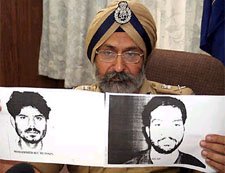
Virtually every newspaper in India today has front-paged the police account of an 'encounter' with two terrorists in Mysore. According to the official version, the two alleged terrorists -- Mohammad Fahad and Mohammad Hussain -- were travelling on a moped on the outskirts of the city around midnight on October 26/27 when they were asked to stop by a police picket. Whereupon they opened fire on the police with an AK-47, injuring two constables before being captured. The police subsequently raided the flat they were renting and recovered incriminating material suggesting the duo -- who are being described as operatives of the al-Badr terrorist outfit -- were planning attacks on the state legislature and other high-profile targets.

There are, however, some parts of this story of police derring-do which simply don't add up.

First up, both The Hindu and the New Indian Express report that the landlady who rented the flat to Fahad and Hussain says the police had taken the alleged terrorists into custody more than two weeks ago.

"I have not seen my tenants ever since they were taken away by the police 20 days ago," the Hindu quoted a woman named Suvarna as saying. In the New Indian Express, the landlady's name is given as Kanthamma and she is quoted as saying the police picked up her tenants "two weeks ago".

According to the New Indian Express, Kanthamma further clarified that the two men did not own a Hero Puch [moped] and that they always came home at night. One of them was always at home, she said. The newspaper continues:

Meanwhile, asked how they carried an AK 47 on a moped, DCP Balakrishna said the accused had hid the gun in a bag and carried it on their thighs. The DCP reiterated that the militants had fired three rounds from the weapon. The local police did not clarify how the militants entered the ring road around 11.45 pm when the police had already barricaded the road around 11 pm.
In another report, the same newspaper points out that the policemen supposedly injured in the shootout were not bandaged when they subsequently turned up to "search" the house of the two alleged terrorists. And in a reference to the usual police practice of thoroughly working over a suspect before announcing his formal arrest, the newspaper said: "Another factor that did not go amiss was that the encounter took place at midnight and the police held a press conference at 6 am. Normally the terrorists are subjected to tough interrogation and then the arrest is announced the next day."

So what is going on here?

While it is impossible to pass judgment on the strength of the police case against the two suspected terrorists -- they are supposed to be Pakistani citizens and members of al-Badr -- it is fairly clear from the foregoing that the encounter never occured. I am fairly certain, the duo were arrested around two weeks ago and thoroughly interrogated. They may well have been hatching the kind of plot the police say they were but the encounter story simply does not add up.

This, in turn, raises the question of why the police prefer to stage these dramatic incidents.

Often, these encounters end in the death of the suspected terrorists -- this is what happened in the infamous Ansal Plaza incident in November 2002 or the Pragati Maidan encounter in 2005, or the encounter outside the RSS headquarters on 1 June 2006.

Are the police trying to make out that they are braver and more intelligent than they really are? Are they trying to scare the public by exaggerating the imminence and proximity of terrorist threats? Are they planting evidence on terror suspects, such as an AK-47? Suvarna/Kanthamma said nothing about the police carrying away boxes of material from the flat of the two men when they were arrested two weeks/20 days ago and the police have not spoken of the pair having some other safe location. So where was the AK-47 kept all this time? If a gun can be planted, what about other evidence?

The New Indian Express speculates that local politics might have prompted the dramatic encounter -- the desire to divert news space away from the allegation that the Karnataka Chief Minister's son had been involved in a drunken brawl in a Bangalore hotel.

Slowly, perhaps, the real story will filter out. Then again, it might not.

Labels:


Read more

11 October 2006

For India, North Korea's test poses key challenge

Reconfiguring the nuclear order is no longer a simple matter. For the simple reason that there is no longer any nuclear order.

11 October 2006
The Hindu

For India, North Korea's test poses key challenge
Reconfiguring the nuclear order is no longer a simple matter

Siddharth Varadarajan

THE ONE "silver lining" Indian diplomats have latched on to is the "Pakistani connection" to North Korea's "clandestine" nuclear status but this clever point aside, Pyongyang's test of a nuclear weapon has immensely complicated India's quest for assimilation in the existing nuclear order.

The fact is that as of Monday, there is no longer any nuclear order, at least not in Asia. Experts can quibble about its low yield but the North Korean test has brought to a formal end the core bargain on which American nuclear policy in East Asia has rested: that in exchange for Japan and South Korea forswearing their right to nuclear weapons, the United States would guarantee not just their security against nuclear attack from Russia or China but also that there would be no new nuclear weapons state in the region.

Pyongyang may have delivered a body blow to Washington's security architecture but it is China which is likely to be most affected in the medium to long-term. For one, it is now apparent that Beijing has rather less influence over Pyongyang than it had let the U.S. and the wider world believe. Secondly, the spectre of "Japanese militarism" — which continues to haunt not just China but a broad swathe of East Asia including South Korea as well — will start looming larger as Tokyo moves to reassess its security policies in the light of the North Korean test.

Japan's reaction

Since the 1950s, Japan has remained wedded to the "three nuclear principles" — banning the possession, manufacture or presence of nuclear weapons on Japanese soil — and any explicit change on that front is highly unlikely. However, what the North Korean test will do is loosen the bounds of what has until now been a tightly controlled public discourse on this taboo subject. Secondly, greater Japanese commitment to and investment in missile defence systems is a foregone conclusion. Thirdly, a relaxation of constitutional norms on the nature and mandate of Japan's Self-Defence Forces is also inevitable. Article 9 of the country's Constitution says the "Japanese people forever renounce war as a sovereign right of the nation and the threat or use of force as means of settling international disputes. In order to accomplish [this] aim ... land, sea, and air forces, as well as other war potential, will never be maintained. The right of belligerency of the state will not be recognised." Prime Minister Shinzo Abe is keen to amend this article to permit the Japanese military to play a pro-active and even pre-emptive role. Each of these three trends — which worry China and others in Asia — already existed in Japan but Pyongyang's test makes the development of a more robust military profile many times more likely.

In South Korea, the Dear Leader's nuclear test will be seen with a mixture of mostly shock but also a little awe. Whatever Seoul may say about North Korea having blasted its way into the nuclear club, one thing is certain: a reunified Korea, as and when it comes about, is unlikely to surrender the status claimed by one of its halves. The Indian nuclear tests were a serious blow to the U.S. but they eventually facilitated the emergence of closer political, economic, and military ties between the two. Inter-Korean relations have grown tremendously throughout the past decade of tension on the nuclear front and the trend is likely to return to that path once the initial shock of the nuclear test wears off.

Throughout the past two years, the South Korean government pleaded with Washington and Tokyo that the imposition of sanctions would not help resolve the North Korean nuclear question. Now that Pyongyang has crossed the Rubicon, Seoul's energies will be devoted to ensuring Washington gives up any idea of reversing its nuclear status through force or even sanctions. Countries do not take the decision to go nuclear lightly. If sanctions did not succeed in preventing North Korea from testing an unproved weapon, now that the bomb design has been validated there is even less chance that it can be forced to roll back.

For now, the main focus of the international community has to be to avoid converting international anger at the North Korean test into a confrontation. If anything, it is the Bush administration's policies of confrontation that slowly but surely pushed North Korea over the nuclear edge. North Korea signed the NPT in December 1985 but signed a safeguards agreement with the International Atomic Energy Agency (IAEA) only in January 1992. The reason for the delay was the presence in South Korea of American nuclear weapons. It is only when the U.S. decided to withdraw its nuclear weapons from the peninsula and suspend its provocative "Team Spirit" military exercises that Pyongyang felt confident enough to activate the safeguards agreement by mid-1992. But even then, there was a trust deficit with the U.S. insisting on the repeated inspection of non-nuclear facilities. In March 1993, after less than a year of safeguards, North Korea announced its withdrawal from the NPT.

Bush's role

During the Clinton presidency, and even until 2001, the Agreed Framework signed by Washington and Pyongyang in 1994 worked fairly well in ensuring the North Korean nuclear weapons programme remained verifiably frozen. What the Kim regime was looking for was regime survival, economic security, and diplomatic recognition. It also wanted the normalisation of relations on the Korean peninsula and an end to the virtual state of war that has existed between it and the U.S. since 1950. President George W. Bush upset this equation in January 2002 when he gratuitously placed North Korea in the "axis of evil" and marked its government as a target for future regime change.

The goal of regime survival had pushed Pyongyang to cut a deal with President Clinton but now the same imperative propelled it towards the development of a nuclear "deterrent." The lessons of Iraq — where a country that possessed no weapons of mass destruction was invaded and laid waste — were also not lost on the North Korean military. It is significant that in the October 3, 2006, statement warning the world of its impending nuclear test, North Korea referred indirectly to the devastation wrought by the U.S. in Iraq. "A people without reliable war deterrent are bound to meet a tragic death and the sovereignty of their country is bound to be wantonly infringed upon. This is a bitter lesson taught by the bloodshed resulting from the law of the jungle in different parts of the world," the North Korean Foreign Ministry had said.

For the Manmohan Singh Government, the primary concern for the moment will be what happens to the Indo-U.S. nuclear deal. With the Congressional approvals process delicately poised and the Nuclear Suppliers Group yet to study the "India exception" docket, the North Korean test will come as a shot in the arm for all those opposed to allowing the resumption of nuclear commerce with India. The election season debate in the U.S. this fall is likely to focus closely on the Bush administration's mishandling of the non-proliferation issue vis-à-vis North Korea. The Democrats, after all, handed over a non-nuclear Pyongyang to President Bush and now the unthinkable has happened on his watch. To the extent to which the Democrats seek to discredit Mr. Bush's nuclear policies, the India deal too is likely to come under renewed attack. At any rate, the task of keeping the "no nuclear test" clause out of the India-U.S. Nuclear Cooperation Agreement (the so-called `123 Agreement') — a key demand of India — looks much more difficult today now that North Korea has focussed renewed international attention on the danger of testing.

Looking beyond the Indo-U.S. agreement, India needs to join hands with South Korea, China, and Russia to ensure that the lessons of the North Korean fiasco are understood properly by the U.S., Japan, and Europe. As long as nuclear weapons exist and are legitimised in the doctrines and force postures of a handful of states, the "nuclear order" will never be stable. Force and sanctions cannot deter a country from developing nuclear weapons. If anything can work, it is diplomacy and dialogue. Confidence-building is a two-way street. In Korea, the international community has missed the bus. Let the same mistake not be repeated in Iran.

Labels: , ,


Read more

North Korean case different from India's, says Tony Blair


India does not support emergence of another nuclear state: Manmohan

11 October 2006
The Hindu

North Korean case different from India's, says Tony Blair

Siddharth Varadarajan

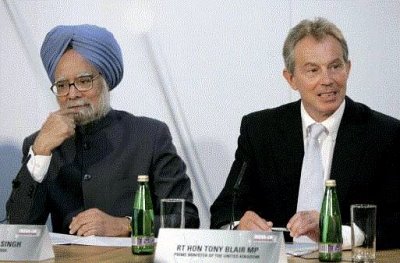
London: Condemning North Korea for conducting a nuclear test, Prime Minister Manmohan Singh on Tuesday said the further erosion of the non-proliferation regime was not in India's interests, and the country did not support the emergence of another nuclear weapon state.

He was speaking at a joint press conference with British Prime Minister Tony Blair at 10 Downing Street here shortly after wrapping up their third annual summit. Counter-terrorism, energy cooperation and investment promotion were the main issues tackled, though Monday's nuclear test by North Korea inevitably figured prominently.

Support from Blair

If the Indian side was anxious that the world should not club Pyongyang with New Delhi, it received a boost from Mr. Blair who stressed, in reply to a question from a British journalist, that North Korea was a "very different situation altogether."

"They are in clear breach of their international obligations. Whereas a country like India has been very strong on counter-proliferation, North Korea is going in the opposite direction," Mr. Blair said.

On his part, Dr. Singh said India had expressed its deep concern over North Korea's nuclear test, and considered it a violation of its international commitments. "India has supported the six-party talks, intended to achieve the goal of denuclearisation of the Korean peninsula. I wish to state that the further erosion of the non-proliferation regime is not in our interests. We do not support the emergence of another nuclear weapon state."

Clandestine programme

In line with India's initial reaction to the test, Dr. Singh again stressed the "clandestine" nature of the proliferation, which facilitated North Korea's nuclear weapons programme. "North Korea's test highlights the dangers of clandestine proliferation. In fact, India's own security has suffered through clandestine proliferation linkages emanating from our neighbourhood."

On terrorism, he said India intended to "take advantage of" Pakistan's offer to cooperate in the investigation into the Mumbai blasts, and "will provide [Islamabad] what we consider as credible evidence to that effect."

Speaking on background, Indian officials said that while Dr. Singh presented to Mr. Blair the broad outlines of what the investigations had revealed, no specific evidence could be shared with anybody until charge sheets were filed in court.

Asked whether India and Pakistan would set up a "working group" on Kashmir, Dr. Singh clarified that the two sides had issued a joint statement in Havana recently, in which "we have reaffirmed our commitment to discuss and resolve all outstanding issues, including the issue of Jammu and Kashmir." In addition to this, India and Pakistan "have agreed to set up an institutional mechanism to deal with terrorist threats, and that mechanism is now in the process of being worked out."

Though a direct question was put to Mr. Blair whether his interactions with Dr. Singh had given him a better understanding of Pakistan's alleged role in abetting terrorism, the British Prime Minister refrained from pointing fingers in any specific direction. "I think we've both agreed that we've got to send the strongest possible signal everywhere that terrorism cannot be tolerated, whether it is Mumbai, or London or Kashmir."

Describing Dr. Singh's meeting with General Musharraf in Havana as a "positive outcome," Mr. Blair said he had himself met the Pakistani President a few weeks ago, "and we went back over this ground."

Mr. Blair said India and Britain had agreed on a new package of measures to enhance cooperation in counter-terrorism.

Labels: ,


Read more

'World big enough to accommodate India and China'

The Indian Prime Minister tells businessmen there may be some worries about China, "but they have to be taken on board in a constructive manner".

11 October 2006
The Hindu

World big enough to accommodate India and China: Manmohan

Siddharth Varadarajan

London: A high-level gathering of business leaders from India and Britain presented a sector-wise wish-list to Manmohan Singh on Tuesday, but the Prime Minister steered clear of making any specific commitments on some of the more contentious issues involved.

India and Britain are the third largest foreign investors in each other's countries, and Indian foreign direct investment (FDI) in Britain has exceeded the reverse flow since 2004. Tuesday's U.K.-India Investment Summit — an initiative of the CII, FICCI and the Confederation of British Industry — was aimed at finding ways of boosting the investment relationship.

"The normal rule in government is that the higher you go, the less you know," Dr. Singh told the summit somewhat disarmingly when called upon to respond to the questions being raised. "So, you will forgive me if I can't answer all your questions."

"A big push"

Infrastructure was one area where there could be a big push, he said, with India in a position to absorb $320 billion worth of investment.

He acknowledged the importance of some issues raised by the CEOs in their deliberations — the lack of clarity about rules and regulatory processes, and the lengthy delays in approvals — but added that his Government was working hard to rectify the situation.

On the manufacturing front, where he said most barriers to FDI had been dismantled, the Prime Minister disagreed with the view that Chinese industry was a threat to its Indian counterpart. "I believe the world is large enough to accommodate the growth ambitions of India and China," he said.

"We are trying to engage China, and the volume of our trade is growing handsomely. I do agree that there are some worries about China, but they have to be taken on board in a constructive manner."

He said he was looking forward to his summit meeting with President Hu Jintao later this year.

"Already converted"

In response to a question on financial sector liberalisation — the Investment Summit working group made a strong pitch for capital account convertibility and further banking liberalisation — the Prime Minister told the CEOs that they were "talking to the converted."

"We remain committed to further liberalisation," he said. India needed to promote a widely held pension fund system, and have a "much larger insurance sector with a higher capital base."

At the same time, whenever enabling legislation was required to be passed by Parliament, the Government had to consult its coalition partners.

His own remarks emphasised India's adherence to "all international codes and regulations pertaining to safety and protection of investment and intellectual property." And in response to fears in a section of the British press about outsourcing in India leading to data theft, he said the country had a "well-designed system for data protection" but was "always willing to learn from our friends how to do things better."

Labels: ,


Read more

10 October 2006

Does anybody care about Manipur?

The question of repeal of the Armed Forces (Special Powers) Act needs to be debated publicly in the light of the Justice B.P. Jeevan Reddy Committee's report.

10 October 2006
The Hindu

Does anybody care about Manipur?

Siddharth Varadarajan

THERE IS a statement, perhaps apocryphal, that Mahatma Gandhi supposedly made to the effect that satyagraha worked against the British but might not have against a more ruthless opponent like the Germans. Considering the indifference with which Official India has greeted the unprecedented civic protest in Manipur against the Armed Forces (Special Powers) Act these past few years, the question arises whether we have become the kind of opponent Gandhiji spoke about. That we have so inoculated ourselves against the weapon of peaceful protest that nothing other than guns and bombs seems to rouse us from our torpor.

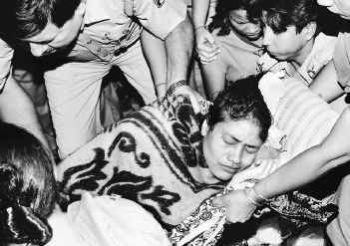
Two years ago, the abduction and killing of Manorama triggered massive protests by the people of Manipur against the AFSPA. A group of brave Manipuri women shook the conscience of the whole of India by baring themselves in front of the guns and bayonets of the Army. Thanks to the power of democratic protest, Prime Minister Manmohan Singh told a delegation of the Apunba Lup — the umbrella organisation spearheading the campaign — in New Delhi in November 2004 that he would consider replacing the AFSPA with "a more humane law that will address both the concerns of national security and the rights of citizens."

Later that month, Dr. Singh went to Imphal and met some of the women who had staged that dramatic protest against the AFSPA outside Kangla Fort. According to a report filed soon after by the Press Trust of India, the Prime Minister "held the hand of a weeping mother and said, `We will do something'."

True to his word, the Prime Minister appointed a high-level committee headed by Justice B.P. Jeevan Reddy with the mandate of "review[ing] the provisions of AFSPA ... and advis[ing] the Government of India whether (a) to amend the provisions of the Act to bring them in consonance with the obligations of the Government towards protection of human rights; or (b) to replace the Act by a more humane Act." The members of the committee were carefully selected so that the concerns of the Union Government and the security forces would not be unrepresented. There was one retired General, V.R. Raghavan, who, prior to joining the committee, had advocated in newspaper columns the case for the continuation of AFSPA in Manipur. There was also a senior retired official from the Union Home Ministry, P.P. Srivastava. From civil society were the academician S.B. Nakade and the journalist Sanjoy Hazarika.

Though the composition of the committee led some impetuous critics to suggest the outcome of its exertions would be to advocate the retention of the law, the Prime Minister's nominees took their job seriously and discharged their mandate fairly and objectively. Extensive public hearings were conducted in all Northeastern States and in Delhi. The views of the armed forces and various government departments were also solicited.

The Jeevan Reddy panel submitted its recommendations in under seven months. On June 6, 2005, its five members unanimously signed off on the report. Shortly thereafter, a copy was handed over to Union Home Minister Shivraj Patil. Since then, however, the process has inexplicably ground to a halt. Nearly a year and a half has elapsed with the Government refusing to say anything definitive about its recommendations.


This is presumably not what the Prime Minister meant when he told that weeping mother, "We will do something."

Though the report was never made public because of the opposition of the Army and the Ministry of Defence, a misleading summary of its findings was leaked to the press according to which the Jeevan Reddy Committee was seeking little more than a change of nomenclature: Scrap the AFSPA, but retrofit the Unlawful Activities (Prevention) Act with all its controversial provisions. One can only surmise that the intention of this half-truth was to so discredit the report that no one would bother agitating for its release.

This neat equation, however, came unstuck last week with the unexpected arrival in Delhi of Irom Sharmila. Ms. Sharmila has been on a hunger strike for the past six years demanding repeal of the AFSPA. Unlike other hunger strikers, she has not allowed even a drop of water to cross her lips all this while. She cleans her teeth with cotton and not water and has been kept alive through force-feeding via a nasal drip five times a day. Last week, her fifth sequential one-year sentence for "attempted suicide" expired and before she could be rearrested she boarded a plane to the national capital. After a visit to Rajghat, she settled down at Jantar Mantar demanding that the Jeevan Reddy Committee report be released and the AFSPA be repealed.

Life and death issue

As the extracts published in this newspaper on Saturday confirm, the report clearly recommends scrapping the Armed Forces Act. At the same time, acknowledging both the reality of insurgency and the fact that the armed forces cannot be deployed inside the country without a proper legal framework, the Committee has pointed out that the Unlawful Activities (Prevention) Act already provides the kind of protection against legal suits the armed forces are demanding. What is needed are amendments to protect civilians against the abuse of power. Thus, it has sought the insertion of important safeguards to ensure there is no violation of human rights.

In fairness to the Committee and to all those who have been exercised about the Armed Forces Act, the report deserves a careful and critical reading. Its recommendations need not be considered the final word. In an open society, they can and should be debated and ways found to improve the core suggestions. But for this to happen, it is essential that the report be put in the public domain. The AFSPA has become a question of life and death for millions of people in India today. And they have a right to discuss it.

Now that the report has been unofficially released by The Hindu, its contents can be studied and evaluated by civil society. But what is mystifying is the inordinate time the Manmohan Singh Government has taken in forming an official opinion on its recommendations. The Prime Minister is entitled to reject or modify the recommendations of the Reddy committee if he wants. In turn, the people of Manipur, the Northeast, and the rest of India are entitled to draw whatever conclusions they wish about the sincerity of the promises he made in November 2004. If the Government wants to retain the AFSPA despite the measured counsel of Justice Jeevan Reddy and his colleagues, let it do so. The only requirement is that Dr. Singh and his officials should have the courage openly to defend their decision rather than dodging responsibility by claiming the report is "still being studied."

In the film Lage Raho Munnabhai, which the Prime Minister himself has confessed to admiring, citizens are urged to send flowers to someone who is suffering from a social affliction or ailment. For Gandhiji, indecisiveness was a disease as deadly as indifference. Fifteen months is a long time to study a report prepared by one's own hand-picked experts. Is Dr. Singh suffering from indecisiveness? Should the people of India start sending flowers to his residence at 7 Race Course Road?

Labels: ,


Read more

India condemns North Korean test

Though India itself, as a non-signatory to the Nonproliferation Treaty, tested nuclear weapons in 1998 and North Korea is no longer a state party to the NPT, New Delhi claims the North Korean test at Hwaderi on October 9 violates that country's "international commitments".
10 October 2006
The Hindu

India condemns North Korean test
"Don't compare us with Pyongyang"

Siddharth Varadarajan

On board Air-India One: Anxious to avoid any possible comparison between North Korea and India as two nuclear-armed countries outside the Nuclear Non-Proliferation Treaty (NPT) system, New Delhi on Monday officially accused Pyongyang of violating its "international commitments" and "jeopardising peace, stability and security on the Korean peninsula and in the region" by testing a nuclear weapon.

In a brief statement, the Ministry of External Affairs spokesman also said the test "highlights the danger of clandestine proliferation," an implicit reference to the nuclear links which have existed in the past between North Korea and Pakistan.

Challenge for diplomacy

Though the North Korean test — with its dramatic implications for international security — is likely to top the agenda during Manmohan Singh's meetings in London and Helsinki this week, some indication of the challenge it poses for Indian diplomacy was provided by the reluctance of the Prime Minister's advisers to elaborate on New Delhi's perspective on the record. Though unstated, the concern is that debate within the United States — and the Nuclear Suppliers Group — on allowing nuclear commerce with India could now become much more contentious.

North Korea formally withdrew from the NPT in 2003 and is under no legal obligation to forswear nuclear weapons. As per the procedure specified in Article X of the NPT, a state-party can renounce the treaty if "extraordinary events, related to the subject matter of this treaty, have jeopardised the supreme interests of the country." The only requirement is that the country give notice to other member states and the U.N. Security Council three months in advance and include a statement "of the extraordinary events it regards as having jeopardised its supreme interests."

North Korea did this in 1993, only to suspend its withdrawal when the United States entered into an agreement for nuclear cooperation with it soon thereafter. That agreement was terminated in 2002 and in January 2003, Pyongyang declared it was no longer a party to the NPT.

Safeguards obligations

Asked by reporters on board the Prime Minister's special plane which "international obligations" North Korea had violated by testing, senior officials speaking on background claimed the question of North Korea's membership of the NPT was not yet settled and that the test, in any case, violated the country's safeguards obligations with the International Atomic Energy Agency. They said North Korea signed an "in perpetuity" safeguards agreement, and this barred them from using any safeguarded material or facilities for a non-peaceful purpose.

The officials said they would rather not get into the question of what India's stand would be if North Korea said its weapon had been assembled from unsafeguarded material. "In any case, the North Korean test has happened not because they are outside or inside the treaty but because of clandestine proliferation," an official said.

"India separate, distinct"

Indian officials insist Pyongyang's legal or political status could not be compared to India's position as a country outside the NPT. India, the officials said, had never violated its safeguards agreements. "Please don't lump us with North Korea. India has been transparent, clear. We are separate, distinct. It is ridiculous to compare us to them," a senior official said.

The officials said the "politics" of the test would take a few days to play out, and that India was in close touch with other countries. Views have already been exchanged with China, South Korea and Japan, all of whom condemned North Korea. Everyone's concerns were that the "secondary effects" of the nuclear explosion be "contained."

Acknowledging that shifts in U.S. policy towards North Korea probably played a role in Pyongyang's decision, the officials said that ultimately, blame must lie with the country which tested. The officials also expressed concern about what the reaction in Japan is likely to be.

Labels: , ,


Read more

08 October 2006

Repeal Armed Forces Act: official panel


Secret report of Justice Jeevan Reddy Committee says the Act is a "symbol of oppression, instrument of high-handedness".
8 October 2006
The Hindu

Repeal Armed Forces Act: official panel

Siddharth Varadarajan

New Delhi: On Friday, Union Home Minister Shivraj Patil declined to make public the report of a high-level official panel tasked with reviewing the provisions of the Armed Forces (Special Powers) Act (AFSPA).

He had good reasons.

The 147-page report of the Justice B.P. Jeevan Reddy Committee — a copy of which is now with The Hindu — unambiguously recommends the repeal of the controversial law against which people in Manipur and elsewhere in the North-East have been agitating for several years.

"The Armed Forces (Special Powers) Act, 1958, should be repealed," it notes in its recommendations. "The Act is too sketchy, too bald and quite inadequate in several particulars".
The report adds that the impression gathered by the Committee during the course of its work is that "the Act, for whatever reason, has become a symbol of oppression, an object of hate and an instrument of discrimination and high-handedness."

Acknowledging that the Supreme Court had upheld the constitutional validity of the Act, the Committee said that judgment "is not an endorsement of the desirability or advisability of the Act."

The apex court may have endorsed the competence of the legislature to enact the law. But "the Court does not — it is not supposed to — pronounce upon the wisdom or the necessity of such an enactment."

On this point, the Jeevan Reddy Committee's findings are clear: "It is highly desirable and advisable to repeal the Act altogether, without, of course, losing sight of the overwhelming desire of an overwhelming majority of the [North-East] region that the Army should remain (though the Act should go)."

Panel members

The other members of the Committee — set up by the Prime Minister in November 2004 — are Lt. Gen (Retd.) V.R. Raghavan, P.P. Shrivastava, a former special secretary in the Union Home Ministry, Dr. S.B. Nakade, a former Vice-Chancellor of the Marathwada University, and senior journalist Sanjoy Hazarika.

The panel turned in its report in June 2005 but the Manmohan Singh Government has yet to officially accept or reject its findings.

Submission rejected

Rejecting the principal submission made by the armed forces in favour of continuation of the AFSPA, the Committee pointed out that protection from legal proceedings against soldiers acting in good faith already exists in Section 49 of the Unlawful Activities (Prevention) Act, 1967 (ULP Act).

Accountability

It also noted that "while providing protection against civil or criminal proceedings in respect of the acts and deeds done by [the armed] forces while carrying out the duties entrusted to them, it is equally necessary to ensure that where they knowingly abuse or misuse their powers, they must be held accountable therefore and must be dealt with according to the law applicable to them."

Accordingly, the Committee recommends amending the ULP Act to incorporate measures that would regulate the already permissible conduct of armed forces personnel in areas where they are deployed to fight terrorist activities and provide protection to ordinary citizens against possible abuse.

Labels: ,


Read more

Official panel wants stringent safeguards on Army use

`Scrapping AFSPA will help erase feeling of alienation, discrimination in North-East'

8 October 2006
The Hindu

Official panel wants stringent safeguards on Army use
`Scrapping AFSPA will help erase feeling of alienation, discrimination in North-East'

Siddharth Varadarajan

New Delhi: Although the Union Home Ministry has let it been known that the Justice Jeevan Reddy Committee report on the Armed Forces (Special Powers) Act had recommended repeal of the legislation, they have also allowed the impression to go around that the panel merely wanted the prerogatives of the armed forces transferred wholesale onto another law, the Unlawful Activities (Prevention) Act, 1967.

In fact, a careful reading of the report makes it clear how mistaken that impression is. The Committee wants the AFSPA scrapped and the ULP Act amended but all its suggested amendments are aimed at inserting safeguards against possible abuse of power rather than expanding the scope of already existing powers.

The report makes its strongest argument in favour of the repeal of the AFSPA when it points out that both the mandate to fight militant organisations in the North-east as well as the legal protection sought by the Army, the Assam Rifles and other paramilitaries already exists in the ULP Act. "[It] can be said that there are two enactments for fighting militant/insurgent/terrorist organisations, groups and gangs in the North-eastern States, viz. the Armed Forces (Special Powers) Act whose application is limited to the North-eastern States alone, and the ULP Act which extends to the whole of India including the North-eastern states."

Starting from this premise, the report's major recommendations focus on how the ULP Act needs to be amended to specify the "powers, duties and procedures relevant to [the armed forces'] deployment" in the area pursuant to the ULP Act. The ULP Act, for example, "does not also provide for an internal mechanism ensuring accountability of such forces with a view to guard against abuses and excesses by delinquent members of such forces. It is this lacuna, which is to be supplied by inserting appropriate provisions in the ULP Act."

If the Jeevan Reddy panel's recommendations are accepted, the amended ULP Act would differ from the AFSPA in four crucial areas.

First, under the AFSPA, any officer not below the rank of an NCO (non-commissioned officer) may fire upon and even kill any individual or group carrying weapons or in contravention of orders prohibiting the assembly of five or more persons. The proposed amendment to the ULP Act limits the right to open fire to situations where an individual or group "is reasonably suspected of being in unlawful possession" of weapons. Thus, the killing of passengers at a bus stand in Malom, Manipur — which prompted Irom Sharmila to begin her hunger strike against the AFSPA six years ago — would not be protected.

Second, unlike the tendency in the AFSPA for soldiers to delay by more than 24 hours the production of an arrested person before a magistrate, the proposed ULP Act amendment provides for the handing over "forthwith" of any arrested person to the nearest police station.

Third, a major safeguard proposed in the amended ULP Act is the establishment of a grievance cell to "ensure public confidence in the process of detention and arrest." The three-member cells comprising a senior member of the local administration, a captain of the armed forces, and a senior police officer would be set up in each district where armed forces are deployed. "These cells will receive complaints regarding allegations of missing persons or abuse of law by security/armed forces, make prompt enquiries and furnish information to complainant."

If the complainant is unsatisfied and furnishes an affidavit to this effect, the grievance cell must call upon the local commanding officer "to make appropriate enquiries and furnish information to the cell" within one week.

Lastly, the Committee has recommended that the Supreme Court's list of "Do's and Don'ts" — appended to its judgment on the constitutional validity of the AFSPA — be explicitly incorporated into the ULP Act so that their violation by the armed forces would be justiciable. Among these: women should not be physically searched or touched in any manner or arrested without the presence of women police. Only women police should search women."

While the campaign against the AFSPA in Manipur and elsewhere has been going on for many years, it was the arrest and custodial killing — including the alleged rape or sexual molestation — of a young Manipuri woman named Manorama Devi in 2004 that sparked off a more intense movement. None of the arresting personnel were women.

Prime Minister Manmohan Singh promised a delegation of Manipuri students later that year that he would set up a committee to make recommendations for a more humane law. In its report, the Committee said it had been guided by three basic conditions while devising a solution. First, "the security of the nation, which is of paramount importance," and which the Union and States must uphold. Second, "it is equally the duty of the Union and the States to not only respect the fundamental rights conferred upon the citizens of India by ... the Constitution, they are also under an obligation to ensure the conditions wherein the citizens can enjoy and avail [their] ... fundamental rights." Third, the "armed forces of the Union are meant to ensure the defence of the Union and all its parts."

Though the deployment of the armed forces may be unavoidable, the report stresses that "too frequent a deployment, and too for long periods of time, carries with it the danger of such forces losing their moorings and becoming, in effect, another police force, a prey to all the temptations and weaknesses such exposures involve." Such exposures, it notes, "may well lead to the brutalisation of such forces — which is a danger to be particularly guarded against."

Labels: ,


Read more

Newer Posts Older Posts