31 March 2006

Orden de Bernardo O'Higgins

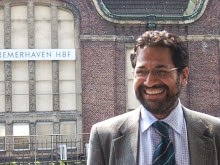
On March 30, the Ambassador of Chile in India, Jorge Heine, conferred the Orden de Bernardo O'Higgins -- one of Chile's highest civilian honours for a foreign citizen -- on me.

At a formal ceremony, Ambassador Heine delivered a speech where he explained the origin and significance of the award, which is named after Chile's liberator and founding father who was of Irish descent. [This is what The Hindu reported the next day]

My speech in response.....

"My emotional association with Chile began as a university student in England in the 1980s, when the struggle against the Pinochet dictatorship was a cause that many of us at the London School of Economics saw as our own. We saw in the tragic but righteous personality of Salvador Allende -- and in the simple poetry of Pablo Neruda -- and in the determination of the mothers and families of the young desaparecidos -- the personification of all that is honest and pure and noble in human beings everywhere. It didn't matter that the tragedy was being enacted thousands of miles away. It could just as easily have been next door.

"In 1995, my wife, Nandini Sundar, and I had the chance to visit Chile. Those were happier times. The dictatorship was no more but Chileans were still struggling to undo the damage it had done to their country, their economy, their social fabric and sense of solidarity. At the main cemetery in Santiago, we witnessed the moving scene of a young man who had been killed by the dictatorship -- and whose body had finally been identified -- being given the dignity of a proper burial. We saw in Chile a proud country that was trying to start life anew. But we also wondered whether it would manage to confront the question of justice head on.

"Today, it seems to me that Chile is one of only a handful of nations which have had the courage to realise that the only way a people can be at peace with their past is if truth and justice are accorded pride of place. Not out of the desire for retribution, but because the victims of violence deserve nothing less. Today, Chile is clearly moving in that direction. And it was also Chile's desire for justice internationally, I believe, which led it to withstand, as a member of the UN Security Council, arm-twisting by the War Party in the run up to the invasion of Iraq in 2003.

"Chile may be a country which is small and distant from every continent but its people know that dignity and fidelity to truth often matter more in international affairs than size or political or physical proximity to the major power centres. And I consider it an honour, Mr Ambassador, to be associated -- through the Bernardo O'Higgins Order -- with the Chilean people and their country.

"For India, which is confronting anew the complexities of globalisation and world order, Chile and Latin America occupy a special place.

"For too long, we in India have been used to thinking about globalisation and strategic relationships only along predictable geopolitical and geographical axes. But Latin America is a region where exciting things are happening. From Cuba and Venezuela in the north, down through Brazil, Bolivia, Uruguay, Argentina and Chile in the south, America Latina is breaking free from the dogmatism which others around the world have been trapped by. The continent is helping once again to define the contours of modern democracy, of modern, inclusive economic policies and of modern diplomacy built around the democratisation of international affairs.

"In my writings I have argued that India can benefit in more ways than one in building links with this vast and exciting continent. These links will create economic and strategic space for both India and Latin America and help push the international system in a more positive direction. I don't think I have done enough to deserve the honour bestowed on me, but am grateful to Chile and its people for this very flattering recognition of my work".

Labels: ,


Read more

30 March 2006

The countdown in Kathmandu has begun

The anti-monarchy protests planned for April 6-9 will be the first test of strength for the new partnership between Nepal's Maoists and parliamentary parties.

The King says the joint action will be treated as an act of terror and the U.S. is also opposed to the protests. India is still reluctant to take a public position but unless it comes out in favour of popular sovereignty, the situation in Nepal will continue to deteriorate.

30 March 2006
The Hindu

The countdown in Kathmandu has begun

India's Nepal dilemma must be resolved soon, in favour of popular sovereignty


Siddharth Varadarajan

AS THE date for the launch of a new nationwide agitation against the autocratic rule of King Gyanendra approaches, all the players on the Nepalese political stage are being forced to confront the imminence of their own particular moment of reckoning. All except India, that is.

Faced with the prospect of mass protests to be launched in unison by the Maoists and the seven-party alliance (SPA) of parliamentary parties on April 6, the monarchy has turned once again to the familiar weapons of intimidation and deception. The parties are being warned of dire consequences if they operationalise their latest political understanding with the Maoists. And the people of Kathmandu are being fed stories about armed Maoists infiltrating into the Capital to wreak terror on its inhabitants.

But if King Gyanendra's armoury is the same, there is a new urgency in the manner in which it is being deployed.

The monarch knows that the second understanding reached between the SPA and the Maoists last week is a decisive twist in the noose that is slowly tightening around the neck of autocracy. For the first time since the two principal players in the struggle for democracy agreed last November that a Constituent Assembly holds the key to ending Nepal's political crisis, an agenda for united political action has emerged. The identical statement released separately but simultaneously by the Maoists and the SPA on March 19 unequivocally declares that "the People's Movement is the only means to achieve [the] goal" of ending the conflict, "establish loktantra and restore people's sovereignty" in Nepal. To be sure, the Maoists have not renounced violence as the parties and India would like. But for them to concede the primacy of a people's movement is a major step in the direction of reducing the salience of `people's war."

The first test of this new alliance will be on April 6 when the two partners launch a three-day “mass mobilisation programme” in Kathmandu. The March 19 agreement was struck in the teeth of opposition from both the Palace and the United States, which had publicly denounced the 12-point agreement reached with the Maoists last November and warned the parties against taking their understanding any further. Having failed to prevent the `Second Memorandum of Understanding’ from being reached, the U.S. Ambassador to Nepal, James Moriarty, has joined hands with King Gyanendra to ensure next week’s agitation does not get off ground.

For India, which indirectly facilitated the conclusion of the latest agreement between the parties and the Maoists, the political and diplomatic challenge has now become critical.

When King Gyanendra usurped power on February 1, 2005, India was quick to signal a tough line against him. Despite being aware of the monarchy's historical role in continuously interrupting the development of democracy in the kingdom, the Indian Government raised its demand for the restoration of democracy within the framework of the `twin pillar' theory, which saw constitutional monarchy as central to Nepal's political stability. At the same time, senior officials have been saying privately that India's commitment is to Nepal and its people and not to any institution. And that if forced to choose between the monarchy and the Nepalese people, India would have to back the latter. New Delhi has been reluctant to articulate this sentiment publicly though senior officials point out that the Ministry of External Affairs' latest pronouncements on Nepal have undergone a subtle change in this direction. Recent statements, for example, make no reference to twin pillars. Indeed, the February 8 statement issued by the MEA after the farcical municipal elections says: "We are of the view that the grave challenges facing Nepal demand the initiation of a genuine process of national reconciliation, dialogue and participation which can facilitate a peaceful political settlement." The implication, say officials, is that dialogue and reconciliation with the Maoists is one of the keys to a peaceful political settlement of the crisis in Nepal.

Though the officials may be right in arguing that India's public position has begun to change, the transformation is far too subtle and slow to have any serious political impact.

The irony is that having backed the latest understanding between the Maoists and the SPA, India will have to bear all of the associated political costs without being in a position to ensure that any benefits accrue to it. The King and the U.S. know the Second Understanding between the Maoists and the parties would not have been possible without India, as do the two parties to the understanding. But in the absence of some public signalling by India, the SPA will always be plagued by doubts about the extent of India's commitment to their new course of action. This, in turn, makes the parties susceptible to the King's threats.

Even as it remains wary of getting directly involved, India needs to send a clear and unambiguous message that it backs Nepal's parliamentary parties in the course of action they have chosen to follow. In the run-up to April 6, an Indian announcement of support to the pro-democracy forces would be a major morale booster for the leadership and cadres of the SPA. Such an announcement would also send an unambiguous message to King Gyanendra and Washington that the only pillar democracy in Nepal really needs is people's sovereignty.

On their part, the Maoists should consider the announcement of another ceasefire as a means of encouraging the widest possible public participation in the planned demonstrations. Their attack on Thankot on the eve of an earlier mass demonstration by the parties in Kathmandu gave the King an excuse to impose curfew. This time too, King Gyanendra is likely to impose curfew on the eve of April 6. But the announcement of a ceasefire by the Maoists would take the political initiative away from the Palace and help cement their new partnership with the parliamentary parties.

© Copyright 2000 - 2006 The Hindu

Labels: ,


Read more

29 March 2006

Looking beyond the nuclear deal

The inaugural issue of TERI's new energy newsletter, Energy Security Insights has just come out. With articles by TERI Director R.K. Pachauri, the Department of Atomic Energy's Anil Kakodkar and R.B. Grover, anti-nuclear critics Suchitra Y.J. and M.V. Ramana, and TERI researcher M.P. Ram Mohan, the newsletter seeks comprehensively to tackle the recent India-U.S. nuclear agreement from the perspective of energy security, including the question of financial, environmental and political costs.

Also included is a contribution by me, 'Looking beyond the nuclear deal'. [The entire newsletter can be dowloaded in PDF here.]

March 2006, Volume 1, No. 1
Energy Security Insights

Looking beyond the nuclear deal

Siddharth Varadarajan*
The Hindu

Though there are manifest difficulties in negotiating the recent India–US agreement on the civilian nuclear cooperation through the twin thickets of the US legislative process and the NSG (Nuclear Suppliers Group), it is reasonable to assume that the Indian nuclear energy industry is likely to avail of imported fuel and equipment in the not too distant future.

That such an eventuality is at all possible is due, primarily, to three reasons. First, the growing economic and strategic significance of India in a world that is in transition from one system of order to another. For the US, which intends to weather this transition with its hegemonic power intact if not augmented,
nuclear cooperation with India forms the bedrock of a wider set of strategic interactions aimed at harnessing the Indian strategic capabilities. Indeed, strategic factors have overdetermined the American approach to the Indian nuclear question to such an extent that India’s nuclear weapons are probably considered
an asset for the US rather than a liability in the global balance. This has enabled realists in the American policy planning system to overcome the non-proliferation theologians and push for the mainstreaming of India’s nuclear capabilities even if this means accepting many conditions laid down by the Indian nuclear scientists, such
as excluding the fast breeder programme from the purview of international safeguards for the time being.

Second, the rise of India and China is exerting tremendous pressure on the
international hydrocarbon market as far as the US and western oil majors are concerned. This is not so much due to the current levels of demand – indeed, it is a fallacy that demand growth in these two countries is an important, let alone pivotal, cause of the recent upwards trend in the international oil prices – as to the hedging strategies that China and India have embarked upon. These strategies are aimed at securing a major upstream presence through equity oil acquisitions as well as establishment of new transportation infrastructure, such as transcontinental and trans-regional pipelines. India, in particular, is seriously examining prospects of a strategic natural gas pipeline from Iran via Pakistan. If completed, such a project
would fill a major gap in the emerging Asian energy architecture and open the possibility for generalized outflow of Central Asian and Caspian oil and gas southwards towards the Persian Gulf and hence to Asia, rather than exclusively westwards via the US-promoted pipelines like Baku-Tbilisi-Ceyhan.

Third, the US nuclear reactor construction industry has been in doldrums since 1976 and is looking towards China and India as a major source of new demand. Although the Indian nuclear establishment would be more comfortable sourcing reactors from Russia or France, it is highly unlikely that lifting of the embargo on civil nuclear cooperation with India at the urging and initiative of the US will not result in some contracts going to the American companies. The US would also be looking
forward to leveraging the nuclear agreement to secure a greater share of the growing Indian arms market.

The fact that none of these three reasons sound particularly appetizing – indeed all
reasons suggest that the offer of civil nuclear cooperation comes with a collateral price tag in some other area – is by itself not a sufficient ground to reject or oppose such a historic deal, which offers the Indian nuclear industry a chance to end more than 30 years of isolation. But they do suggest the policy areas where
utmost caution is required.

If unreasonable expectations of the US – on the strategic front, energy security front, and trade front – are met fully or even partially, many of the gains stemming from resumption of civil nuclear cooperation will be lost. This newsletter is perhaps
not the best forum to address the first and third fronts but energy security is a question that demands utmost clarity and it is to this subject that I will now turn.

Simply put, India must reject the notion that there can be any trade-off between the prospects of greater civil nuclear cooperation and those of cooperative hydrocarbon ventures of the kind the country is looking at with Iran, Pakistan, and even China. That the US is looking at these two as a trade-off should be amply evident both from
the timing of US Secretary of State Condoleezza Rice’s initial offer of an energy dialogue in March 2005 as well as from the pronouncements made since then by her, by the US ambassador to India David Mulford, and by the sundry officials and legislators in the US. The US president George W Bush’s remarks in Islamabad on 4 March 2006 that the US has a problem not with the Iran pipeline but with Iran’s nuclear ambitions is not a shift in line as some have suggested but a cleverer
reformulation of the same objection.

Oil and, particularly, natural gas will continue to be an important part of the Indian energy mix in the short and medium term, and nuclear power can be seen as a substitute only in the long term. Up until the middle of this century then, finding and securing new sources of hydrocarbons will have to be a key aspect of India’s quest for energy security. Given the enormous reserves of natural gas in Iran, that
country is a natural partner for India and multiple forms of transport infrastructure – including pipelines and LNG (liquefied natural gas) tankers – will be needed between the two countries. The presence of Pakistan is not a problem but an opportunity for India because involving Islamabad in a trilateral or even
multilateral energy grid is an excellent way of raising the level of economic interaction between the two neighbours who have traditionally been at loggerheads with one another. Ever since prime minister Manmohan Singh came under fire for suggesting in an interview to the Washington Post in July 2005 that the Iran
pipeline might never take off, his government has been careful to reiterate its commitment to the project, provided it is found to be financially viable. While financial viability is important, particularly when comparing alternative modes
of transportation or indeed imports, there should be no underestimation of political
benefits that the pipeline might also bring.

These benefits will accrue in three distinct and mutually reinforcing ways. First, India and Pakistan will experience the burden of mutual dependency for the first time in decades. Second, Iran will get to develop a stable and secure export market for its natural gas. Third, the Iran–Pakistan–India pipeline might become a
catalyst for a wider network of pipelines criss-crossing the Asian heartland and connecting areas of supply with areas of demand in a manner unmediated by the outside influence.

Though a recent convert to the cause of pipelines, India has begun to compensate for its earlier lack of interest with an ambitious proposal for an Asian gas grid that would take these two connections – Iran–India and Kazakhstan–China – and extend them in a way that links Asia’s major energy-producing and -consuming regions to one another. At the meeting in New Delhi in November 2005 of principal north and central Asian energy producing and consuming countries, India unveiled an ambitious 22.4-billion-dollar pan-Asian gas grid and oil-security pipeline system. The grid has four principal elements.

The first would extend the existing Baku–Tbilisi–Ceyhan pipeline system – originally
conceived by the US as a means of shipping central Asian hydrocarbons westwards – down to the Red Sea via Syria, Jordan, and Saudi Arabia, allowing Caspian crudes to be exported easily to the Indian Ocean littoral. Second is the famous Iran–Pakistan–India pipeline, with the possibility of two additional sourcing spurs, one from the Caspian–Turkmenistan region to Iran, the other from Turkmenistan via Afghanistan.
The third element would be a pipeline system connecting eastern India to Myanmar and
south-western China with one connection running from Sittwe on the Burmese Bay of
Bengal coast to Mizoram, Manipur, and Assam into China, eventually connecting up to the West–East China gas pipeline near Shaanxi, the other from Yangon to Kunming. The fourth element would involve the laying of pipelines that would connect the Sakhalin deposits in Russia to Japan, China, and South Korea.

Pipelines aim to deliver gas, crude, or products between discrete points but this does not mean they have to be a zero-sum game. The underlying economic logic of a grid is that capital costs can be more easily absorbed and amortized and energy supplies calibrated to match demand variations in the consuming countries without too much effort. But there is a political logic as well. As the Asian grid will
create mutual dependencies, giving countries a stake in the political and economic stability of one another, it will hasten the process of regional integration. If at all Asia is to make progress towards creating an Asian counterpart to the IEA (International Energy Agency) and developing a regional market for energy with its
own price markers, construction of physical infrastructure such as pipelines is essential.

While the Iran–India energy link is crucial to the emergence of any Asian gas grid, Sino-Indian collaboration will likely be the platform on which any wider energy architecture in Asia will emerge. The two countries have travelled some distance in reaching an agreement in January 2006 for the joint bidding of oil and gas assets in third-world countries but there are many more areas for cooperation that can and
should be explored. India, in particular, must not lose interest in this aspect of energy security now that the nuclear deal with the US looks increasingly likely to come through.

Above all, India and China need to keep in mind the big picture: evolution of an Asian market for crude and products with long-term supply contracts and stable prices, and, eventually, an Asian Energy Union. As Mani Shankar Aiyar, who was India’s petroleum and natural gas minister until 30 January 2006, pointed out in a recent lecture to the Chinese energy specialists in Beijing, the European Union started life as a coal and steel union before growing eventually into a full-fledged
economic and political community. Could energy play the same role in Asia, with India and China serving as sheet anchors in the way France and Germany did in Europe? With India and China committed to building strategic petroleum reserves, South Korea offering to work on an ‘Inter-Asia Oil and Gas Transportation System’, and Iran planning its own hydrocarbon bourse, such an idea is no longer far-fetched.
Linked to an Asian oil market is the billion euro question of non-dollar denominated energy trade. Asian countries collectively hold more than two trillion dollars worth of foreign reserves, the overwhelming share of which is in dollar-denominated instruments. Prudential norms suggest that diversification of the Asian Insights
reserve portfolio is overdue. In China, the SAFE (State Administration of Foreign Exchange) has signalled its intention to explore the more ‘efficient use’ of the country’s forex reserves and in India, commentators like S Venkitramanan have suggested the Reserve Bank of India start thinking along similar lines. One way to sustain this shift would be to consider yen- or eurobased trading in energy. The economic dynamism of Asia for the foreseeable future suggests that what is needed is a strategic rather than a tactical change in composition of reserves. Huge and unsustainable deficits being run by the US are undermining the ‘oil standard’ that has been central to the hegemony of both the dollar and Washington for more than
three decades. Relying exclusively on the dollar for energy trade will hurt Asia’s producers and consumers alike in the long run and there is need for a shift in some other direction.

To conclude, India’s quest for energy security cannot be considered in a unidimensional manner in which sectors and timeframes are collapsed in an unrealistic manner. The Indian economy will require both hydrocarbons as well
as nuclear power, not to speak of other sources of conventional and non-conventional energy. The biggest mistake that policy planners can commit is to consider one source as a trade-off for another, especially given the differing timeframes. As a stand-alone deal, the nuclear cooperation agreement with the US has much to
commend it. But its costs will start adding up if, as a consequence, we turn away from the Iran pipeline and from the wider agenda of an Asian energy grid and energy market.

Labels: , ,


Read more

25 March 2006

From India now, 'out of the box' ideas on Kashmir

Manmohan Singh speaks of two internal and two bilateral tracks for peace.

He says the governments of India and Pakistan should each conduct an "internal dialogue"with the people in areas of Jammu and Kashmir under their respective control. And in addition to the official India-Pakistan dialogue on resoloving the Kashmir issue, the two parts of the state should be encouraged to develop cross-LoC institutions to further the economic and social development of the region.

25 March 2006
The Hindu

NEWS ANALYSIS

From India now, 'out of the box' ideas on Kashmir

Siddharth Varadarajan

IN A major departure from the studied official refusal to engage with any of Pakistan's "out of the box" proposals on Kashmir, India on Friday signalled a new readiness to embrace fresh ideas in the search for "pragmatic, practical solutions" to the problems of the disputed region.

The ideas were contained in a speech delivered by Prime Minister Manmohan Singh in Amritsar during the flagging-off ceremony of the new bus service to Nankana Sahib in Pakistan. Taken together with his call for the speedy resolution of the Siachen, Sir Creek, and Baglihar issues, the Prime Minister's suggestions on Kashmir and his formally stated desire for a Treaty of Peace, Friendship and Security with Pakistan have cleared the way for the peace process to be raised to a higher level.

On Kashmir, the Prime Minister outlined a road map for peace that would have four distinct components. Two of these would be internal to those areas of Jammu and Kashmir that are in the "control" of India and Pakistan, and two would be bilateral. The latter would involve the India-Pakistan official dialogue as well as a process of encouraging the two parts of Jammu and Kashmir to work out "cooperative, consultative mechanisms" between themselves to solve problems of economic and social development in the region.

By stressing the necessity of internal dialogues in both India and Pakistan -- aimed at establishing "good governance" rather than "self-governance" as propopunded by President Musharraf -- Dr. Singh has achieved two objectives.


The first is to emphasise that insofar as there is a problem to be resolved, this concerns the entire territory of the erstwhile princely State of Jammu and Kashmir and not just those areas in India's control or within the boundaries of "Azad Jammu and Kashmir." This means the so-called Northern Areas in Pakistan-administered Jammu and Kashmir would also have to be a part of the peace process. The second objective is to find a way of squaring the circle defined by India's unwillingness to include "representatives" of the people of the State in the formal India-Pakistan dialogue on Kashmir. By linking internal dialogue to the eventual resolution of the problem, however, the Prime Minister is acknowledging the centrality of popular grievances to the emerging equation.

Where the Prime Minister has broken exciting new ground is in his suggestion that the two parts of Jammu and Kashmir should be encouraged to develop cross-border institutional mechanisms.

These mechanisms provide the only practical way of making borders irrelevant while keeping intact the de jure sovereignty of both India and Pakistan over territories they control. Such an approach would appear to meet the `Agra test' mentioned by President Pervez Musharraf during the ill-fated India-Pakistan summit in 1999. During his famous breakfast interaction with Indian editors, he had argued that the two Governments needed to "negate" solutions to the Kashmir issue that were unacceptable to the other and focus on what would remain on the table once maximalist positions were abandoned.

Soon after he became Prime Minister in 2004, Dr. Singh said that short of redrawing borders or partitioning territory on a religious basis he was willing to look at any solution to the Kashmir issue. President Musharraf, while acknowledging that borders could not be redrawn, has also stressed that the Line of Control cannot be made into a juridical border either. During his visit to New Delhi in April 2005, he suggested that the only possible solution was to make the LoC irrelevant.

In the aftermath of the historic joint statement during that visit, where many of these ideas were hinted at or incorporated, India appeared reluctant to follow through with proposals that could give a precise shape to the notion of making borders irrelevant. The Indian bureaucracy was distrustful of the idea and was more interested in holding the question of Kashmir in abeyance until the two sides had built up a sufficient fund of trust between themselves. But with Prime Minister Singh now indicating a certain desire to break away from the conservatism of the Indian security establishment, a path has been opened for India and Pakistan to enter into a meaningful and practical dialogue on Kashmir rather than the reiteration of settled positions we have seen so far.

Labels: ,


Read more

The Sawers letter: The game plan on Iran is becoming clearer

The Anglo-Americans want a Security Council resolution allowing for the eventual use of force. Iran must play its cards very carefully from now onwards.

25 March 2006
The Hindu

The game plan on Iran is becoming clearer

Siddharth Varadarajan

THIS WEEK, the fog of Anglo-American diplomacy on the Iranian nuclear question parted momentarily to give the world a rare glimpse of the drive to war that lies behind. On Wednesday, the Times of London reproduced a letter written last week by John Sawers, the British Foreign Office pointman on Iran, to his counterparts in the United States, France, and Germany outlining the line of action the four allies should follow in the United Nations Security Council.

Stripped of the verbiage and the too-clever strategising on how to choreograph Russian and Chinese consent for sanctions and war, the main point in Mr. Sawers' letter is that the Iranians need to know that "more serious measures" are likely from the Security Council than just a Presidential Statement.

Mr Sawers elaborates on what the E3+US has in mind:
"This means putting the Iran dossier onto a Chapter VII basis. We may also need to remove one of the Iranian arguments that the suspension called for is ‘voluntary’. We could do both by making the voluntary suspension a mandatory requirement to the Security Council, in a Resolution we would aim to adopt in, say, early May".
Chapter VII is that part of the UN Charter dealing with threats to international peace and security. Putting the Iranian dossier on to a Chapter VII basis would allow the Anglo-Americans to do two things. First, circumvent Iran's legal right to uranium enrichment, as enshrined in the Nuclear Non-Proliferation Treaty (NPT), its safeguards agreement, its Additional Protocol, and in every single resolution passed by the International Atomic Energy Agency Board of Governors on the Iranian issue. Secondly, generate a minimally plausible but absolutely essential legal fig leaf for military action against Iran in the likely event that the Iranians do not comply with such a Chapter VII resolution.

So far, the Russians and Chinese have made it clear that they are not prepared to appease the "Christmas in Teheran" folks in Washington and London. But in allowing the Iranian file to reach the Security Council, Moscow and Beijing have allowed the U.S. to ratchet up the rhetoric and pressure. This drive to penalise Iran in some way will become a test case for how seriously Russia, China, and the world have learned the lessons of the 2003 invasion of Iraq.

The reason the U.S. is keen to bring in Chapter VII is because it would like to provoke Iran into walking out of the NPT. If Iran were ever to commit this folly, the U.S. regime change plan will move swiftly into high gear. As and when force is used, it would likely be a Yugoslav-style prolonged air war aimed at targeting civilian and industrial infrastructure rather than an Iraq-style invasion.

So fluid is the situation that the Iranians need to carefully consider all their legal and political options and build a strategy aimed at widening the circle of countries opposed to confrontation and in favour of dialogue and diplomacy.

In legal terms, both Article XVII of the IAEA Statute and Article 22 of Iran's Safeguards Agreement with the IAEA provide for a dispute resolution mechanism through arbitration or the involvement of the International Court of Justice. Article 22 of the ICJ Statute is clear on this point:
Any question or dispute concerning the interpretation or application of this Statute which is not settled by negotiation shall be referred to the International Court of Justice in conformity with the Statute of the Court, unless the parties concerned agree on another mode of settlement.[Emphasis added]
The Sawers letter suggests the E3+US are trying to create a situation where the IAEA Statute would not be applicable to Iran any longer, particularly the rights that devolve upon an NPT non-nuclear weapons state whose facilities are safeguarded.

Alongside this is the growing number of threats of use of force by the United States and Israel, an issue that has already been formally raised by the Iranian ambassador to the UN, M. Javad Zarif, in a note verbale to the Secretary General on March 21:
"These statements and documents, in view of past illegal behavior of the United States, constitute matters of utmost gravity that require urgent, concerted and resolute response on the part of the United Nations and particularly the Security Council.

"It is indeed regrettable that past failures have emboldened senior US officials and even others to consider the threat or use of force, both of which are specifically rejected under Article 2(4) of the Charter as violations of one of the most fundamental principles of the Organization, as options available on the table.

"The United Nations has a fundamental responsibility to reject those assertions and to arrest this trend.

"It will be highly appreciated if this letter and its annex were circulated as a document of the General Assembly under Agenda Items 9, 82, 87, 94, 95, 97, 110 and of the Security Council.
The General Assembly Agenda Items referred to by Ambassador Zarif include, inter alia, prohibition of the development and manufacture of new types of weapons of mass destruction and new systems of such weapons, establishment of a nuclear-weapon-free zone in the region of the Middle East, conclusion of effective international arrangements to assure non-nuclear-weapon states against the use or threat of use of nuclear weapons, and general and complete disarmament.

What the E3+US are doing is subverting the NPT system by attacking the core bargain underlying it: that countries which renounce the right to make nuclear weapons shall not be prevented from developing civilian nuclear technology. There are valid legal grounds for considering the IAEA Board of Governors' referral of Iran to the UN Security Council as ultra vires the IAEA Statute and the U.N. Charter.

As Michael Spies of the Lawyers’ Committee on Nuclear Policy, New York, has argued:
The authority of the Board to refer matters to the Security Council is granted by the IAEA Statute, the Safeguards Agreements, and the Additional Protocol when applicable. Under the Statute (Art. 12(C) and the Safeguards Agreement the Board may only refer Iran to the Security Council if it finds that, based on the report from the Director General, it cannot be assured that Iran has not diverted nuclear material for non-peaceful purpose. In the past findings of “non-assurance” have only come in the face of a history of active and ongoing non-cooperation with IAEA safeguards. The pursuit of nuclear activities in themselves, which are specifically recognized as a sovereign right, and which remain safeguarded, could not legally or logically equate to uncertainty regarding diversion.
None of the reports of the Director General have ever said that inspectors has not been able to verify that there has been "no diversion of nuclear material required to be safeguarded under this Agreement, to nuclear weapons or other nuclear explosive devices," the condition under which the Safeguards Agreement with Iran allows the IAEA to "make the reports provided for in paragraph C of Article XII." What the Director General has consistently said is that there has been no diversion of safeguarded nuclear material but that he is not yet in a position to say there are no undeclared nuclear activities. But since more than 100 countries have yet to ratify the Additional Protocol, this is a "finding" the Director General will have to make for not just Iran alone. Interestingly, China, which voted in February to refer Iran to the Security Council, explicitly stated in its explanation of vote that this referral was not a referral as construed by Article XIIC of the IAEA Statute.

In the light of the foregoing analysis, this much is clear. First, the E3+U.S. want to render inoperative the IAEA Statute and the NPT as far as Iran is concerned. Secondly, the E3+U.S. want to rewrite, through a Chapter VII resolution, the provisions of a Treaty, the NPT, that 188 countries are currently signatories to. Thirdly, the U.S. and Britain have used force in contravention of the U.N. Charter and international law to attack a neighbour of Iran's barely three years ago. Fourthly, Iran has real and justifiable fears that it too will be subjected to an armed attack.

On the basis of these bald facts, Iran should try and get the U.N. General Assembly to seek an Advisory Opinion from the International Court of Justice under Article 96 of the U.N. Charter on the following question: Non-nuclear weapon state parties to the NPT have the right to develop civilian fuel cycle technology. The E3+U.S. insistence on unilaterally imposing new rules on NPT signatories is not in the interest of international peace and security. Right from the outset, Iran has had the law on its side. Even as it displays an open mind on the question of participating in multinational fuel cycle arrangements with Russia, China, and other potential partners, Iran cannot be compelled to give up legal rights, which devolve upon it as an NPT signatory. Nor is it in the interest of other NPT members or non-members that the Security Council arrogate to itself the right to dictate changes to treaty law. In the run-up to its vote against Iran at the IAEA, India said it did not want to see any other state in its neighbourhood acquire nuclear weapons. It is only fitting that India should also state openly that it does not want to see any other state in its neighbourhood subjected to armed aggression in the name of weapons of mass destruction.

Labels:


Read more

23 March 2006

And now on to the NSG

As the United States and India move forward to implement their agreement on civil nuclear cooperation, one hurdle which must be crossed is the Nuclear Suppliers Group to which all significant suppliers of nuclear-related material belong.

Paragraph 4(a) of the Nuclear Suppliers Group's revised Guidelines for the Export of Nuclear Material, Equipment and Technology -- adopted in 1992 and formally circulated as an annex to INFCIRC/254/Rev.2/Part 1 by the International Atomic Energy Agency in October 1995 explicitly prohibits "nuclear transfers" to a country like India:

Suppliers should transfer trigger list items or related technology to a non-nuclear-weapon State only when the receiving State has brought into force an agreement with the IAEA requiring the application of safeguards on all source and special fissionable material in its current and future peaceful activities.
The two exceptions to this rule are transfers "deemed essential for the safe operation of existing facilities" (Paragraph 4(b)) and transfers pursuant to "agreements or contracts drawn up on or prior to April 3, 1992... or [in the case of countries joining the NSG after that date] to agreements (to be) drawn up after their date of adherence" (Paragraph 4(c)).

ArmsControlWonk.com has just uplinked, via Daryl Kimball of the Arms Control Association, the text of the draft "Pre-Decisional Statement on Civil Nuclear Cooperation with India" submitted by the United States to a meeting of the NSG Consultative Group in Vienna on Wednesday. In a nutshell, the U.S. wants this offending paragraph waived for India.

In brief comments to ArmsControlWonk.com, Kimball, a prominent critic of civil nuclear cooperation agreement with India, says the proposed arrangment "would further erode rules-based efforts to curb the spread of nuclear weapons related technology".

With all due respect, I think Kimball is barking up the wrong tree. Here's why.

This is the operative bit of the U.S. proposal:

In exchange for

(a) having publicly designated peaceful civil nuclear facilities which will be submitted to IAEA safeguards in perpetuity,
(b) having committed to continue its moratorium on nuclear testing, and to work with others towards achievement of a Fissile Material Cutoff Treaty,
(c) having committed to accept an Additional Protocol covering designated civil nuclear facilities, and also committing generally to having good export control systems &c.
the draft says the NSG will over-ride Paragraphs 4(a), 4(b) and 4(c) and allow its members to sell nuclear equipment, fuel and technology to "safeguarded civil nuclear facilities in India" provided they are satified India is adhering to all its commitments.

By way of abundant caution, the U.S. draft text refers to India as "a State not party, and never having been a party, to the NPT".

This is a clever bit of drafting. Paragraph 4(a) talks of non-nuclear weapon states. Now the only legal definition of an NNWS is via the NPT. Since India is not and has never been party to it, India cannot, by definition, be an NNWS. Presumably, this allows the integrity of Paragraph 4(a) to be maintained, a point reiterated by the U.S. draft in also stressing that NSG members "will continue to strive for the earliest possible implementation of the policy referred to in paragraph 4(a)".

Two other states have never been parties to the NPT -- Pakistan and Israel -- and it will be interesting to see whether China will suggest to the NSG that transfers to Pakistan be allowed under the same set of commitments.

In the fog of debate, and there has been tonnes of it ever since July 18, 2005, people tend to forget that neither the Nuclear Non-proliferation Treaty (NPT) provisions nor the NSG rules prior to their amendment in 1992 prohibit nuclear commerce with countries which do not accept safeguards on all source and special fissionable material in its current and future peaceful activities, i.e. full-scope safeguards (FSS).

Let me repeat this point so everyone is clear about it.

The NSG, was created as an explicit response to India's first nuclear test in 1974 but it did not ban the sale of either nuclear reactors or nuclear fuel to India. All it required was that anything sold to India (or other non-signatories to the NPT) be placed under safeguards.

This is what the original NSG guidelines said in Paragraph 3:

Suppliers should transfer trigger list items only when covered by IAEA safeguards, with duration and coverage provisions in conformance with the GOV/1621 guidelines. Exceptions should be made only after consultation with the parties to this understanding.
So why did the NSG feel compelled to revise this sensible guideline and insist on FSS and NPT membership as a condition for nuclear exports? Because in the aftermath of the First Iraq War, the IAEA found that Iraq had been fairly successful in developing a secret nuclear weapons programme on the basis of imported dual-use equipment. But while this explains the tightening of rules for nuclear-related dual-use transfers it does not explain the insistence on FSS rather than facility-specific safeguards for those countries which were not members of the NPT.

After all, Iraq had been a member of the NPT and had been subject to full-scope safeguards. Fat lot of good that did.

The IAEA had the right idea when it sought to plug the loophole by coming up with the Additional Protocol as an add-on to the normal safeguards system. But the NSG simply came up with wrong medicine for the right disease. Iraq hid a secret weapons programme despite accepting FSS. How did it help to insist, as a cure, that India and Pakistan must accept FSS?

In April 1992, when the NSG adopted its revised guidelines, 35 countries other than India, Pakistan and Israel had not signed the NPT. Between then and October 1995, when the guidelines were circulated by the NPT, all except four of the 35 signed up: Slovenia, Uzbekistan, Croatia, France, Azerbaijan, Niger, Namibia and Myanmar (1992), Czech Republic, Slovakia, Belarus, Armenia, Guyana, Mauritania (1993), Tajikistan, Kazakhstan, Georgia, Kyrgyzstan, Bosnia, Turkmenistan and Moldova (1994), Algeria, Argentina, Macedonia, Eritrea, Monaco, Palau, Micronesia, Chile, Vanuatu, UAE and the Comoros (1995).

The remaining four, too, slowly came on board: Angola and Djibouti (1996), Brazil (1998) and Cuba (2002). One new country, Timor Leste, came into being and joined the NPT in 2003 while North Korea formally withdrew from the treaty that year.

Has the revised NSG guideline played a role in preventing the spread of nuclear weapons technology? Nobody can seriously make this claim. If we set aside the bulk of the non-NPT signatories during that period -- the Pacific Island states, the former Soviet and Yugoslav republics -- the only serious hold-outs with a potential nuclear weapon capability were Argentina, Brazil and Algeria. But Argentina and Brazil acceded to the Treaty of Tlatelolco (the South American Nuclear Weapons Free Zone) in 1994, effectively ending all speculation about weapons, one year before the revised guidelines were circulated by the IAEA. And Algeria, though opposed to the discriminatory nature of the NPT (like India), accepted IAEA safeguards in January 1992, allowing its El Salam reactor at Ain Oussera -- suspected by the U.S. and Spain to be a cover for weapons-related activities -- to be inspected three years before it eventually acceded to the NPT.

In other words, the NSG Revised Guidelines Paragraph 4(a) was a panic reaction to the discoveries made by IAEA in Iraq in 1991 and 1992. It was a pointless rule which gave the nuclear cartel and the wider international community no additional protection against the spread of nuclear weapons technology.

Far from being an integral part of the non-proliferation architecture, it was an unaesthetic and pointless adornment that looked good on paper but served no real purpose.

It is not the suspension of this paragraph for India (and eventually Pakistan) which will lead to the non-proliferation regime unravelling but the American and European insistence, in the context of the Iran crisis, that the "core bargain" of the NPT system be scrapped.

The NPT is built around countries giving up the "right" to possess nuclear weapons in exchange for the right to develop civilian nuclear power including the fuel cycle and the right to expect that the nuclear weapons states take meaningful steps to disarm. India was never a part of the non-proliferation system and restoring the status quo ante as it existed in October 1995 or April 1992 will not make the system unravel. But the doctrines of pre-emptive war and regime change, missile defence, weaponisation of space and the lunacy of usable nuclear weapons are what will push the system to breaking point. If I were Kimball, these are the issues I would be losing sleep over. Not the prospect of a new civil reactor coming up in India under international safeguards in perpetuity.

Labels: , ,


Read more

20 March 2006

Why not CBMs for India and Bangladesh?

Begum Khaleda Zia comes to India today on her first visit as Prime Minister of Bangladesh but Delhi and Dhaka remain firmly stuck in a diplomatic groove. The two countries have made no substantive progress on any bilateral issue for nearly a decade. Rather than a 'big-bang' agreement, then, perhaps it is time they started looking at smaller confidence-building measures as a way of establishing trust.

20 March 2006
The Hindu

New Delhi, Dhaka looking at `CBMs' route

Siddharth Varadarajan

New Delhi: Confidence-building measures (CBMs) -- that staple of the India-Pakistan peace process -- could provide a way out of the bilateral logjam on India's eastern front with this week's state visit of Bangladesh Prime Minister Khaleda Zia provid9ing the perfect occasion for the two sides to engage in some creative diplomacy.

Begum Khaleda, arriving here on Monday, will hold talks with Prime Minister Manmohan Singh on Tuesday. The visit, her first in her current tenure as Prime Minister, comes even as Bangladesh slowly slips into poll season. General elections are due to be held no later than January 2007.

With Bangladesh holding SAARC chairmanship, Begum Khaleda's visit has a formal focus on regional issues but both sides are anxious to get the bilateral agenda on to a firmer political footing. After a long period during which normal institutional mechanisms for bilateral discussion on different subjects had fallen into disuse, India and Bangladesh have managed over the past year to revive high-level engagement in trade, security and water management.

For sustained engagement

The Indian side sees the visit as the culmination of that process. "From now on, we want to make sure there is sustained and continuous engagement with Bangladesh", a senior official told The Hindu.

Though the agenda of discussion is fairly open-ended, each side is expected to bring to the table issues that are of particular concern to itself. For Bangladesh, this means trade and water. Dhaka wants Delhi to cut or eliminate tariff and non-tariff barriers so that Bangladesh has a fair chance of reducing its yawning $2 billion annual trade deficit with India.

Apart from cheaper or easier access to Indian markets, Dhaka is looking for unilateral concessions on some specific product lines and an "early harvest package" under the proposed free trade agreement.

Water issue

On water management, Begum Khaleda will want to hear Dr Singh reiterate the earlier assurances made by Priyaranjan Dasmunsi when he was Water Resources Minister that India's river-linking plans would not cover water in which Bangladesh has lower riparian rights.

In addition, Dhaka is anxious about the effect the proposed Tipaimukh barrage would have on dry season flows of the Surma and Kushiyara rivers.

Indian officials concede that there have been crossed signals in the past and the slow progress on joint water management has not helped either side. "There are 53 rivers (other than the Ganges) waiting to be shared," said an official.

The landmark 1996 Ganges Treaty created the space for a rational discourse on joint river use and development projects but this was not taken forward.

On his part, Dr Singh will raise issues such as security - with the alleged presence inside Bangladesh of training camps of Indian insurgent groups from the northeast a perennial irritant - as well as transit and transport infrastructure linkages.

Road, rail connectivity

India has been seeking to improve connectivity with Bangladesh and between the north-eastern States and West Bengal.

"I am afraid the agenda is the same as it's always been and so is the mindset", a former Indian ambassador to Dhaka told The Hindu. "I don't believe anything of substance will come out of this visit". He criticised Bangladesh Foreign Minister Morshed Khan for once again ruling out transit rights to the North-East for India by either road or rail because of the poor transport infrastructure inside the country. "His comments are a rehash of what we've been hearing for the past 30 years".

Bangladeshi officials disagree. They say that Prime Minister Khaleda is open to discuss India's security concerns as well transit and transport issues.

Reports from Dhaka suggest the government is apparently ready for "forward movement on connectivity" between the two countries. Among the rail and road links on the agenda are revival of the Sealdah-Tongi and Agartala-Akhaura-Chittagong rail lines as well as a bus service between Shillong and Sylhet with onward connections to Guwahati and Dhaka. These will be intended for passengers or perhaps point-to-point trade but they do open up the possibility of a more generalised and efficient movement of goods.

As the experience of cross-LoC transport in Jammu and Kashmir has shown, the movement of passengers gives rise to pressure for the movement of goods. Economists who have been active in Track-II dialogues suggest that rather than pressing for a big-bang approach to transit rights and unilateral tariff concessions, India and Bangladesh should initiate sub-regional border trade as a first step.

This might involve granting preferential access to the north-east for certain Bangladeshi product lines via traditional but now defunct border trading points like Daugarghat, and combining this with transit rights for India.

© Copyright 2000 - 2006 The Hindu

Labels: ,


Read more

19 March 2006

Another blow for popular sovereignty in Nepal

On March 19, the Communist Party of Nepal (Maoist) and the seven party pro-democracy alliance released two separate but identically worded statements. Titled the 'Second Understanding between the Seven Party Alliance and Communist Party of Nepal (Maoist)', the statement would have had greater impact as a joint (i.e. seven-plus-one) communique as was originally envisaged but is nevertheless a landmark event. Despite the pressure from the United States and King Gyanendra, the parties have held firm to the 12-point agreement. The text in English is given below, via INSN. Incidentally, the first understanding between the SPA and the Maoists -- the 12-point agreement of 22 November 2005 -- was also issued in the same manner, as separate but identical statements.

In a press release issued on Sunday, the United People's Movement All Party Central Meeting said it met on March 19, 2006 at the Maharajgunj, Kathmandu residence of Nepali Congress leader Girija Prasad Koirala and had taken the decision to make public the understanding reached between the seven political parties and the CPN Maoist. "We are committed to move forward by further concretizing and clarifying the 12 point understanding reached in the past", the release said.

In separate press releases issued on Sunday, CPN (Maoist) leader Prachanda said the Maoists were calling off their bandh and would fully support the April 6-9 protest of the parties. He also hailed the 'second understanding' as a major step forward for the struggle against the autocratic monarchy.

The Second Memorandum of Understanding

between the Seven Parties Alliance and CPN (Maoists)

Everyone is well aware of the 12-point understanding reached between the seven party alliance and the Communist Party of Nepal (Maoist) on November 22, 2005 for loktantra, peace, prosperity, forward thinking, and national independence. The understanding created a nationwide wave which completely defeated the February 8 municipal polls orchestrated by the autocratic regime. This failure leaves no doubt that the understanding has been endorsed by the people. The widespread international support for the 12-point understanding also proves that it is the real foundation for the resolution of the conflict. On this occasion we express our strong commitment for the firm implementation of the understanding from all quarters.

We would like to once again recall that the seven parties are fully convinced that the force of the movement will restore parliament which in turn will form an all powerful interim government and conduct constituent assembly elections on the basis of dialogue and agreement with the Maoists. Such elections will end the conflict, establish loktantra, and restore people’s sovereign and state power. The Maoists feel and are committed that an interim government formed by a national conference of democratic forces and the constituent assembly elections conducted by it can lead to the above-mentioned political goal. We [political parties and Maoists] have agreed that we will continue dialogue on this procedural issue and reach a common agreement.

We have agreed that the People’s Movement is the only means to achieve our goal. We appeal to all the democratic forces, civil society, professional groups, marginalized and oppressed people, the press and public to actively take part in the ongoing peaceful movement that will establish absolute democracy which will restore people’s sovereignty and state power through constituent assembly elections. Likewise we would like to appeal to the international community to provide all support in our attempt to end the 10-year old armed conflict and establish peace and loktantra by ending Nepal’s autocratic monarchy.

Together with this understanding, Seven Party Alliance has made a call for a non-cooperation movement and massive mass mobilization programs on April 6, 7, 8, and 9 in Kathmandu. The SPA has also requested CPN (Maoists) to withdraw its ongoing blockade programs and extend its full support to the SPA programs.

In response to the SPA’s demand, CPN (M) has issued a statement agreeing to withdraw the ongoing blockade programs effective from tomorrow and extended its full support and cooperation to the April 6,7,8 and 9 SPA’s Kathmandu centered agitation programs.

------

This MoU was signed by Girija Prasad Koirala, President, Nepali Congress, Amrit Kumar Bohara, Acting General Secretary, CPN (Unified Marxist-Leninist), Sher Bahadur Deuba, President, Nepali Congress-Democratic, Lila Mani Pokharel, Vice-president, People's Front, Nepal, Narayan Man Bijukshe, President, Nepal Workers and Peasants Party, Rajendra Mahato, General Secretary, Nepal Sadhbhawana Party (AanandiDevi), and Nanda Kumar Prasai, President, United Left Front.

CPN (Maoist) leader Prachanda signed the same MoU separately.

Labels:


Read more

18 March 2006

Crucial deal in Nepal hits roadblock

Leaders of the seven-party alliance are wary of the hostility of the United States and the Palace to any further agreement with the Maoists. And India's official indifference is not helping matters either.

18 March 2006
The Hindu

Key deal in Nepal hits roadblock

Siddharth Varadarajan

NEW DELHI: A crucial agreement that would involve Nepal's Maoists joining the seven-party alliance of parliamentary parties in a "peaceful non-violent agitation" against the monarchy has hit an eleventh hour roadblock. Party leaders are under intense pressure from King Gyanendra and Washington not to take their partnership with the rebels any further.

After many days of talks at an undisclosed location in the vicinity of the Indian capital, negotiators from the two sides agreed on the language of a draft "7-plus-one communiqué." This would take last November's 12-point agreement forward by launching a Nepal-wide campaign of demonstrations against the "autocratic monarchy."

Joint appeal

The joint appeal has to be approved by leaders of the seven-party alliance, but in the face of threats from Narayanhiti Palace and dire warnings from the United States against having any truck with the Maoists, the parties' leadership decided to withhold their endorsement.

Meeting in Kathmandu on Friday to discuss the possibility of a joint appeal or two "parallel" appeals to be issued separately by the parties and Maoists, senior alliance leaders like Girija Prasad Koirala and Sher Bahadur Deuba failed to reach an agreement on a course of action and postponed a final decision to Sunday.

Bitterness

As matters stand, there is no deal between the Maoists, and the parties and sources familiar with the course of the negotiations say there is considerable bitterness in the rebels' camp as a result. The Maoists, said one source, were looking for a "respectable exit from the present national stalemate" and felt the draft communiqué offered a balanced way forward for themselves and the parties.

"That the seven-party alliance leadership had now developed cold feet is purely a result of pressure from the King and [the U.S. Ambassador to Nepal] James Moriarty," the source said.

Mr. Moriarty's criticism last month of the 12-point agreement between the parties and the Maoists has been reiterated recently by Donald Camp, U.S. State Department's pointman for Nepal.

"We are concerned that Maoists, who have refused to renounce violence, have gained a greater degree of legitimacy from their engagement with the political parties," Mr. Camp told a Congressional committee in Washington on Wednesday. The 12-point understanding, he said, "has further consolidated [the Maoists'] power and strengthened their position against the king."

With the U.S. administration ranged openly against any further deepening of political relations between the Maoists and the parties, India has been reluctant publicly to articulate its view that there is still plenty of scope for the two to work in tandem.

Moriarty's attack

Within days of Mr. Moriarty's attack on the 12-point understanding, the Indian side informed the leadership of the Nepali Congress, the UML and other parties that the U.S. Ambassador's negative assessment of the understanding was not shared by New Delhi. But with Washington keen for the parties to sever their ties with the Maoists, India appears to have gone back to sitting on the fence.

The apparent Indian indifference to the outcome of the last few days of negotiations, say sources, has led the alliance leaders to wonder whether New Delhi would provide them with the necessary cover should King Gyanendra respond with a heavy hand to the formal initiation of a joint agitation with the Maoists.

Poll dates

With the King likely to announce dates for fresh parliamentary elections, the party leaders are increasingly finding themselves in a difficult position. There is pressure from their cadres for a more sustained and widespread agitation and the proposed agreement with the Maoists was intended to galvanise public protests in the Kathmandu valley.

Labels: ,


Read more

17 March 2006

Key role envisaged for India in new U.S. national security strategy

Democracy promotion, pre-emption and non-proliferation are the main themes in the Bush administration's latest national security strategy document.

The renewed and even messianic emphasis on the 'freedem agenda' has a special resonance for India because it provides a clue to what might be expected of New Delhi as its "strategic partnership" with Washington moves ahead in the months and years ahead.

17 March 2006
The Hindu

Ties with India on a new path, says U.S.

Siddharth Varadarajan

New Delhi: The Bush administration’s latest National Security Strategy (NSS) document, released in Washington on Thursday, continues to stress the major themes of pre-emptive war and regime change even as it outlines new areas for cooperation with the “other main centres of global power” such as Europe and India in “democracy promotion”, the “war against terror” and the drive to prevent nuclear proliferation.

Listing the setting aside of “decades of mistrust” with India as an example of the “unprecedented levels of cooperation” the U.S. is enjoying “on many of its highest national security priorities”, the document says relations with “the world's most populous democracy” have been put “on a new and fruitful path”.

In a reflection of the conjoint nature -- in American thinking -- of India’s status as a world power and its willingness to work closely with the U.S., the report also says “India now is poised to shoulder global obligations in cooperation with the United States in a way befitting a major power”.

Even though it notes that “some of our oldest and closest friends disagreed with U.S. policy in Iraq”, NSS 2006 is more explicit than its earlier 2002 version in stressing the importance of the “freedom agenda” as both the basis for alliance-building and the object of foreign and military policy.

Indeed, the latest document says the U.S. national security strategy is founded on the “two pillars” of “working to end tyranny, to promote effective democracies” and “confronting the challenges of our time by leading a growing community of democracies”.

The United States, it asserts, “may face no greater challenge from a single country than from Iran”.

The document also breaks new ground by describing the “struggle against militant Islamic radicalism” as “the great ideological conflict of the early years of the 21st century”. This conflict, it says, “finds the great powers all on the same side - opposing the terrorists. This circumstance differs profoundly from the ideological struggles of the 20th century, which saw the great powers divided by ideology as well as by national interest”.

Among the “seven essential tasks” identified by the NSS are the need to “strengthen alliances to defeat global terrorism”, work with others to defuse regional conflicts, prevent countries and terrorists from threatening the U.S. and its allies and friends with weapons of mass destruction, and developing “agendas for cooperative action with other main centres of global power.” Some conflicts, it notes “pose such a grave threat to our broader interests and values that conflict intervention may be needed to restore peace and stability”.

In discussing the evolution of U.S. relations with other powers, the report expresses concerns about Russia’s commitment to democracy and warns China’s leaders to realize “they cannot stay on [a] peaceful path while holding on to old ways of thinking and acting that exacerbate concerns throughout the region and the world”.

According to NSS 2006, Washington “cannot pretend that our interests are unaffected by states’ treatment of their own citizens. America’s interest in promoting effective democracies rests on an historical fact: states that are governed well are most inclined to behave well”. Referring to China, the document says that while the U.S. does not seek to dictate to other states the choices they make, it had to “hedge appropriately in case states choose unwisely”.

The national security document accuses China of expanding its military in a non-transparent way and “acting as if they can somehow ‘lock up’ energy supplies around the world or seek to direct markets rather than opening them up – as if they can follow a mercantilism borrowed from a discredited era”. China, it says, is also “supporting resource-rich countries without regard to the misrule at home or misbehavior abroad of those regimes”.

Preemption and use of force

On the unilateral use of force, NSS 2006 says that while “there is little of lasting consequence that we can accomplish in the world without the sustained cooperation of our allies and partners”, America “must be prepared to act alone if necessary”.

In countering the threat of nuclear proliferation which it claims Iran poses, the document says Washington’s “strong preference… is to address proliferation concerns through international diplomacy, in concert with key allies and regional partners”. But it adds: “If necessary, however, under long-standing principles of self defense, we do not rule out the use of force before attacks occur, even if uncertainty remains as to the time and place of the enemy’s attack… The place of preemption in our national security strategy remains the same”.

Turning to the subcontinent, the U.S. document describes South and Central Asia as “a region of great strategic importance where American interests and values are engaged as never before”. It notes with satisfaction the progress achieved with India “even as the United States has improved its strategic relationship with Pakistan”. Washington’s relations with Islamabad could not be a mirror image of its relations with Delhi, it notes. “For decades, outsiders acted as if good relations with India and Pakistan were mutually exclusive. This Administration has shown that improved relations with each are possible and can help India and Pakistan make strides toward a lasting peace between themselves”.

On the military front, NSS 2006 says the U.S. is pursuing a future force that will “provide tailored deterrence of both state and non-state threats while assuring allies and dissuading potential competitors”. The document emphasises the need to establish “results-oriented partnerships on the model of the Proliferation Security Initiative to meet new challenges and opportunities”. These partnerships, it notes, “rely on voluntary adherence rather than binding treaties. They are oriented towards action and results rather than legislation or rule-making”.

Labels: , ,


Read more

More light on the nuclear deal

Normally, scientists and governments who want to make nuclear bombs insist that what they are really interested in is nuclear power. In India, however, we recently saw the reverse happening. Scientists who actually wanted to protect the Fast Breeder from intrusive international inspections so that they could do their research on the three-stage nuclear power programme were forced to claim the Breeder couldn't be safeguarded because it would be producing weapons.

In his first interview since the March 2 agreement with the United States over the separation of India's civilian and military nuclear facilities, Department of Atomic Energy chief Anil Kakodkar has explained to T.S. Subramanian of The Hindu the reason the Fast Breeder reactor programme has been excluded from international safeguards:
"The development of Fast Breeder Reactor technology and the development of its associated fuel cycle technology have to go hand in hand because breeders have to operate in a closed cycle mode. In the development of breeders, we have to go through evolution of several fuel cycle technologies, not one. For example, the PFBR will initially be on the mixed oxide fuel system. We will have to reprocess and re-fabricate the mixed oxide fuel. Then we want to take it to the next stage of development where we have to develop the metallic fuel. We then have to talk about the fuel cycle for metallic fuel. Later about the thorium fuel cycle. So there is an intimate link between the development of FBR technology and the development of associated reprocessing and refabrication technology. Our infrastructure for fuel cycle activities are rather small now. That is also intimately linked to the strategic programme. So the PFBR and the FBTR cannot be brought under safeguards because they are closely associated with the strategic programme through the fuel cycle linkage".
Astute observers will note that this explanation differs slightly from the one Dr Kakodkar gave Pallava Baggla in the Indian Express on 6 February 2006:

"Both, from the point of view of maintaining long term energy security and for maintaining the minimum credible deterrent (as defined by the nuclear doctrine) the Fast Breeder programme just cannot be put on the civilian list. This would amount to getting shackled and India certainly cannot compromise one for the other... [I]n the long run, the energy that will come out from the nuclear fuel resources available in India (from domestic uranium and thorium mines) should always form the larger share of the nuclear energy programme as compared to the energy that will be generated from imported nuclear fuel. So it is important in the long run that our strategy should be such that the integrity and autonomy of our being able to develop the three-stage nuclear power programme, be maintained, we cannot compromise that"." [emphasis added]
Dr Kakodkar is telling The Hindu the Fast Breeder cannot be safeguarded because of backward and forward linkages to reprocessing and re-fabrication facilities that are dual-use. If the Breeder were to go under IAEA inspections, so would these facilities under the principle of pursuit. He said much the same thing to Bagla too. But he is no longer implying that the Breeder has strategic implications of its own in terms of fissile production.

While the Breeder has obvious links to a weapons programme -- basically, you can feed in dirty, reactor-grade plutonium and "launder" it into weapons-grade Pu -- scientists who have worked the programme insist the principal purpose is to produce power and not bombs. So why then did Kakodkar say what he did in February?

My hunch -- and I have no way of confirming this -- is that the referrence to deterrent capabilities in the February 6 interview was a last-ditch attempt by Kakodkar to keep the Breeder programme from being offered up to the Americans on the safeguarded list.

The DAE had tried to convince the Government about the importance of preserving the R&D integrity of the Breeder programme on grounds of energy self-sufficiency and autonomy (i.e. the three-stage, thorium route) but was not taken seriously. After the U.S. objections became known in the third week of January, Indian analysts who had earlier praised the DAE for making nuclear bombs now derided the Department as "reactionaries" for blocking the U.S. deal on this issue. The Times of India ran a story quoting unnamed but highly-placed officials as saying the Prime Minister had decided to make the scientists fall in line. With his back to the wall, so to speak, Kakodkar used the one argument that he knew the Government would not be able to brush aside, especially if it were brought into the public domain.

And that was to say India needs the Breeder to make bombs.

A negative consequence of the way the debate finally played out is that the world will now consider the Fast Breeder to be an explicit and integral part of India's nuclear weapons programme, which it is not. To a certain extent, such a perception was inherent in the very exercise of separation because although one might want to keep civilian facilities out of safeguards for a variety of non-military reasons, the terms of the July 18 agreement are such that this can only be done so by labelling them "military".

Labels:


Read more

16 March 2006

The new deal: When Bush comes to shove

India must treat the nuclear agreement with the United States as a standalone deal and reject the idea of any broader fusion of strategic interests. From Iran, Iraq and Palestine to Korea and Japan, Washington 's policies have emerged as the principal threat to regional stability. What is bad for Asia cannot possibly be good for India.

March 11 - 24, 2006, Volume 23 - Issue 05

Frontline

COVER STORY

The new deal

The nuclear agreement with the United States has many commendable features, but the problem is that the Bush administration does not like to see it as a standalone deal.

SIDDHARTH VARADARAJAN

A LIE, Mark Twain said famously, can travel half way around the world while the truth is still putting on its shoes. With the offensive reality of Guantanamo Bay and Abu Ghraib sequestered thousands of miles away, United States President George W. Bush began his speech at the Purana Qila in Delhi on March 3 with a spectacular falsehood. The U.S., he said, was a "brother" to India "in the cause of human liberty".

With a start like that, things were bound to go rapidly downhill, and they did.

Describing India as a "natural partner" of the U.S., Bush said,

"[T]he partnership between our free nations has the power to transform the world... As a global power, India has a historic duty to support democracy around the world... India's leadership is needed in a world that is hungry for freedom. Men and women from North Korea to Myanmar to Syria to Zimbabwe to Cuba yearn for their liberty. In Iran, a proud people is held hostage by a small clerical elite that denies basic liberties, sponsors terrorism, and pursues nuclear weapons."
Ordinarily, one could have dismissed these statements as the rhetorical flourishes of a man whose belief in the redemptive power of Neocon theology is almost as potent as the military forces he commands. But this was no ordinary occasion. Just a day before, Bush had told journalists that the world had changed and that he was willing to turn his back on 30 years of nuclear non-proliferation policy in order to sign an agreement on nuclear cooperation with India. And now it was time to spell out in the clearest possible language the manner in which Washington intended to collect on this `debt' in the near future.

As a standalone deal, the Indo-U.S. nuclear agreement - in the form in which it currently stands - has much to commend it. To be sure, the terms of separation between the civilian and military parts of the country's nuclear programme will involve major expenses and there is still the battle on "India-specific safeguards" to be fought. And yet, the integrity of India's civilian research and development programme in the nuclear field has been protected - this despite great pressure being brought to bear on its fast-breeder reactor and fuel-cycle related facilities. If all goes according to Bush's plans now, the U.S. Congress will presently amend the Atomic Energy Act along the lines suggested by the Bush administration and the Nuclear Suppliers Group its export rules, in order to make a one-off exception for India. At that point, provided a proper safeguards agreement is worked out, India would be able to access imported nuclear fuel and equipment as an "additionality" to both its indigenous civil nuclear programme and its imports on the hydrocarbons front. Any way one looks at it, that would be a major political and diplomatic achievement for the country - and the Manmohan Singh government.

The only hitch is that the Bush administration does not like to think of the nuclear agreement as a standalone deal.

Indeed, the principal reason why Bush and his senior advisers were prepared to accept most Indian objections on the separation front is that they recognise the strategic significance of the "partnership" they are trying to build with India and had they insisted on certain conditions, the deal would have fallen through.

Broadly speaking, there are four distinct but inter-related factors underlying Washington's desire to build a strong partnership with India centred around civil nuclear and conventional military cooperation with India.

First, the growing economic and strategic importance of India in a world that is in transition from one order to another. For the U.S. - which intends to weather this transition (and the rise of China) with its hegemonic power intact if not augmented - nuclear cooperation with India forms the bedrock of a wider set of strategic interactions aimed at harnessing Indian strategic capabilities. Indeed, strategic factors have over-determined the U.S. approach to the Indian nuclear question to such an extent that India's nuclear weapons are today considered an asset for the U.S. rather than a strategic challenge. This has enabled the realists in the U.S. policy-planning system to overcome the non-proliferation theologians and push for the mainstreaming of India's nuclear capabilities even if this means accepting many of the conditions laid down by Indian nuclear scientists, such as excluding the fast-breeder programme from the purview of international safeguards for the time being.

The Indian nuclear weapons capability has not been capped, but the cost to the Indian establishment of maintaining or expanding it further has been raised - which will provide the U.S. enough of a guarantee against India eventually posing a threat to its interests.

Second, in line with the changes in U.S. force deployment and basing patterns around the world and Asia, as well as the foreseeable increase in offensive missions the U.S. Armed Forces are likely to undertake on the Asian landmass, building a strong military relationship with India is absolutely vital. The idea is that the U.S. could eventually draw upon Indian capabilities to outsource activities at the lower end of the military food chain, such as peacekeeping, maritime patrolling and disaster relief, thereby freeing its own forces for the "high-end" task of waging (pre-emptive) war. This means increasing the "interoperability" of the two armed forces through joint exercises, training and use of equipment. It is possible the Bush administration regards the nuclear deal as a sweetener that would ensure progress on the military front.

Third, the rise of India and China is exerting tremendous pressure on the international hydrocarbon market as far as the U.S. and Western oil majors are concerned. This is not so much owing to the current levels of demand - indeed, it is a fallacy that demand growth in these two countries is an important, let alone pivotal, cause of the recent upward trend in international oil prices - as to the hedging strategies China and India have embarked upon. These strategies are aimed at securing a major upstream presence through equity oil acquisitions as well as the establishment of new transportation infrastructure such as transcontinental and transregional pipelines. India, in particular, is seriously examining the prospects of a strategic natural gas pipeline from Iran via Pakistan. If completed, such a project would fill a major gap in the emerging Asian energy architecture and open the possibility for the generalised outflow of Central Asian and Caspian oil and gas southwards towards the Persian Gulf and thence to Asia, rather than exclusively westwards via U.S.-promoted pipelines such as Baku-Tbilisi-Ceyhan. Against such a backdrop, providing India a viable nuclear energy option makes eminent sense.

Fourth, the U.S. nuclear reactor construction industry has been in the doldrums since 1976 and is looking to China and India as major sources of new demand. Although the Indian nuclear establishment would be more comfortable sourcing reactors from Russia or France, it is highly unlikely that the lifting of the embargo on civil nuclear cooperation with India at the urging and initiative of the U.S. will not result in some contracts going to American companies. At the very least, as noted above, the U.S. would certainly be looking forward to leveraging the nuclear agreement to secure a greater share of the growing Indian arms market.

The fact that none of these four reasons sounds particularly appetising - indeed all suggest that the offer of civil nuclear cooperation comes with a collateral price tag in some other area - is by itself not sufficient grounds to reject or oppose such a historic deal which offers the Indian nuclear industry a chance to end more than 30 years of isolation. But they do suggest the policy areas where utmost caution is required. If the unreasonable expectations of the U.S. - on the strategic front, the energy security front, and the trade front - are met fully or even partially, many of the gains stemming from the resumption of civil nuclear cooperation will be lost.

Simply put, India must reject the notion that there can be any trade-off between the prospects of greater civil nuclear cooperation and the prospects of cooperative hydrocarbon ventures of the kind the country is looking at with Iran, Pakistan and even China. That the U.S. is looking at these two as a trade-off should be amply evident both from the timing of Secretary of State Condoleezza Rice's initial offer of an energy dialogue in March 2005, as well as from the pronouncements made since then by her, by U.S. Ambassador to India David Mulford, and by sundry officials and legislators in the U.S. Bush's remarks in Islamabad on March 4 that the U.S. did not have any problem with the Iran pipeline but only with Iran's nuclear ambitions is not a shift in line as some have suggested but a clever reformulation of the same objection.

Oil, and particularly natural gas, will continue to be an important part of the Indian energy mix in the short- and medium-term and nuclear power can be seen as a substitute only in the long-term. Up until the middle of this century, then, finding and securing new sources of hydrocarbons will have to be a key aspect of India's quest for energy security. Given the enormous reserves of natural gas in Iran, that country is a natural energy partner for India and multiple forms of transport infrastructure - including pipelines and liquefied natural gas (LNG) terminals and tankers - will be needed between the two countries. The presence in between of Pakistan is not a problem but an opportunity for India because involving Islamabad in a trilateral or even multilateral energy grid is an excellent way of raising the level of economic interaction between the two neighbours who have traditionally been at loggerheads with each another.

Ever since Manmohan Singh came under fire for suggesting in an interview to The Washington Post in July 2005 that the Iran pipeline might never take off, his government has been careful to reiterate its commitment to the project provided it is found to be financially viable. While financial viability is important, particularly when comparing alternative modes of transportation or indeed imports, there should be no underestimation of the political benefits the pipeline might also bring.

These benefits will accrue in three distinct and mutually reinforcing ways. First, India and Pakistan will experience the necessary burden of mutual dependency for the first time in decades. Second, Iran will get to develop a stable and secure export market for its natural gas. Third, the Iran-Pakistan-India pipeline might become the catalyst for a wider network of pipelines criss-crossing the Asian heartland and connecting areas of supply with areas of demand in a manner unmediated by outside influence.

However, the U.S. is very clear that Iran is not a country that anybody should be doing business with, least of all India. And to a considerable degree, it has already boxed India into a corner as far as the Iranian issue is concerned. While India and the rest of the world have legitimate concerns about the possibility of Iran acquiring nuclear weapons, the way to resolve these concerns is through dialogue and diplomacy, not coercion and confrontation. Instead of becoming a party to the decision to refer Iran to the U.N. Security Council, India should have counselled restraint. But the fear of losing the nuclear deal pushed the Manmohan Singh government into endorsing the U.S. approach.

The danger is that India's action on the Iran question at the International Atomic Energy Agency (IAEA) might get converted into a general pattern of behaviour as the U.S. pushes its other pet projects. While in Delhi, Bush served notice on regime change in Cuba, Syria, Iran, Zimbabwe, Myanmar and North Korea. He also sought to undercut India's approach to the Nepal crisis. And there is the perennial question of what the emerging India-U.S. partnership might do to India's relationship with China.

Citing specious arguments based on `balance of power', a number of Indian analysts have begun exaggerating the areas where Indian and U.S. strategic interests converge. Nothing could be further from the truth. From West Asia to East Asia, the U.S. has emerged as the principal threat to strategic stability. Its policies of regime change, pre-emptive war and sanctions against states that refuse to accept its diktat, combined with permissiveness towards Israel, is degrading the security environment in Asia in a way that will adversely affect India's interests. Even as it looks forward to the implementation of its nuclear deal with the U.S., then, New Delhi must be mindful of the collateral damage its relationship with Washington could cause for itself and the region.

Labels: , ,


Read more

15 March 2006

Not All Bright

In a previous post, I had promised to analyse the report put out by David Albright and Susan Basu of the Institute for Science and International Security (ISIS) on India's Rare Materials Plant (RMP). Well, I don't have to, because my colleague, Dr. R. Ramachandran, Science Editor of Frontline magazine, has done the needful in today's edition of the Hindu.

The report, "India’s Gas Centrifuge Program: Stopping Illicit Procurement and the Leakage of Technical Centrifuge Know-How" makes the astonishing claim that
"ISIS has uncovered a well-developed, active, and secret Indian program to outfit its uranium enrichment program and circumvent other countries’ export control efforts. In addition, ISIS has concluded that Indian procurement methods for its nuclear program leak sensitive nuclear technology".
Now, any programme that has been subject to years of sanctions will have evolved methods of producrement that are, shall we say, a little unconventional. There is no need to be defensive about that. If chinks exist in the sanctions dragnet, it is only natural that these will be exploited by countries on the receiving end.

Having said this, I am amazed at just how thin the case prepared by Albright and Susan against RMP and India Rare Earths is. Since I can only assume they have been spoonfed the case file by diehard nonproliferation-wallahs in the erstwhile NP bureau of the U.S. State Department [see here for David Ruppe's excellent account of the fight within the Bush administration on the question of nuclear cooperation with India], one would have thought the ISIS could come up with something a bit more clinching than a bunch of advertisements (or tenders) that are all in the public domain.

Ramachandran points out the obvious contradiction in Albright's report:
According to the ISIS report, the procurements for the RMP are coordinated by BARC through the Indian Rare Earths (IRE) Ltd., a public sector undertaking under the DAE and public information about this procurement process is shrouded in secrecy. After stating this, Mr. Albright goes on to contradict himself by saying that, since at least 1984, IRE has regularly procured items for the RMP by inviting bids from potential suppliers. Now, if items have been procured openly through the public tendering process — as required by the Government's purchase and audit regulations — how does it become "shrouded in secrecy."

Labels:


Read more

Media inquiries


If you are a print or web-based news organisation looking for a quote on any of the subjects I cover, please drop me an email at sv1965[at]gmail.com. Many of my columns are reproduced on Znet in North America. Fair use and not-for-profit reprinting or reproducing or translating is all right but for any commercial use, you will need prior permission from me or my newspaper, The Hindu, where my work appears.

If you are an overseas radio or television station looking for a comment from me in English, Hindi or Urdu, please email me in advance so we can set up time.

If you need a comment from me on an emergency basis, you may call me on my cell phone (+91-98111-60260) but please bear in mind that India is 5.5 hours ahead of GMT and 9.5/10.5 hours ahead of EST.

Select television interviews

The Charlie Rose Show on India and the world[28 February 2006]
Australian Broadcasing Corporation on India's new Employment Guarantee Scheme [14 September 2005]
Australian Broadcasing Corporation on what's wrong with an India-U.S. alliance [14 August 2005]
PBS on the anti-Muslim violence in Gujarat, India [24 May 2002]

As and when I locate video or transcript links for my interviews on Doordarshan, NDTV, CNN-IBN, CNBC (all in India), Geo-TV and IndusTV (in Pakistan) and BBC World, I will uplink these as well.

Radio

Listen to me being interviewed by David Barsamian on Alternative Radio

I am a frequent commentator on All-India Radio, BBC World Service, BBC Hindi Service, BBC Urdu Service, and National Public Radio [listen to two of my NPR audio bites here and here], and an occasional commentator on Deutsche Welle Hindi and Urdu service, ABC radio (Australia) [click here for the transcript of an interview I gave ABC on media and the war on terror], Radio Television Hong Kong and CBC radio (Canada).

Chat

'PM bigger lame duck than Bush'. Transcript of live chat on rediff.com [27 February 2006]

For my complete web archive, click here.

Labels:


Read more

Newer Posts Older Posts