28 February 2006
Why comments are moderated


24 February 2006
Bush nuclear plan demotes India

On the eve of his visit to Delhi, President Bush has revealed the true intent behind the U.S. offer of civil nuclear cooperation with India: as a "recipient" country, the Indians should rely on imported nuclear fuel and not aspire to reprocess spent nuclear fuel generated by power reactors on Indian soil.
The irony is that this kick in the pants -- part of Dubya's Asia Society speech in Washington on February 22 -- was served to India live by Doordarshan, the national television channel that normally reserves live telecasts for speeches delivered by the Indian President and Prime Minister.
24 February 2006
The Hindu
Bush plan demotes India
Siddharth Varadarajan
| Says `no' to nuclear reprocessing |
NEW DELHI: On the eve of his visit to South Asia, United States President George W. Bush has demoted India from the ranks of "leading countries with advanced nuclear technology" — the phrase used in the July 18, 2005 India-U.S. agreement — to those who merely have a "developing nuclear energy programme."
This unilateral reclassification is not a minor issue. For, only countries that have "advanced civilian nuclear energy programmes" will have the right to reprocess spent nuclear fuel under Mr. Bush's proposed `Global Nuclear Energy Partnership,' of which the India-U.S. deal is "an integral part."
In his speech to the Asia Society in Washington on Wednesday, India was named a country that would have to hand over its spent nuclear fuel to a handful of "supplier nations" for reprocessing, forgoing, in the bargain, its right to reprocess the waste generated from its civilian nuclear programme.
"Under this partnership," Mr. Bush said, "America will work with nations that have advanced civilian nuclear energy programmes such as Great Britain, France, Japan and Russia to share nuclear fuel with nations like India that are developing civilian nuclear energy programs."
The supplier nations would then collect the spent nuclear fuel and invest in new methods to reprocess that fuel "so that it can be used for advanced new reactors." This strategy "will allow countries like India to produce more electricity from nuclear power ... it will decrease the amount of nuclear waste that needs to be stored and reduce the risks of proliferation."
There is an irony here for New Delhi, which is backing the U.S. in its attempts to get Iran to forgo its right to enrich uranium or reprocess plutonium: Mr Bush is saying that in his plans India, too, must rely on imported fuel and not be involved in reprocessing.
Mr. Bush's proposal has upset Indian nuclear scientists, who see it as an attempt to undermine India's civilian programme, including the fast breeder and the use of thorium, which crucially depend on reprocessing of spent fuel.
"Even though India set up its first reprocessing plant in Trombay in 1965, Bush has relegated us to the status of a recipient country," says M.R. Srinivasan, member, Atomic Energy Commission. "This is a major breach of the basis of the July 18 agreement. India cannot be lumped together with countries which are said to be developing their nuclear programmes, with countries which do not have enrichment and reprocessing facilities."
Dr. Srinivasan said any attempt to pursue this proposal would "not only negate any chance of nuclear rapprochement between India and the U.S. but would raise new obstacles as well."
Other scientists said that even the Pellaud Committee — set up by the International Atomic Energy Agency last year to examine multinational nuclear facilities — noted that India was one of those countries which had achieved complete mastery over the front and back ends of the nuclear fuel cycle.
"I don't know who has advised Mr. Bush on this matter," said Dr. Srinivasan. "This proposal appears to be the handiwork of the old guard of non-proliferationists in the American establishment."
© Copyright 2000 - 2006 The Hindu
23 February 2006
That Syrian oil deal: Government lies about U.S. pressure
Well, a day after The Hindu pointed out the government was misleading Parliament, the same minister told the Rajya Sabha the U.S. had "informally" asked India to cancel the deal. The CPI is now threatening a privilege motion against the minister.
23 February 2006
The Hindu
Lok Sabha misled on U.S. demarche on Syrian oil deal
Minister denies any such communication
Special Correspondent
- One-page aide memoire had been handed over by the U.S.
- It wanted purchase of oilfield by ONGC Videsh cancelled
In an unstarred question, the Prime Minister was asked whether the U.S. "has asked the Union Government to cancel the proposed investment in buying a stake in a Syrian oilfield in partnership with China." The two-word answer provided by E. Ahamed, Minister of State for External Affairs, was: "No, Sir."
Question asked by 6 MPs
The question was raised by M.P. Veerendra Kumar, Nivedita Mane, Eknath Gaikwad, P.C. Thomas, Kirti Vardhan Singh and Ganesh Singh. They wanted to know what reasons the U.S. had advanced against the deal and whether the Government "had agreed to the said suggestions." To all of these related questions, Mr. Ahamed replied: "Does not arise."
The Minister's statement, delivered on behalf of the Prime Minister, is at variance with the facts as reported in this newspaper and subsequently confirmed by U.S. embassy spokesman David Kennedy.
On January 28, The Hindu reported that senior U.S. embassy officials had handed over to the Government a one-page aide memoire, in which concern at ONGC Videsh Ltd's purchase of a Syrian oilfield was raised and the blunt demand made that India cancel the deal.
It said: "We ask that you reconsider this decision to extend such a significant amount of investment in Syria." A copy of the note is in the possession of this newspaper.
When news agencies asked the U.S. embassy whether such a message had indeed been passed on to the Indian Government, Mr. Kennedy confirmed that this was the case.
"Our views on Syria are well known," Mr. Kennedy was quoted by IANS as saying on January 28 itself. "A communication was made from our side to the Indian Government [in] early December conveying our objections to the oil deal."
PTI also confirmed the same. "When contacted, U.S. Embassy spokesman David Kennedy said the American `views' were expressed as part of [the] overall dialogue between the two countries witnessing growing and deepening relations," the agency reported on January 28.
"Mr. Kennedy said the U.S.' views on Syria were well known — that the country is on the `wrong side of history and [the] Middle East. So there should be no economic cooperation with that country till it improves its behaviour'," it added.
© Copyright 2000 - 2006 The Hindu
The retraction -- and threat of privilege motion
24 February 2006
The Hindu
CPI plans privilege motion
Charges Ahamed with misleading on Syrian oilfield issue
Special Correspondent
NEW DELHI: Communist Party of India (CPI) is planning to bring a privilege motion against Minister of State for External Affairs E. Ahamed for misleading the Lok Sabha on Wednesday on the question of whether the United States had asked India to reconsider its purchase of an oilfield in Syria.
This was announced by CPI leader Gurudas Dasgupta at a briefing here on Thursday, shortly after the Government gave an entirely different answer to a similar question in the Rajya Sabha. While the Government had answered in the negative in its written reply in the Lok Sabha, its response to a similar question in the Rajya Sabha by Congressman Motilal Vora was that the matter had been ``raised informally by the U.S.''
Mr. Ahamed is learnt to have written to the Lok Sabha Secretary-General stating that a correct picture was not presented on the issue because of an inadvertent lapse in handling of papers in the External Affairs Ministry. As a result, an uncorrected version of the answer was sent to the Secretariat.
The Ministry has submitted a corrected version for the records of the House. Seeking the indulgence of the Chair, Mr. Ahamed also sought permission to apprise members of the House in person of the correct position.
Given the negative answer to the question in the Lok Sabha, Mr. Ahamed's reply to all related queries was ``does not arise.'' However, on Thursday to a related question in the Rajya Sabha, he said the Government had rejected ``any such objection'' raised by the U.S. and added that companies engaged in oil production would be allowed to purchase oil fields in Syria.
Though in both cases the question was put to the Prime Minister — who holds the portfolio of External Affairs — the answer was given by Mr. Ahamed. Citing newspaper reports — which quoted from the one-page aide memoire handed over to the Government by the U.S. embassy expressing concern at ONGC Videsh Limited's purchase of a Syrian oilfield and made a blunt demand for cancelling the deal — Mr. Dasgupta said the Minister's response in the Lok Sabha was at variance with facts.
22 February 2006
Nepal, India and the long shadow of Moriarty
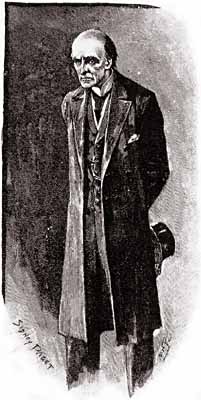
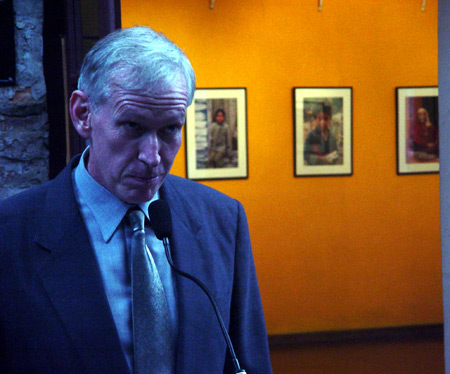 America's ambassador in Kathmandu, James Moriarty, has denounced an agreement between the Maoists and the Nepalese parliamentary parties that New Delhi sets much store by.
[Coincidence: Both men pictured here bear the name James Moriarty. One is the U.S. ambassador, the other the infamous villain created by Sir Arthur Conan Doyle]
What should India do now? As Sherlock Holmes would have said when confronted with evidence of Moriarty's villainy, it's elementary, my dear Watson.
22 February 2006
The Hindu
U.S. and India part company on Nepal
Siddharth Varadarajan
THE UNITED States and India, never fully on the same page as far as King Gyanendra's illegal seizure of power in Nepal was concerned, have now decisively parted company with Washington publicly opposing a key aspect of Indian policy: the need for the Nepalese parliamentary parties and Maoists to make common cause for the restoration of democracy in the Himalayan kingdom.
On February 15, James F. Moriarty, the American Ambassador in Kathmandu, delivered a blistering attack on the agreement reached last November between the Nepalese Maoists and the parliamentary parties, an agreement that has the implicit support of the Indian Government.
The 12-point agreement of November 22, 2005, commits the parties and the Maoists to a common struggle against the "autocratic monarchy" of King Gyanendra and to the establishment of "lasting peace" through elections for a constituent assembly. The Maoists also declared their willingness to participate in multiparty democracy and internationally supervised elections — a commitment reiterated recently by their leader, Prachanda, in an interview to The Hindu.
According to Mr. Moriarty, all of this is a ruse and the political parties are making a big mistake in joining hands with the Maoists against the palace. In prepared remarks aimed at sending a clear warning both to the parties and to India — which has encouraged the parties to work with the Maoists — the U.S. Ambassador said the 12-point agreement was "wrong-headed" and "fraught with danger." Accusing the parties of "wish[ing] away... the uncomfortable fact that their Maoist partners are committed to violence to achieve political ends," he posed three questions to the backers of the agreement. Are the Maoists truly committed to peace and democracy, as the 12-point understanding suggests? Are the Maoists committed to joining the political mainstream? If the parties and Maoists were ever able to topple the monarchy, what then?
The U.S. Ambassador then proceeded to give his own "uncomfortable answer" to these questions — that the Maoists have not changed their policies and have instead managed to draw the parties closer towards their own agenda. The United States, he said, "views the uneasy partnership between the parties and the Maoists as wrongheaded... [W]e believe cooperation along current lines between the Maoists and the parties is fraught with danger — for the political parties themselves, and for the future of the Nepalese people."
India must now choose
Mr. Moriarty's remarks pose a particularly acute challenge for India. Since the February 1, 2005, royal takeover, New Delhi has believed that the crisis in Nepal cannot end unless the Maoists are given a "soft landing." Unlike the U.S., which sees the Nepalese Maoists as a detachment of that undifferentiated, amorphous threat known as "international terrorism," the Indian Government has worked on the assumption that a political rather than a military approach to the problem is the only way forward.
Before King Gyanendra's coup and in its immediate aftermath, India believed the principal challenge to Nepal's stability came from the Maoists and that the palace and political parties had to join hands to find a political solution. Of late, however, Indian policymakers have grown increasingly wary of the King himself. They have also warmed to the idea of "mainstreaming" the Maoists by linking them in an alliance with the parliamentary parties. Though India is still officially committed to the `twin pillar theory' — that Nepal needs both multiparty democracy and constitutional monarchy — the King's refusal to accept constitutional limits has led an important section of Indian officialdom to conclude that he is his kingdom's biggest problem. New Delhi's tacit support for the 12-point agreement was the product of that conclusion.
At the same time, the Manmohan Singh Government still finds itself at a crossroads as far as the endgame of its Nepal policy is concerned. If Gyanendra's revanchist agenda suggests the monarchy is hell-bent on abolishing itself, the inherent conservatism of the Indian security establishment prevents New Delhi from totally abandoning the King. In his interview to The Hindu, Prachanda deliberately sought to allay some of India's misgivings on four specific counts. He stressed the strategic nature of his party's commitment to multiparty democracy, said Indian encouragement to the democratic forces did not constitute intervention, advised India's Naxalites to consider participating in competitive elections, and suggested China should coordinate its Nepal policy with India. One of the reasons Mr. Moriarty launched his broadside on the 12-point agreement was precisely in order to ensure that the Manmohan Singh Government is not seduced by the Maoists' attempt to mend fences with India.
Though the U.S. Ambassador also had words of criticism for King Gyanendra in his February 15 speech, it is clear that Washington has emerged as the Nepalese monarch's principal international backer. For India, the choice is now a stark one. It can continue to sit on the fence and allow the United States to dictate the contours of yet another counterfeit political settlement in Nepal. Or it can get off the fence and give a fillip to the united struggle of the political parties for a permanent end to the absolutist monarchy via elections to a constituent assembly.
King Gyanendra is already implementing the American plan. "To establish a foundation of trust, the United States believes it is up to the King to initiate [a] dialogue," Ambassador Moriarty had said on February 15. The King made an appeal to this effect three days later, with the judicially ordered winding up of the Royal Commission for Control of Corruption providing a convenient legal opening.
So far the parties have been dismissive but the more resources Washington commits to this process, the greater the likelihood that some combination of leaders will come forward to claim a mandate that is neither King Gyanendra's to give nor theirs to receive. And once a "civilian" and "democratic" government is formed, said Mr. Moriarty, the U.S. "would look eagerly for ways to assist" it by, inter alia, "renewing assistance for the Royal Nepalese Army." Thereby putting Nepal back on the destructive cycle of repression, counter-insurgency, and insurgency.
In response to the American challenge, India must now clearly state its belief that the 12-point agreement between the parties and the Maoists provides a viable road map for the restoration of peace and democracy in Nepal.
It must also call on the parties to be bolder still in their campaign to force the palace to back down. A clear signal — or even a subtle hint — that the monarchy in Nepal is no longer the pillar it used to be and that a constituent assembly is needed to determine the country's political future would give a huge boost to the morale of the democratic forces. Difficult as this decision may be for some in New Delhi to take, the alternative is far worse. For remaining silent in the face of Ambassador Moriarty's provocation would be to cede the political initiative to the U.S. — a mistake that can only have disastrous consequences for both Nepal and India.
© Copyright 2000 - 2006 The Hindu
14 February 2006
Perils of three-way security cooperation
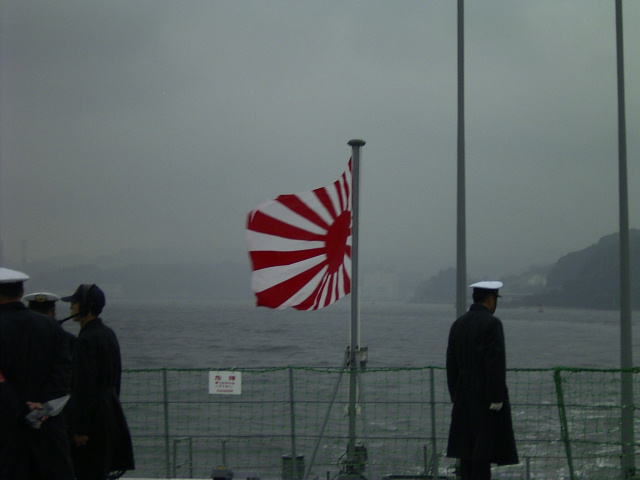
Tokyo wants India, Japan, and the U.S. to develop a trilateral framework for security cooperation. But New Delhi has good reason to be wary.
14 February 2006
The Hindu
Perils of three-way security cooperation
Siddharth Varadarajan
THIS WEEK, the chief of Japan's Maritime Self-Defence Force — a well-equipped and robust navy that is still shy about calling itself by its proper name — will arrive in India to kick off a series of the most intensive high-level military and security-related contacts the two countries will have had to date.
Admiral Takashi Saito's visit will be followed in March by that of General Tsutomu Mori, head of Japan's Ground Self-Defence Force (i.e. army), and in April, the chief of Japan's Air Self-Defence Force, General Tadashi Yoshida, will come calling. Sandwiched between these high-profile visits is the annual security dialogue between the two foreign offices as well as a visit to Tokyo by India's Defence Minister, Pranab Mukherjee. In April, provided Prime Minister Manmohan Singh names a full-fledged External Affairs Minister by then, Japan and India will conduct their first strategic dialogue at the Foreign Minister level. And the grand finale will be Dr. Singh's visit to Japan sometime in June or July, by which time both Indian and Japanese officials hope to have brought about a qualitative transformation in the strategic aspect of the bilateral relationship.
One Japanese diplomat used the phrase `hop, step and jump' — to describe Prime Minister Junichiro Koizumi's visit to India last year, Foreign Minister Taro Aso's visit this January, and Dr. Singh's return visit to Japan later this year when Tokyo hopes the two sides will be ready and willing to "jump" to a new level of understanding. From India's point of view, this growing engagement with Japan makes good sense. The two countries have dealt with each other on the economic front for years but the political and strategic dimension in the relationship is relatively new.
India, Japan, South Korea, and China have emerged as principal powers in Asia and it is essential that they interact with each other both at the bilateral level as well as in multilateral regional forums. Without these four countries — and Russia — establishing a relationship of comfort among and between themselves, it will not be possible to develop the security architecture Asia needs to deal with future challenges. This is where the present round of interaction between Japan and India — and the unprecedented visit of the three Japanese service chiefs in successive months — could play a useful role. The only hitch is that Tokyo wants more.
Apart from developing the bilateral strategic relationship with India, Japan is keen to establish a trilateral framework for dialogue and security cooperation with the United States as the third leg. The Indian side is understandably wary. The Manmohan Singh Government seeks a strong strategic relationship with the U.S. but India has no interest in ganging up — or being seen to be ganging up — against China. As it is, there is considerable wariness in China and South Korea about the future direction of Japanese regional policies. Japan has maritime disputes with both countries over the Senkaku/Diaoyutai islands and the Takeshima/Dokdo islets, respectively, and at least on the latter, there has been an escalation of rhetoric in the past few years. In February 2005, Japan also angered the Chinese by agreeing with the U.S. that Taiwan was a "common strategic objective." The last thing India wants to do is wade into that triangular relationship.
Testing the waters
When Mr. Aso visited Delhi last month, the Ministry of External Affairs displayed little enthusiasm for developing the trilateral framework that both Tokyo and Washington would like to see. But the Japanese foreign office has not dropped the idea completely. As a first step, it would like to broaden the ongoing Track-II demi-official bilateral security dialogue between the two countries by including an American component. Thus, in the next meeting of this forum in Tokyo at the end of March, the Japanese side intends to test the waters by inviting Richard Armitage — who served under Colin Powell as Deputy Secretary of State in the first administration of President George W. Bush — as an observer. This will mark the first time the bilateral India-Japan dialogue takes a trilateral turn with the inclusion of the U.S.
From the Bush administration's perspective, trilateral cooperation makes good sense. New Delhi is a crucial part of the web of alliances it has with Japan, India, and Korea which — as Secretary of State Condoleezza Rice said at Tokyo's Sophia University last March — ensure that China plays a "positive role" in Asia. "[I]f China were simply untethered, simply operating without that strategic context," Ms. Rice had said, it may be likely to play a more "negative role."
As far as Japan-India defence exchanges are concerned, a trilateral element has already crept in because of Washington's decision to use Japan-based air assets for the `Cope India' joint exercises held in Kalaikunda, West Bengal last year. The F-16s that took part in the exercise came from the Misawa USAF base in Japan and the E-3 Awacs from the Kadena base. Not only did U.S. air force personnel come from Japan (and Guam and Hawaii) but six Indian Air Force personnel visited Misawa before the exercises to familiarise themselves with the F-16.
In general terms, the trilateral idea has two dimensions. At the military level, the United States would like to enhance the inter-operability of Asian forces loosely aligned with Washington. And at the political and strategic level, it would like to demonstrate that India, Japan, and the U.S. will provide the nucleus around which any emerging security architecture in Asia must be built. A precursor on both fronts was the short-lived but strategically crucial four-power naval initiative the U.S. launched with India, Japan, and Australia in the wake of the Asian tsunami. The selection of the three countries was not fortuitous. China and South Korea also had naval assets that could have been used in relief work but they were not asked to join. In their own way, the Chinese have taken note of the significance of the quartet.
At last year's naval commanders conference organised by the U.S. Pacific Command, the dominant theme for discussion was how to effect a defence transformation that would strengthen inter-operability between the U.S. Navy and friendly or allied navies like those of India, Japan, and Singapore. The purpose being mainly to deal with the so-called Chinese military and naval build-up and the development by Beijing of an "assassin's mace" type of capability. These discussions — which are still ongoing — parallel what is being attempted on the domestic political front in Japan since the March 1999 and December 2001 "suspicious boat incidents' and more specifically after the defence panel set up by Mr. Koizumi called for a smaller but more "functional" SDF.
In its October 2004 document, "The vision for the future national security and defence capabilities," the panel also advocated a change in the constitutional principles that have prevented the Japanese military from playing a more pro-active or offensive role.
When Admiral Saito meets his Indian counterpart, he is likely to explain Japan's evolving defence policy. According to Japanese diplomats, he will focus on the "importance of the U.S. military presence in Asia, and their contribution to peace and security" as well as the "Chinese military build-up" and the situation in the Korean Peninsula. There will also be the usual plans of fleet visits and friendly maneouvres.
How to remain strategically engaged with Japan while also developing a strategic relationship with China and South Korea is a key diplomatic challenge that India will increasingly have to face up to. In its interaction with Japan, the Indian side needs to encourage a constructive approach to Asian security based on addressing current concerns as well as the lingering burdens of history.
Security, and maritime security in particular, is not a zero-sum game in which a select group of countries needs to band together and exclude others in a manner reminiscent of the Cold War. Cooperative security rather than containment is what Asia needs. This is the goal India and Japan should work with others in the continent to achieve.
© Copyright 2000 - 2006 The Hindu
10 February 2006
Transcript of the complete Prachanda interview
The Hindu
Exclusive interview with Prachanda, Maoist leader This is a complete verbatim transcript of Nepali Maoist leader Prachanda's interview with Siddharth Varadarajan of The Hindu, conducted at an undisclosed location in the first week of February 2006. Highlights and excerpts from the interview were published in the print edition of The Hindu of February 8, 9, and 10, 2006. Varadarajan: Your party has waged a "people's war" in Nepal for 10 years and the anniversary is now coming up. There are some who say that this war - and the Royal Nepal Army's counter-insurgency campaign - has cost the country dearly in terms of the violence and bloodshed that has accompanied it. In your estimation, what has been the main accomplishment of these 10 years? Prachanda: For 250 years, our peoples have been exploited under the oppression of feudal lords. The people's war has helped crush the feudal structure in the rural areas. We think this is the main achievement. Also, in the overall sense we feel that in Nepal there is going to be a great leap forward in the socio-economic condition because we are going to lead the country to a democratic republican structure. A political situation has been developed through this process, and we feel this is also a very big achievement of the people's war. Varadarajan: In your party plenum last August in Rolpa, you took a momentous decision - to strive for and participate in multiparty democracy. If you were going to accept multiparty democracy after 10 years of war, why go about this in a roundabout way? Prachanda: I want to answer your question in two parts. There is the whole theoretical and ideological question that we are trying to develop, because we want to analyse the experience of revolution and counter-revolution in the 20th century on a new basis. Three years ago we took a decision in which we said how are we going to develop democracy is the key question in the 21st century. This meant the negative and positive lessons of the 20th century have to be synthesised in order for us to move ahead. And three years ago we decided we must go in for political competition. Without political competition, a mechanical or metaphysical attitude will be there. So this time, what we decided is not so new. In August, we took serious decisions on how practically to build unity with the parliamentary political parties. We don't believe that the people's war we initiated was against, or mainly against, multiparty democracy. It was mainly against feudal autocracy, against the feudal structure. Varadarajan: How difficult was it for your party to come to this decision? How difficult was it to build consensus on the need for multiparty democracy within the leadership and cadres? Prachanda: An agenda was first presented to the Central Committee on democracy. Then there was an internal debate within the party rank and file for a whole year. After that, the CC plenum unanimously decided that within a definite constitutional framework we have to go in for competition. Without competition, we will not be able to go forward. This was a unanimous decision. Varadarajan: Is this decision a recognition by you of the impossibility of seizing power through armed struggle? That because of the strength of the RNA and the opposition of the international community, a new form of struggle is needed in order to overthrow the monarchy? Prachanda: Here again there is not only one question. There is a specificity to the political and military balance in today's world. This has to be seen. The second thing to be seen is the experience of the 20th century. Third, there is the particular situation in the country - the class, political and power balance. It is by taking these three together that we came to our conclusion. We are talking of multiparty democracy in a specific sense, within a specific constitutional framework. We are not talking about bourgeois parliamentary democracy. This multiparty democracy will be anti-imperialist and anti-feudal. In other words, only within an anti-feudal, anti-imperialist constitutional framework is multiparty democracy possible. That is why armed struggle is also necessary, and unity in action with the other political parties against the monarchy is also a necessity. The socio-economic change we are fighting for is against feudalism and imperialism and it is within the context of that struggle that we are talking of multiparty democracy. Road map to democratic republic Varadarajan: So if the king announces tomorrow that the steps he took last year were wrong and allows free and fair elections under the present Constitution, the Maoists will not take part? Is a new constitutional framework a pre-condition for taking part in elections? Prachanda: Yes, you can put it that way. If the king says that I was wrong to have done what I did last year, now come on, let us sit across the table, and then he talks of a free and fair election to a constituent assembly, then we will be ready. Our minimum, bottom line is the election of a constituent assembly, that too under international supervision, either by the United Nations or some other international mediation acceptable to all. Under those circumstances, we will go in for elections and accept whatever the peoples' verdict is. This is our bottom line. But if the king says, come on, make an interim government and hold elections, we will not come forward. Varadarajan: But will you oppose the parties doing that? If the parties agree to go ahead on this interim basis, what will happen to your alliance or agreement with the parties? Prachanda: If the king asks them to form a government and the parties go in for parliamentary elections without looking at the demands we have been making for the past 10 years, it would be difficult for us to go along with the parties. Because this is what you had before. The king and the parties were together for 7-8 years. That was the situation. And still there was struggle, because the demand for a constituent assembly is a longstanding one. It is not a demand that came up only today. Varadarajan: How crucial was the August plenum decision on multiparty democracy to paving the way for the 12-point agreement with the parties? Prachanda: After the Royal Palace massacre itself, we had made an appeal to the parliamentary parties. There was a general understanding and some meetings were also held because the 2001 royal massacre was against democracy. In the 1990 movement, we were together with the Congress and UML [Unified Marxists-Leninists]. We felt the change that was needed in Nepal was against feudalism but the parliamentary parties were not ready for this. For three years we struggled inside Parliament. For three years we were there. Our 40-point demands were placed but there was not even any discussion on this. So the seeds of our armed struggle were sown inside Parliament, in a manner of speaking. This is a very big difference between us and, say, those in India who say they are waging a people's war. They didn't begin from inside Parliament. We were inside Parliament, so we had good relations with the parliamentary parties for a long time. The 1990 movement produced limited gains. We could have taken more but got less from the palace because of a compromise. At the time we said the Nepali peoples have been cheated. We said this compromise was bad and that there was a danger of the palace grabbing power again, as had happened in Mahendra's time. We said this from the rostrum of Parliament but the other parties did not have the courage even to act against those elements from the panchayat system that the Malik commission had identified as criminals. And gradually a situation arose where those elements were able to enter the parties, the government. After the palace massacre, we said that what we had predicted in 1990 had come to pass, that diehard elements have hatched a conspiracy and come forward. And we appealed to the parties to unite together as we had done in 1990. The parties were in government so it was not possible for them to understand our appeal. But slowly, the king's designs became clearer: he dissolved Parliament, dismissed the government and took direct power. This is when I think the parties realised they had been taken for a ride all this time. This is also when our plenum took concrete steps on the question of multiparty democracy. And our statement stressed that the time had come for all the parliamentary parties to join hands with our movement and civil society to fight against autocracy and monarchy. At the plenum, we decided we needed to show more flexibility, that it was our duty to do this. So we took concrete steps and declared to the parties, 'You lead, we will support you.' This so-called king - he is not a traditional king and the Nepali people do not accept him as king. He and his group are well-known goons and people see them as a regicidal-fratricidal clique. He is not even a person who is capable of thinking politically. So we told the parties, come on, we want to help you. Before the plenum, we contacted the Nepali Congress and UML leaders and tried to bring them to Rolpa. But this was not possible. Commitment to democracy not a tactic Varadarajan: Nowadays, we hear the phrase 'The Maoists will sit on the shoulders and hit on the head.' Does this mean your alliance with the parties is tactical rather than strategic, that when the head - the monarchy - is weakened or defeated, you might then start hitting the shoulder? Prachanda: It is not like this. Our decision on multiparty democracy is a strategically, theoretically developed position, that in a communist state, democracy is a necessity. This is one part. Second, our decision within the situation today is not tactical. It is a serious policy. We are telling the parties that we should end not only the autocratic monarchy but monarchy itself. This is not even a monarchy in the traditional way it was in Birendra's time, so we have to finish it. After that, in the multiparty democracy which comes - interim government, constitutional assembly and democratic republic - we are ready to have peaceful competition with you all. Of course, people still have a doubt about us because we have an army. And they ask whether after the constitutional assembly we will abandon our arms. This is a question. We have said we are ready to reorganise our army and we are ready to make a new Nepal army also. So this is not a tactical question. Varadarajan: The 12-point agreement suggests you and the political parties have met each other half-way. They have agreed to a constitutional assembly and you have dropped your insistence on a republic. Prachanda: We have not dropped our demand for a democratic republic. But to achieve that minimum political slogan, we have said we are prepared to go through free and fair elections to a constituent assembly. There shouldn't be any confusion that we have now agreed to a ceremonial monarchy. Some people have tried to draw this conclusion from the 12-point agreement but even at the time we explained to the parties that our slogan is a democratic republic. Earlier, we were saying people's democratic republic but this does not mean we have dropped that goal either. It's just that according to today's power balance, seeing the whole situation and the expectation of the masses, and that there [should] not be bloodshed, we also responsibly believe that to get there too we will do so through peaceful means. Varadarajan: So the struggle for "people's democracy" will also be peaceful? Prachanda: We will go for the goal of the people's democracy through peaceful means. Today, we are talking of a democratic republic and our understanding with the parties is that the way to realise this is the constituent assembly. At that time, any other party would be free to call for a ceremonial monarchy, some may be for constitutional monarchy - such a thing is possible with the seven parties. Varadarajan: But whatever the outcome, you are ready to accept it. Prachanda: We are ready to accept whatever is the outcome. This we are saying in clear-cut language. Logic of ceasefire Varadarajan: Your three-month ceasefire, and then the one month extension, did a lot to improve the profile and image of the Maoists, which had been damaged by certain incidents like the Madi bus blast. What was the logic behind that ceasefire and what are the roadblocks in the way of declaring another ceasefire in the near future? Prachanda: When we called our ceasefire, there was no 12-point agreement with the parties nor was there any particular political or moral pressure on us from them or civil society. But we acted based on the whole political situation, because on our side too, some mistakes were increasing, from below, in the implementation of our policy and plan. At the lower level, some mistakes were happening such as the Madi bomb blast. So with the middle class our relationship was getting worse. Earlier, there was an upward trend in that relationship but we felt there was a danger of the graph falling. We were saying things from the top but still this was not being implemented. So we wanted the middle classes to be with us, and put out our political message to the broad masses in a new way. We also wanted to tell the international community that Gyanendra is not a monarch, these are autocratic, fascist elements who are more keen on bloodshed and violence than anybody else. We wanted to demonstrate this, and rehabilitate our image with the masses. So for these reasons we decided to go for a ceasefire. As for the specific timing, there were two factors. The UN General Assembly was going to be held and the so-called king was going to go there. There he would have said he was for peace and democracy. Such a notorious element was going to go and create confusion over there. This possibility also needed to be crushed. This was a question. So we thought of a ceasefire as one way politically to hit out at him. It was only after the ceasefire that the dialogue with the political parties began. And then a conducive atmosphere got created for the 12-point agreement. We also wanted to send a message to the international community that we were different from the way we were being projected ideologically. For example, right now we are having discussions with the European Union and with others, but among all the international forces, U.S. imperialism is the most dogmatic and sectarian element. The U.S. ruling classes are dogmatic. They don't understand what is happening. We are trying to look at the world in a new way, to change in a new way, and we wanted to send out this message. And in this regard, during the ceasefire, we were quite successful. Right from the outset, we knew the monarch wanted us to abandon the ceasefire immediately. He was under so much pressure, he had to cancel his programme of going to the U.N. He was so politically isolated that he was desperate to provoke us to break the ceasefire. We knew that we had to sacrifice and ensure that for three months at least it was upheld because there were festivals, and we wanted to develop our psychological relations, spiritual relations with the masses. When we extended the ceasefire by a month, it became clearly established that this so-called monarch does not want a political solution, does not want peace. He is a bloodthirsty element, a fascist and autocrat. And when we finally ended the ceasefire, we clearly stated that if a forward-looking atmosphere for a political solution emerges, and all the political forces are ready for peace and democracy, then in that situation at any time we can again announce a ceasefire, and sit down for negotiations. But now, that situation does not obtain. Nature of alliance with parties Varadarajan: As a first step, are you prepared to join together with the parliamentary parties, with Mr. Koirala and Madhav Nepal, and go and talk face-to-face with the king to discuss the future of Nepal? Prachanda: Immediately after the 12-point agreement, I had clearly said that if there is a unanimous understanding with the parties that we should go and talk to the king, then we will go. We are not prepared to meet the king alone, and we are also requesting the parties that they should also not go alone. Nothing will come of it. Only if we act collectively can we achieve anything. The alliance has to be strengthened and taken forward. For example, right now we have this huge drama of municipal elections. More than two-thirds of the seats will be vacant, and still he is trying to stage a drama. Varadarajan: But rather than the Maoists calling a seven-day bandh, wouldn't it have been better as a tactic for you and the parties to have given a united call for the political boycott of the elections. That way, the king would not get the opportunity to claim the elections were a farce because of Maoist threats. Prachanda: Yes. I agree with what you are saying. That would have been better. When the 12-point agreement was reached, there was a second understanding that within a week or two, we eight parties - the seven party alliance and the Maoists - would issue a joint statement appealing to the masses to boycott elections and stage mass demonstrations. But that has not proved possible. Varadarajan: Why? Prachanda: Because the parties' leadership is a little hesitant. They are perhaps a little afraid that if they join with the Maoists and issue a joint statement for boycott, there could be greater repression on them. I think this could be a factor, though we have not had face-to-face discussions on this with them. Varadarajan: Some feel that the Maoists' military actions are reducing the political space for the parties. For example, a few days before the parties were planning a big demonstration in Kathmandu, the Maoists attacked a police station in Thankot and the king got the opportunity to impose curfew, thereby ensuring the demonstration failed. Have you considered what actions you need to take so that your political space also increases but the parties don't feel squeezed between the king and you? Prachanda: I agree a way has to be found. This is a serious and complicated question. When the 12-point agreement was reached, there was a need for continuous interaction between us and them. There was need for several meetings. Only then could we establish some synchronicity between their movement and ours. This did not happen. Despite this, we told the parties through other mediums that whether we stage actions or not, the king is still going to move against you. This is the same king, the same goons - he is also a very big smuggler - who made sure we couldn't peacefully demonstrate. When we went for negotiations in Kathmandu and our team was there, we decided to have a big meeting there. Sher Bahadur Deuba was the Prime Minister at the time. But the RNA and Gyanendra insisted we could not have such a rally and threatened curfew. They compelled us to move the meeting to Chitwan. So we told Girija and Madhav that even if we had done nothing in Thankot, they would not have allowed any big demonstration. Curfew would have been imposed anyway. Instead, Thankot has put Gyanendra under greater pressure. Nature of monarch Varadarajan: You mentioned the RNA and I would like your assessment: Does the king control the RNA or does the RNA control the king? Prachanda: This is a very interesting question. Right now, in fact, this is precisely what we are discussing within our party and outside. Until now, it seemed the balance was 50-50. Sometimes the RNA runs the king, and sometimes the king runs the RNA. But it seems as if we are now going towards a situation where the RNA is in the driving seat. It seems as if power in the hands of Gyanendra is decreasing and he is doing what the RNA dictates. This seems to be the emerging situation but we cannot say this with facts. But looking at the overall situation, it seems that Gyanendra is going down the path laid out by the RNA. One thing is clear. He became king after the royal massacre - and it is clear that without the RNA, that massacre could never have happened, the Army core team was in the Narayanhiti palace and they are the ones who engineered the massacre. So he was made king in the same way as before, during the Rana days, when Tribhuvan fled and came to India and Gyanendra as a small boy was put on the throne. So there is no question of his going beyond the script dictated by the RNA. And this small clique of feudal aristocrats designed the royal massacre and is dominant. The manner in which he became king obliges Gyanendra to follow their direction. Varadarajan: I too was in Kathmandu immediately after the palace massacre to cover the story. Like many reporters, I was initially suspicious of the Dipendra theory but later, after managing to meet some of the closest relatives of those who died, who spoke to actual survivors like Ketaki Chester and others who cannot really be termed as people connected to any monarchical faction with a particular agenda. And they all said it was Dipendra who committed the crime. Prachanda: This is impossible. Of course, the clique has managed to establish the story amongst its own circles, among people who may be neutral as you say. They have established it in their class but that is not the reality. You know how different stories were put out immediately. First that the guns went off automatically, then another story was made. There was even an effort to suggest the Maoists had made a surprise attack. In the end, they pinned it on Dipendra. So the question arises, if it was so clear-cut, why didn't this story come out in the beginning? But my main logic is not this. If you look at the whole history of [crown prince] Paras - he was there at the time - now the whole history of Paras is well-known. Second, the role of Gyanendra in the 1990 movement. He had a big role then - he wanted to shoot down 2,000 people in Kathmandu and control the movement through force, he was a die-hard element. Even Surya Bahadur Thapa used to call them the bhoomigat giroh, an underground clique, and their leader was Gyanendra.What kind of goon Paras was - this is also known. For more than a month, the massacre was planned and Gyanendra based himself outside. So I don't think for even a moment that it was Dipendra. And in any case, the Nepali people simply refuse to believe this story. Reorganisation of PLA and RNA Varadarajan: Let us say a situation is created for a constituent assembly. In the run-up to that, the People's Liberation Army is not going to lay down its arms. Is it not possible that the parliamentary parties will feel themselves threatened by your dependence on arms? What kind of guarantees can you give in the run-up to any election that there will be no obstacle placed by you or the PLA in the political mobilisation by the parties? Prachanda: When we had discussions and had an agreement last year - and we hope to meet again and take things forward after these municipal elections - we said we understand you have doubts and reservations about us and our army. We want a political solution to Nepal's problems, a democratic solution. So we made a proposal that you rehabilitate Parliament, we will support you. A two-thirds majority of MPs is with the Nepali Congress, UML and smaller parties. Call a meeting and declare that Parliament has been reinstated, that this is the legitimate parliament and that what Gyanendra is doing is illegitimate and illegal. Do this and then set up a multiparty government. We will not be part of it but will support it. And then you invite us for negotiations and we will come forward. After that, there will be a move to set up an interim government, and the main aim of that government will be to have elections for a constituent assembly. In this rehabilitation and restoration of Parliament, there is no need to have anything to do with the king. He would have become illegal anyway. He has violated the constitution and also people's expectations for peace and democracy. So he would be illegal, your parliament would be legal and we would fully accept the legality of your parliament. We will come for negotiations with your leadership. Under your leadership, we will be in the interim government. As for the RNA, you should appeal to the democratic elements within it by saying the king has violated the constitution, and the expectations of the masses, you come over to this side, this is the legal government and it is your responsibility to support it. And then the king should be given an ultimatum of a week or two weeks - that he should move back to the status quo ante before February 1, 2005 and agree to elections for a constituent assembly. If he doesn't agree, we would then abolish the monarchy. And we would tell the international community, this is the legitimate government, please stop recognising or supporting him. Ours is a legitimate government and this should be under the leadership of Girija Prasad Koirala. We are ready to support this. Under such a situation, the democratic elements of RNA will be there, and so will the PLA, so we will organise the army as a new Nepal army. At that point, the problem will not be our weapons. The problem of arms and weapons is with the RNA which for 250 years has been loyal to the feudal lords. That is the problem. Our army has only been around for 10 years. This is not a problem. If there is a political solution, we are prepared to change that too. This is the first proposal that we have put forward. We will abolish the monarchy, there will be an insurrection (bidroh), the kingship will be over and then we will have the peaceful reorganisation of the army. This is one way to deal with this problem and we are seriously putting it forward. It is revolutionary, it is viable, it is possible. It is precisely in this way that it is necessary to end the monarchy in Nepal. This is our first proposal and I feel the parties are not ready for this. Varadarajan: What you are proposing is that the parliamentary parties stage a revolution! Prachanda: Yes, but we feel their role can be a historic one. But they are not ready. The second way is also what we have been discussing, that the U.N. or some other credible body will supervise things. The RNA will be in the barracks and the PLA will also be under supervision. Both armies and arms will be under international supervision and will not enter the fray. Then there will be elections for a constitutional assembly. Our army will not interfere in the process. Varadarajan: But what form will this international supervision take? Will it include foreign troops? Prachanda: No troops. There can be a militia or police, which we create only for election purposes. Varadarajan: Who will be part of this militia? Prachanda: We have not gone into such details - there can be the cadres of the different parties, but all without firearms, to manage security for the elections. So there will be elections for the assembly and whatever verdict of the masses comes, it is on that basis that the army has to be reorganised. If the republic result comes, then the RNA's generals and commanders will have to go and the interim government would appoint as generals officers who are loyal to democratic values. If a constitutional monarchy wins, then there is the danger that the old generals will remain. So my point is that the army can be changed. This is the underlying idea behind the 12-point agreement and the parties also agree with this. Varadarajan: So you are saying the problem of the PLA and its arms is not a big problem. Prachanda: It is certainly not a problem the way people outside believe. If there is political will on our side and the parties, it can be solved. Varadarajan: But you concede there is a history, which is why the parties are suspicious. Prachanda: Yes there is, but we are talking about this too. There have been attacks by us on them, and we had seized property. Whatever had been taken from the Congress leadership has been returned - land and property - UML leadership too. So we are trying to build an understanding. If the parties' leaders say that in the past the Maoists attacked us, then we can also say that the RNA army was deployed against us when you were in government and so many of our comrades were killed. Whatever we may have done, the other side did so much more and this also has to be accounted for. But if we start talking like this, we will not be able to solve the major problem. If we have to make a breakthrough, then we should both review our history. We have to review our mistakes but you have to as well, because we have a common enemy - feudal aristocracy. We have to defeat this enemy and in consonance with democratic values we have to reorganise the army and state. Role of India, China, and U.S. Varadarajan: How do you see the role of India today? Last year, when the King seized power, India took a tough stand against him which surprised many. Today, this policy has its critics but the bottom line is that the Indian Government does not seem to regard the Nepal Maoists as illegitimate in the way that the king and the U.S. regard them. Prachanda: In the past, India's role was not good. It was a policy of total alignment with the king. Last year, after February 1, when the situation changed in a big way, the role of the Indian authorities strikes us as positive. There is now a tough stand against autocracy. Still, the two-pillar theory [that Nepal's stability rests equally on constitutional monarchy and multiparty democracy] persists and the Indian authorities have not officially abandoned this theory. They haven't said there is need for only one pillar. So officially, India is still sticking to the two-pillar theory and we want the Indian authorities to change this theory. They are right to support the democratic movement, but sticking to the two-pillar theory causes confusion. Varadarajan: But if India abandons it, wouldn't the King accuse the Indians of interfering in Nepal's affairs, and then he will accuse the Maoists of being agents of India. Prachanda: We do not think such a thing is possible. During the 1990 movement, when Rajiv Gandhi imposed a blockade on Nepal, the Nepali people did not oppose the blockade because it was in the context of the blockade that the democratic movement picked up speed and advanced very fast. If India is in favour of the democratic movement and a forward-looking political solution, then it will not be considered intervention. But if India supports regressive forces, this would be called intervention. Exertion of external pressure in favour of the masses is never regarded as interference. This is how it seems to us. The people of Nepal will not see this as intervention. For example, some political leaders came from India recently to show solidarity with the movement. Gyanendra tried illegally to detain them at the airport, calling it intervention. But more than 99 per cent of Nepali people did not regard that as intervention. They saw it as fraternal assistance. Of course, when Hindu fundamentalists like this Singhal comes to Nepal, the King welcomes him. When they crown him 'King of the Hindus', he doesn't call it interference, but when political leaders come and say there should be democracy, he says this is interference. So the anger of people has grown against the King, not India. This is why we feel it is time for India to abandon the two-pillar theory. Varadarajan: If tomorrow you were to meet Manmohan Singh, what would you ask him to do? Prachanda: First, change this two-pillar theory. The Nepali people are trying to end the monarchy and you should end your relationship with it. Second, release all our comrades who are in prison in India. We are fighting for genuine multiparty democracy but they are imprisoned there, in Patna, Siliguri, Chennai. If you release them all, a message will go out. And if you feel the Naxalite movement in India is a problem for you, we feel we are trying to deal with the problems in Nepal in a new way, so if you release our comrades and we are successful in establishing multiparty democracy in Nepal, then this will be a very big message for the Naxalite movement in India. In other words, the ground will be readied for them to think in a new political way. Words are not enough, we need to validate what we are saying by establishing that democracy. Third, once a democratic republic is established in Nepal, then the historical doubts that have existed in the relations between Nepal and India can be ended once and for all. So for all these reasons, you should strongly support the movement for democracy. Varadarajan: In many ways, the United States has emerged as the king's strongest backer. How do you evaluate Washington's role? Prachanda: Their role has not been good. After February 1, India's role has been positive - for example the agreement we were able to reach with the political parties, I do not think it is likely that the Indian authorities knew nothing about this. But the U.S. role from the beginning has been negative and they are still trying to effect a compromise between the monarch and the political parties against the Maoists. Despite the fact that we are talking of pushing multiparty democracy, the U.S. has decided our movement and alliance has to be crushed. So they have a negative role. Varadarajan: What is the American interest in being soft on the king? Prachanda: It is not that they are afraid of what might happen in Nepal. Rather, their strategy is against the Indian and Chinese masses and also, I think, against the Indian and Chinese authorities. The U.S. has a grand strategy, and Bush is talking of China and India as big economic powers and even as threats. Perhaps they see Nepal as a country that is between these two countries and believe that if the situation here does not give rise to forces which are in step with themselves, then there could be a problem. So the U.S. is looking at Nepal from the strategic point of view. It is not that they have any economic interest here. Political control is the key, so they want to strengthen the king. Varadarajan: What about the attitude of China? Some people in India argue that if India continues to take a tough stand against the king, he will turn to China for help and Beijing will benefit. Prachanda: Earlier, we had a doubt, that perhaps China might be behind the king, that China would try and take advantage. But then we analysed the situation and came to the conclusion that China would not play this role. China's relations with India are improving and China will not want to jeopardise such a big interest by backing the Nepal king. And in the end, I think our analysis has been proved correct. Recently, when the Indian Foreign Secretary, Shyam Saran, went to Beijing, he had talks, and a few days later, for the first time, the Chinese authorities issued a statement that they are worried about the situation inside Nepal and that it needs a careful resolution. Until then, Beijing had always maintained that what was happening inside Nepal was an internal problem. Today, China has no interest in antagonising India to build a relationship with the king. This is our analysis. And it looks like India and China could have a common approach towards Nepal. Certainly, a common approach is needed. If China and India do not work together, there will be a big problem not only for now but the future. So they need to have an understanding in favour of democracy, in favour of the people of Nepal. As far as U.S. interests are concerned, they are neither in favour of Indian or Chinese masses. So at the political level, all of us must come together to counter them, we should not fall under their trap. Varadarajan: How do you explain for the contradictory nature of some of U.S. Ambassador Moriarty's statements? Last year, he did use tough language against the king in his speech to the Institute of Foreign Affairs. Prachanda: The U.S. from the start believes the Maoists are a more immediate threat than the king. Even in the most recent statement from the State Department, they said the king should immediately open talks with the parties to deal with the Maoists. And this is the product of their vested interest. If the Bush administration's intentions were good, there is no reason to regard us as a threat. If its intention is in favour of democracy and solving Nepal's political problems, then there is no reason to see us as a threat especially when we are saying we are for multiparty democracy and are willing to accept the verdict of a constituent assembly. We are glad with the new situation that is emerging after Shyam Saran went to China, it seems the situation can change. Our movement is also going forward and I think in 2-3 months, if the struggle continues, then there is a real chance of ending the kingship once and for all and making a democratic republic in Nepal. This is the best outcome for China and India, and everyone else. The U.S. does not want this. They want to maintain the monarchy at all costs. Moriarty consistently has been speaking against the Maoists. He is connected to the Asia-Pacific military command of the U.S. He is not a political man. And we know that although his views are different from some in the U.S. establishment like, say, Senator Leahy, but overall, the position of the U.S. authorities is not in favour of democracy and Nepal people. Leadership question and inner party life Varadarajan: Has your party put behind it the differences which emerged last year between yourself and Baburam Bhattarai? Prachanda: There was a problem and we solved it so well that the unity in our party is stronger than ever before. Our problems were not of the kind the media wrote about. We had an ideological debate about how to evaluate the 20th century. Why did the communist movement suffer such an enormous setback? Why did the Russian revolution get overcome by counter-revolution? Why did China also go down that path? This was a debate within the central committee for many years. There were other problems linked to shades of opinion within the party - like the Madi blast - but the purpose was to sort out our future plan. This was the purpose of the debate. But the timing was such that these things happened after February 1. If the timing had not been so bad, there wouldn't have been that much propaganda. But the time the king took over was also the time the debate in our party sharpened. Varadarajan: The question was raised of a cult of personality in the party. As you know, any objective evaluation of the experience of the 20th century communist movement has to consider the cult of personality as certainly one of the factors in the reversals. Prachanda: That is correct. But I want to clarify one thing. Between Dr. Bhattarai and me, there was never any debate on the issue of leadership. He has never challenged my leadership. On the issue of leadership personally, there has never been a difference. There were differences on ideological questions, about what we should do now, and there was a debate. And this debate we solved in the Rolpa plenum in August. We took it to a higher level and our unity has become stronger. This will be a big sacrifice for our leadership. Of course it does not mean we will be inactive or retire from politics. Our leadership team will go into statesmanship. We are hoping that by doing this we will solve a very big ideological problem of the communist movement. This is not only a technical question but a big ideological question. There can be no question of concentrating power in the hands of any individual or group. When we placed this resolution before the plenum, then our entire leadership team gained confidence in themselves, the movement and the line. Our unity has become much stronger. Now we are in an offensive mood. We feel we have contributed to the ideological development of Marxism-Leninism-Maoism. Traditionally, in the international communist movement there are two types of revisionism - right revisionism of class collaboration, and the other, dogmato-revisionism, of turning certain ideas into a dogma and getting stuck to them. This is more among the Maoists. Those who call themselves Maoists are more prone to dogmato-revisionism, and we have to fight against this too. Varadarajan: To what extent do you think the logic of your line on multiparty democracy applies also to the Maoist movements in India? Prachanda: We believe it applies to them too. We want to debate this. They have to understand this and go down this route. Both on the questions of leadership and on multiparty democracy, or rather multiparty competition, those who call themselves revolutionaries in India need to think about these issues. And there is a need to go in the direction of that practice. We wish to debate with them on this. If revolutionaries are not going to look at the need for ideological development, then they will not go anywhere. Varadarajan: The Indian police agencies say you are providing weapons and training to the Indian Maoists but here you are saying they should go in for multiparty competition. Prachanda: There is no question of us giving anything. They blame us for Madhubani, Jehanabad, but we have no relationship of this kind with them. Varadarajan: What is your evaluation of the recent political developments in Latin America - with what is happening in Venezuela with the Bolivarian movement, in Chile, Bolivia? Prachanda: We feel there is a new wave of revolution on the horizon. The first wave began with the Russian revolution and ended with the Cultural Revolution but now it looks like the second wave could be starting. Dogmatism and ideological stagnation is evident in the U.S. Bush is in league with Christian fundamentalists. Throughout Latin America there is resentment and hatred against imperialism, from Venezuela, Brazil, Bolivia and Chile, and an explosion can come at any time. The encirclement of America has begun. But I also believe this explosion can start from South Asia. Nepal and India have a big role to play. The U.S. will not be able to control things. And the developments in Latin America are a good augury. Varadarajan: In conclusion, tell us a little about yourself. How old are you now? When did you join the movement? Where did you study? Prachanda: I am 52 and have been in the movement full time for the past 34 years. I drew close to communism when I was 16, as a student in high school, and became a whole-timer when I was 28. I did a B.Sc. at the Chitwan agriculture university and was studying for a Masters in Public Administration when there was a big movement around the time of the referendum Birendra was organising. That is when I joined the movement, and couldn't complete my course. Since then I have been active, most of the time underground. Varadarajan: And family life? Are you married? Prachanda: Yes. My family, of course, is also in the movement. Varadarajan: Thank you very much for this interview. Prachanda: Thank you. |
"Multiparty democracy in Nepal will be message to Indian Naxalites"
10 February 2006
The Hindu
"Multiparty democracy in Nepal will be message to Indian Naxalites"
Siddharth Varadarajan
| In the second and final part of this exclusive interview withThe Hindu, Maoist leaderPrachandaprovides his evaluation of the role of India, China, and the United States in the struggle for democracy in Nepal. And he has words of advice for the Maoists in India: it is time you started thinking about multiparty competitive democracy as well. |

Prachanda: "Once a democratic republic is established in Nepal, the doubts that have existed in the relations between Nepal and India can be ended." — Photo: V. Sudershan
I want to ask you about the 2001 royal palace massacre. I was in Kathmandu to cover the story. I was initially suspicious of the Dipendra theory but later, I spoke to close relatives of those who died — who spoke to survivors like Princess Ketaki Chester who cannot really be considered part of monarchical factions with a particular agenda. And they all said it was Dipendra who committed the crime.
How do you see the role of India today? Last year, when the king seized power, India took a tough stand against him that surprised many. It is also significant that the Indian Government does not seem to regard the Nepal Maoists as illegitimate in the way that the king and the U.S. regard them.
If you were to meet Manmohan Singh, what would you ask him to do? What is the American interest in being soft on the king? It is not that they are afraid of what might happen in Nepal. Rather, their strategy is against the Indian and Chinese people and also, I think, against the Indian and Chinese authorities. The U.S. has a grand strategy, and Bush is talking of China and India as big economic powers and even as threats. Perhaps they see Nepal as a country that is between these two countries and believe that if the situation here does not give rise to forces which are in step with the U.S., then there could be a problem. So the U.S. is looking at Nepal from the strategic point of view. It is not that they have any economic interest here. Political control is the key, so they want to strengthen the king. What about the attitude of China? Some people in India argue that if India continues to take a tough stand against the king, he will turn to China for help and Beijing will benefit strategically at New Delhi's expense. Earlier, we had a doubt that perhaps China might be behind the king, that China would try and take advantage. But then we analysed the situation and came to the conclusion that China would not play this role. China's relations with India are improving and China will not want to jeopardise such a big interest by backing the Nepal king. And in the end, I think our analysis has been proved correct. Recently, when Indian Foreign Secretary Shyam Saran went to Beijing, he had talks, and a few days later, for the first time, the Chinese authorities issued a statement saying they are worried about the situation inside Nepal and that it needs a careful resolution. Until then, Beijing had always maintained that what was happening inside Nepal was an internal problem. To what extent do you think the logic of your line on multiparty democracy applies also to the Maoist movements in India? Indian police agencies say you are providing weapons and training to the Indian Maoists but here you are saying they should go in for multiparty competition... © Copyright 2000 - 2006 The Hindu
09 February 2006
Prachanda: From people's war to competitive democracy
9 February 2006
The Hindu
From people's war to competitive democracy
Siddharth Varadarajan
| As leader of the Communist Party of Nepal (Maoist),Prachandais arguably the most important political player in the Himalayan kingdom today. In an exclusive face-to-face interview withThe Hindu, he discusses his party's road map for the end to monarchy and the creation of a democratic republic in Nepal. |

Prachanda: "Our strategically, theoretically developed position is that in a communist state, democracy is a necessity." — Photo: V. Sudershan.
Bespectacled and greying, 52-year-old Prachanda looks and sounds distinctly professorial. His measured tone and quiet demeanour bear no resemblance to the fearsome descriptions propagated by his royalist detractors. When I met up with him at an undisclosed location, he spoke for more than an hour-and-a-half on a wide range of topics concerning the situation in Nepal, its international ramifications, and the theoretical problems confronting the communist movement in the 21st century, which have led the Maoists to embrace multiparty democracy. Excerpts:
In your party plenum last August, you took a momentous decision — to participate in multiparty democracy. If you were going to accept multiparty democracy after 10 years of "people's war," why go about this in a roundabout way?
Prachanda: Three years ago we decided that the key question of the 21st century is how to develop democracy. This meant the negative and positive lessons of the 20th century have to be synthesised for us to move ahead. And we decided we must go in for political competition. Without political competition, a mechanical or metaphysical attitude will be there, without competition we will not be able to go forward. This was a unanimous decision. Last August, we took serious decisions on how practically to build unity with the parliamentary political parties. We don't believe that the peoples' war we initiated was against, or mainly against, multiparty democracy. It was mainly against feudal autocracy, against the feudal structure.
Is this decision a recognition by you of the impossibility of seizing power through armed struggle?
Here there is not only one question. There is a specificity to the political and military balance in today's world. The second thing to be seen is the experience of the 20th century. Third, there is the particular class, political, and power balance in Nepal. It is by taking these three together that we came to our conclusion. We are talking of multiparty democracy within a specific constitutional framework that is anti-feudal and anti-imperialist. That is why armed struggle is also necessary, and unity in action with other political parties against the monarchy is also a necessity. The socio-economic change we are fighting for is against feudalism and imperialism and it is within the context of that struggle that we are talking of multiparty democracy.
If the king says the steps he took last year were wrong and allows free and fair elections under the present Constitution, the Maoists will not take part? Is a new constitutional framework a pre-condition for taking part in elections?
Yes, you can put it that way. If the king says I was wrong, now come on, let us sit across the table, and then he talks of a free and fair election to a constitutional assembly, we will be ready. Our bottom line is the election of a constitutional assembly, that too under international supervision, either by the United Nations or some other international mediation acceptable to all. Under those circumstances, we will go in for elections and accept whatever the peoples' verdict is. But if the king says make an interim government and hold elections, we will not come forward.
Is your alliance with the parties tactical rather than strategic? When the monarchy is weakened or defeated, might you turn against them?
But whatever the outcome, you are ready to accept it? We are. This we are saying in clear-cut language. Your recent ceasefire did a lot to improve the image of the Maoists, which had been damaged by incidents like the Madi bus blast. What was the logic behind that ceasefire and when might you declare another one? We called our ceasefire basing ourselves on the whole political situation because on our side too some mistakes were increasing, from below, in the implementation of our policy and plan. Mistakes were happening such as the Madi bomb blast. Our relationship was getting worse with the middle class. We were saying things from the top but still this was not being implemented. So we wanted the middle classes to be with us, and put out our political message to the broad masses in a new way. We also wanted to tell the international community that Gyanendra is not a monarch, these are autocratic elements more keen on bloodshed than anybody else. For these reasons we decided to go for a ceasefire. As for the specific timing, the U.N. General Assembly was going to be held and the so-called king was going to go there and say he was for peace and democracy. We thought a ceasefire is one way politically to hit him. We also wanted to tell the international community we were different from the way we were being projected. When we ended the ceasefire, we clearly stated that if a forward-looking atmosphere for a political solution emerges, we can again announce a ceasefire. But now, that situation does not obtain. Are you prepared to join together with the parliamentary parties, with Mr. Koirala and Madhav Nepal, and go and talk face-to-face with the king to discuss the future of Nepal? If there is unanimous understanding with the parties that we should talk to the king, we will go. We are not prepared to meet the king alone, and we are requesting the parties that they also not go alone. Nothing will come of it. Only if we act collectively can we achieve anything. Rather than the Maoists calling a seven-day bandh against the municipal elections, wouldn't it have been better for you and the parties to have given a joint call for boycott? I agree. When the 12-point agreement was reached with the parties last year, there was a second understanding that within a week or two we would issue a joint statement appealing to the masses to boycott elections and stage mass demonstrations. But that has not proved possible. Why? Some feel the Maoists' military actions are reducing the political space for the parliamentary parties. For example, a few days before their big demonstration in Kathmandu, you attacked a police station in Thankot and the king imposed curfew. Can't you act in a way that increases your political space but does not squeeze the parties? I agree a way has to be found. This is a serious and complicated question. When the 12-point agreement was reached, there was need for continuous interaction between us and them. Only then could we establish some synchronicity between their movement and ours. This did not happen. Despite this, we told the parties that whether we stage actions or not, the king is going to move against you. Even if we had done nothing in Thankot, curfew would have been imposed anyway. Does the king control the Royal Nepal Army or does it control the King? This is a very interesting question. Right now, in fact, this is precisely what we are discussing within our party and outside. Until now, it seemed the balance was 50-50. Sometimes the RNA controls the king, and sometimes the king controls the RNA. But it seems as if we are now going towards a situation where the RNA is in the driving seat. This seems to be the emerging situation but we cannot say this with facts. One thing is clear. Gyanendra became king after the royal massacre — and it is clear that without the RNA, that massacre could never have happened. So there is no question of his going beyond the script dictated by the RNA. What kind of guarantees can you give in the run-up to any constitutional assembly election that your People's Liberation Army will not place obstacles in the way of the parties? We understand the parties have reservations about us and our army. So we made a proposal to them that you rehabilitate parliament, we will support you. A two-thirds majority of MPs is with the Nepali Congress, UML, and smaller parties. Call a meeting and declare that parliament has been reinstated and that what Gyanendra is doing is illegitimate. Do this and then set up a multiparty government with the main aim of elections for a constitutional assembly. In this restoration of parliament, the king would be illegal, and we will come for negotiations with your leadership. Under your leadership, we will be in the interim government. As for the RNA, you should appeal to the democratic elements within it by saying the king has violated the constitution, you come over to this side, this is the legal government and it is your responsibility to support it. And then the king should be given an ultimatum of a week or two to agree to elections for a constitutional assembly. If he doesn't agree, we would then abolish the monarchy. And we would tell the international community this is the legitimate government. Please stop recognising or supporting him. Under such a situation, the RNA's democratic elements will be there, and so will the PLA, so we will organise the army as a new Nepal army. At that point, the problem will not be our weapons. The problem of arms and weapons is with the RNA, which for 250 years has been loyal to the feudal lords. Our army has only been around for 10 years. This is not a problem. If there is a political solution, we are prepared to change that too. This is the first proposal that we have put forward. We will abolish the monarchy, there will be an insurrection, and then we will have the peaceful reorganisation of the army. What you are proposing is that the parliamentary parties stage a revolution! This is one way to deal with this problem and we are seriously putting it forward. It is revolutionary, it is viable, it is possible. This is our first proposal but you are right, the parties are not ready for this. The second way is also what we have been discussing, that the U.N. or some other credible body supervises things. The RNA will be in the barracks and the PLA will also be under supervision. Both armies and arms will be under international supervision and will not enter the fray. Then there will be elections for a constitutional assembly. Our army will not interfere in the process. What form will this international supervision take? Will it include foreign troops? No troops. There can be a militia or police, which we create only for election purposes. Who will be part of this militia? We have not gone into such details — perhaps cadres of the different parties, but all without firearms, to manage security for the elections. So there will be elections for the assembly and whatever verdict comes, it is on that basis that the army has to be reorganised. If the republic result comes, then the RNA's generals and commanders will have to go and the interim government would appoint as generals officers who are loyal to democratic values. If a constitutional monarchy wins, then there is the danger that the old generals will remain. So my point is that the army can be changed. But you concede there is a history, which is why the parties are suspicious... Yes there is, but we are talking about this too. There have been attacks by us on them, and we had seized property. Whatever had been taken from the Congress leadership has been returned — land and property — UML leadership too. So we are trying to build an understanding. If the parties' leaders say that in the past the Maoists attacked us, then we can also say that the RNA army was deployed against us when you were in government and so many of our comrades were killed. Whatever we may have done, the other side did so much more and this also has to be accounted for. But if we start talking like this, we will not be able to solve the major problem. If we have to make a breakthrough, then we should both review our history. We have to review our mistakes but you have to as well, because we have a common enemy — feudal aristocracy. We have to defeat this enemy and in consonance with democratic values we have to reorganise the army and state.